


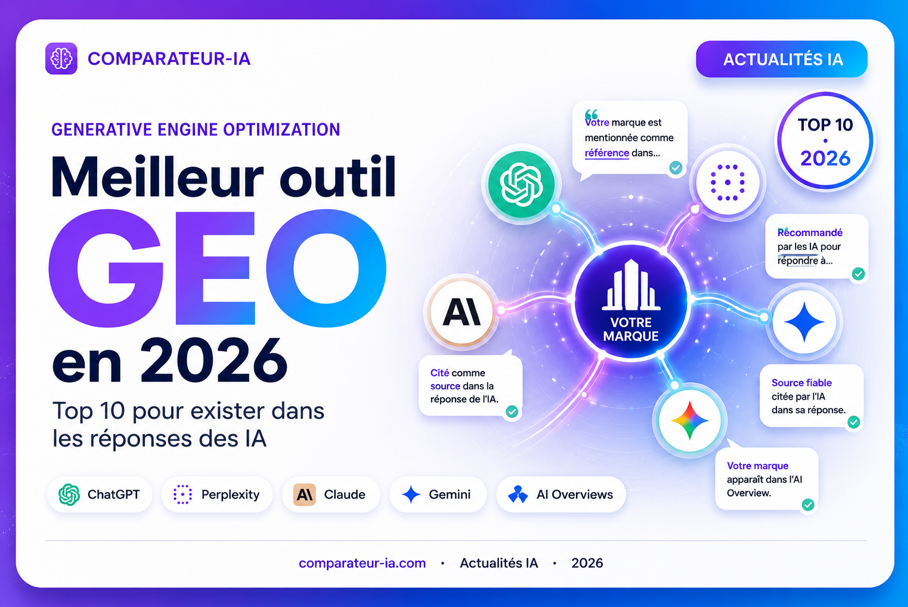
GEO (Generative Engine Optimization) established itself in 2026 as the natural counterpart to SEO. A growing share of searches now ends in a synthetic answer generated by ChatGPT, Perplexity, Claude, Gemini or Google’s AI Overviews . For brands, the challenge is no longer only to rank in the SERPs, but to be cited and recommended by these generative engines.
The market for GEO tools has exploded over the past 18 months. Enterprise solutions costing several thousand euros, specialised monitoring platforms, modules bolted onto classic SEO suites, free tools to get started… We reviewed the 10 most relevant solutions available today, with their strengths, their limits and their positioning.
What a good GEO tool must genuinely be able to do
Before the ranking, let’s set the frame. A serious GEO tool now covers four pillars :
- Multi-LLM monitoring. Tracking your citations on ChatGPT, Perplexity, Claude, Gemini, AI Overviews and ideally Grok. A single-engine tool gives you a partial view.
- Prompt-level analysis. Knowing which queries trigger your appearance (and which ones escape you in favour of competitors).
- Actionable recommendations. Not one more dashboard to interpret, but concrete actions to close your editorial and technical blind spots.
- SEO grounding. GEO does not replace SEO: it extends it. A tool that fully separates the two worlds forces you to stack subscriptions and to rebuild the same intelligence twice.
Top 10 of the best GEO tools in 2026
1🏆 Our pick · The bridge that unifies SEO and GEO
ChatSEO
ChatSEO starts from a simple conviction: GEO and SEO should not be two separate disciplines. When you work on your content for ChatGPT or Perplexity, you also strengthen your Google rankings; when you fix your technical architecture, you make it easier for AI engines to read you. ChatSEO is the tool that fully embraces this unified logic — and that is what makes it, in our view, the most relevant solution on the market in 2026.
Four structural strengths:
- The only GEO tool that starts from your real SEO data. ChatSEO connects to your Google Search Console and cross-references your organic performance with GEO signals. You see which content already generates SEO traffic, which has a chance of being picked up by LLMs, and where to concentrate your optimisation. Where most GEO tools start from a blank page (prompt simulations), ChatSEO starts from your existing SEO assets.
- SEO expertise that carries over into GEO. The tool was trained on real SEO expert processes. Those processes transpose naturally to GEO: content structuring, semantic authority, source quality, citable factual data. You get consistent recommendations for both worlds, in a «1 + 1 = 3» logic rather than «two disconnected tools».
- A conversational approach to GEO. Rather than an enterprise dashboard to interpret, you talk to ChatSEO: «Which AI queries do I have a chance of being cited on?», «How should I restructure this page for Perplexity?», «Which competitors are capturing the prompts I am targeting?». The tool answers with an actionable plan, without jargon. The time saved is real — users report an average of more than 10 hours saved every week.
- A product vision geared towards proactivity. ChatSEO presents itself today as a reactive chatbot. The roadmap clearly points towards an increasingly autonomous tool, able to anticipate your next GEO actions rather than wait for your questions. A product trajectory few players in the GEO market can claim.
Enterprise analytics for AI citations
Profound.ai
Profound has established itself as the enterprise benchmark for fine-grained analysis of AI citations. The platform goes beyond simple counting: it analyses how LLMs describe a brand (sentiment, framing, language used, comparisons) and provides sophisticated dashboards for marketing leadership.
Strengths
Analytical depth, multi-LLM coverage, enterprise credibility.
Limits
Premium pricing on quotation, complexity for small teams.
Ideal for
Global brands steering their AI reputation.
3The unified GEO score built by Google alumni
AthenaHQ
Founded by former Google Search and DeepMind engineers, AthenaHQ monitors a brand’s appearances on ChatGPT, Perplexity, Claude, Gemini, DeepSeek and AI Overviews. Its Olympus Dashboard calculates a unified GEO score combining citations, sentiment, traffic impact and query types. The ACTION Center provides concrete recommendations (schema generation, reformatting, metadata optimisation for LLMs).
Strengths
Exhaustive coverage (3M+ answers analysed), technical credibility, synthetic score.
Limits
Enterprise pricing, demanding learning curve.
Ideal for
Technical marketing teams with a mature data stack.
4Accessible GEO monitoring
Otterly.AI
Otterly.AI has become a benchmark for AI visibility monitoring among SMEs and freelancers. The tool tracks your brand mentions and citations on ChatGPT, Google AI Overviews, Gemini, Perplexity, AI Mode and Copilot, with a system of custom prompts and automated GEO audits. A fast workflow and a readable interface — an excellent entry point for anyone who wants a dedicated tool without an enterprise budget.
Strengths
Full LLM coverage, quick to learn, reasonable price.
Limits
Less prescriptive on content creation than the leaders.
Ideal for
Marketers and SEOs who want a dedicated AI tracker.
5The GEO module from the SEO leader
Semrush AI Visibility Toolkit
Semrush has integrated a complete GEO module into its suite: tracking of mentions and links in generated answers (Google AI Overviews, ChatGPT, Perplexity), competitor comparisons, and a unified SEO and GEO view. For anyone already using Semrush, it is the natural extension. For everyone else, the investment (~€140/month) is only justified if you also need the SEO side.
Strengths
Unified view, historical tracking, mature ecosystem.
Limits
Less exhaustive LLM coverage than pure GEO tools.
Ideal for
Teams already equipped with Semrush.
6Content and AI consistency crawling
Meteoria
Meteoria stands out with an original feature: a crawl of your content that detects inconsistencies between what you publish and what AI systems retain about your brand. The tool offers concrete suggestions to correct those gaps and improve how generative engines use you. Human onboarding and CSV/JSON exports included.
Strengths
A unique approach to content and AI consistency, hands-on customer support.
Limits
€75/month for only 25 prompts, scalability to watch.
Ideal for
Brands with substantial editorial assets.
7The French option for GEO tracking
Peec AI
Peec AI is one of the French solutions positioned on visibility tracking in AI engines. The tool focuses on covering the French-speaking market and on contextualised prompts. Still young, but an option worth considering if you want to work with a French vendor for reasons of compliance, support or proximity.
Strengths
French roots, French-language prompts, local support.
Limits
An ecosystem still being built, functional depth to be validated against your needs.
Ideal for
Teams that favour a French vendor.
8Reputation management in the AI era
Scrunch
Scrunch is positioned on reputation and sentiment. The platform integrates GA4 analysis of AI traffic, offers an «Agent Experience» layer that serves optimised content directly to AI crawlers at CDN level, and holds SOC 2 certification. More oriented towards monitoring than towards prescribing actions.
Strengths
In-depth sentiment analysis, GA4 integration, enterprise security.
Limits
Less prescriptive on the corrective actions to take.
Ideal for
Communications departments and brand teams.
9The free diagnostic to get started
HubSpot AI Search Grader
HubSpot offers a free tool that delivers a snapshot of a brand’s visibility across the main AI engines: share of voice, sentiment, mentions. It is not a complete management platform, but it is the perfect tool for a first diagnostic before investing in a paid solution. Ideal for convincing a marketing department about GEO with hard numbers.
Strengths
Free, accessible, a reassuring brand.
Limits
A point-in-time view, no historical tracking.
Ideal for
Teams discovering the GEO topic.
10Free entry-level tracking
AreYouMention
AreYouMention offers free tracking (with paid tiers) of a brand’s presence in LLMs. You can monitor mentions, get a visibility score and follow several AI engines in discovery mode. It is a useful gateway for solo operators and very small organisations that want to start GEO monitoring without commitment.
Strengths
A genuinely free tier, immediate to pick up.
Limits
Limited advanced features, reduced analytical depth.
Ideal for
Solo freelancers, bloggers, first tests.
Newsletter
Get the AI analyses, once a month
Breakdowns like this one, no hype, no spam.
Summary table of the best GEO tools
| Tool | Approach | Price (from) | Target |
|---|---|---|---|
| ChatSEO | Conversational, unified SEO and GEO | €29/month | Freelancers, SMEs |
| Profound | Enterprise analytics for LLM citations | On quotation | Large accounts |
| AthenaHQ | Unified GEO score, 6 AI engines | On quotation | Technical teams |
| Otterly.AI | Focused multi-LLM monitoring | ~$29/month | SMEs, marketers |
| Semrush AI Visibility | GEO module within an SEO suite | ~€140/month | Semrush users |
| Meteoria | Crawling and inconsistency detection | €75/month | Content-driven brands |
| Peec AI | French GEO tracking | On quotation | French market |
| Scrunch | AI reputation and sentiment | On quotation | Brand teams |
| HubSpot AI Search Grader | Free AI visibility diagnostic | Free | Discovery |
| AreYouMention | Free tracking of LLM mentions | Free / freemium | Solo operators, beginners |
GEO and SEO: why they must be thought of together
The biggest strategic mistake in 2026 is to treat GEO as an independent discipline. Three reasons for that:
- The levers overlap by 70 %. Structuring your content with a direct answer up front, providing citable factual data, looking after your tags and structured data, building semantic authority: these actions serve Google as much as Perplexity or ChatGPT.
- LLMs rely on the indexed web. If your content is not crawled and well ranked on Google, your chances of being cited by AI systems drop sharply. SEO remains a prerequisite for GEO.
- Stacking tools dilutes the strategy. With 4 subscriptions (audit, keywords, GEO, semantics), you spend more time compiling dashboards than producing useful content. A unified approach keeps you on course.
“Hence the value of a tool like ChatSEO, which embraces that continuity: you are no longer doing SEO «with an AI bonus», you are steering your overall organic visibility from a single interface.”
Everything about GEO tools
What exactly is a GEO tool? +
A GEO tool is a solution that measures and improves the visibility of a brand or a site in answers generated by AI engines (ChatGPT, Perplexity, Claude, Gemini, AI Overviews). In practice, it tracks your citations, identifies the prompts where you appear (or do not), analyses what LLMs say about you, and recommends actions to gain visibility.
Do you need a dedicated GEO tool or a unified SEO and GEO tool? +
It all depends on your maturity and your volume. For 90 % of freelancers, founders and SMEs, a unified tool such as ChatSEO is more than enough and avoids scattering your efforts. Large brands with a multi-market strategy and reputation stakes can justify a dedicated GEO tool such as Profound or AthenaHQ alongside a classic SEO tool.
How much does a GEO tool cost? +
Prices range from €0 (HubSpot AI Search Grader, AreYouMention) to several thousand euros a month for enterprise platforms (Profound, AthenaHQ). A complete and accessible solution such as ChatSEO starts at €29/month — today the benchmark for value for money.
Which AI engines should a good tool monitor? +
At a minimum: ChatGPT, Perplexity, Claude, Gemini and Google AI Overviews. A single-engine tool (for example ChatGPT only) gives a partial view that makes you miss the prompts that really matter for your acquisition.
Will GEO replace SEO? +
No. GEO complements SEO without replacing it — LLMs rely on the indexed web, and your Google rankings remain a prerequisite. Think of GEO as a natural extension of your SEO strategy, not as a separate discipline.
How do you get started with GEO on no budget? +
Start with a free diagnostic using HubSpot AI Search Grader to measure your current visibility, then move to a unified tool such as ChatSEO via its free trial to get actionable recommendations. That is the most cost-effective path before any heavier investment.
The right reflex to get started
The best GEO tools in 2026 are not alike. Enterprise platforms for large brands (Profound, AthenaHQ, Scrunch), modules built into SEO suites (Semrush AI Visibility), monitoring specialists (Otterly.AI, Meteoria), free tools to get started (HubSpot, AreYouMention)…
And at the top, ChatSEO stands out as the most relevant solution thanks to its unique ability to unify SEO and GEO in a conversational approach, plugged into your real data and accessible at €29/month.
Also worth reading
⚠️ Transparency: some links may be affiliate links. No impact on our ratings, and none on prices.