


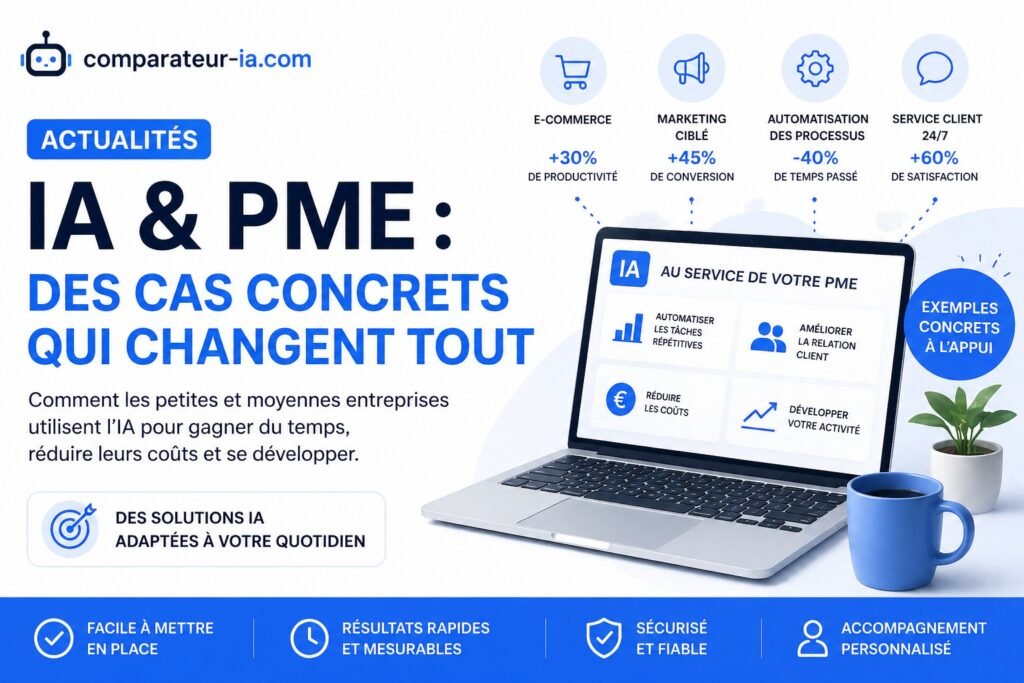
AI in SMEs is often discussed as a topic for the future. On the ground, the first already profitable cases exist and they look alike: narrow scope, a single metric, a clear sponsor, and a human team kept in the loop. Here are five documented examples, with figures.
Three things they all did the same way
- 1
Narrow scope
One use case, one metric, one owner. No 360-degree AI transformation.
- 2
An identified sponsor
Always a committed executive or business director. IT alone is not enough — without a business sponsor, the project dies.
- 3
Human in the loop
None of the five switched to full auto within three months. All keep a human who validates, corrects and adjusts.
Cutting response time by four without hiring
Fashion e-commerce · 35 employees
Problem
Support tickets at 18 h on average, peaking at 36 h on Mondays. 2.3 FTEs saturated, recruitment difficult.
Solution
An AI agent plugged into ticket history, the product FAQ and the returns policy. Automatic triage, with a draft reply for the human team.
Stack
AI agent (custom) Notion FAQ base IntercomAverage delay
18 h → 4.5 h
Tickets resolved autonomously
0 → 38 %
Support NPS
+22 pts
ROI after 3 months
+ 280 %
Five SDR equivalents with a single human
B2B SaaS · 28 employees
Problem
A shallow prospecting pipeline, 250 qualified leads a month, little sector variety.
Solution
An enrichment, scoring and personalised first-email workflow, automated, with systematic human validation before sending.
Stack
Clay Apollo Claude API HubSpotQualified leads / month
250 → 1,350
Email open rate
22 % → 41 %
Meetings generated
+ 180 %
ROI after 3 months
+ 410 %
60 % less data entry on supplier invoices
Accounting firm · 18 employees
Problem
1,800 invoices a month, manual entry into the accounting software, 4 % error rate.
Solution
AI OCR with structured extraction and automatic matching against purchase orders. Human validation on disputed cases only.
Stack
Mindee Pennylane Custom workflowEntry time / invoice
5.2 min → 1.4 min
Error rate
4 % → 0.9 %
Team capacity freed
+ 0.8 FTE
ROI after 3 months
+ 190 %
Living documentation that resolves one ticket in three
B2B software · 42 employees
Problem
Scattered product documentation, 60 % of tickets repetitive, a discouraged support team.
Solution
An augmented knowledge base (RAG on Confluence and past tickets) with an in-product chatbot.
Stack
Confluence Pinecone Claude APIIncoming tickets
−32 %
Self-service rate
8 % → 31 %
Time-to-resolution
−45 %
ROI after 3 months
+ 220 %
An editorial blog tripled without hiring
Manufacturing · 90 employees
Problem
One article a week, a lack of consistency, a marketing team of 1.5 FTE at saturation.
Solution
An AI SEO brief, assisted writing and expert human review. A strict workflow with quality gates.
Stack
Frase Claude WordPress NotionArticles published / month
4 → 13
Organic traffic over 3 months
+ 145 %
Cost per article
−68 %
ROI after 3 months
+ 320 %
Newsletter
Get the AI analyses, once a month
Breakdowns like this one, no hype, no spam.
How to quantify your own ROI
Calculating the ROI of an AI project is not mysterious — it is simply rare in practice. A framework that works in SMEs:
- 1
Measure the baseline
Before any rollout, measure the target metric (time, rate, cost) for 4 weeks. Without a baseline, there is no credible ROI.
- 2
Calculate the total cost
Licences, integration, training and maintenance. Not just the subscription price.
- 3
Estimate the gain in hours
Convert the qualitative gain into hours saved (× loaded hourly rate) or into attributable additional revenue.
- 4
Measure over 12 weeks
Three months is the minimum to stabilise. Before that, you are in the noise.
- 5
Document the externalities
Side effects: team satisfaction, NPS, perceived quality. Often more important than the direct ROI.
“My first AI project did not succeed because it was more ambitious. It succeeded because it was simpler — and because we measured.”
Frequently asked questions
Do you need an in-house data team to get started? +
No, not for a first use case. Most SMEs start with one or two SaaS tools connected to their existing data. A data team becomes useful at scale, not at the first iteration.
What budget should be planned for 3 months? +
Expect €3,000 to €15,000 depending on scope, including licences, integration and support. Rule of thumb: if you cannot target a 12-month ROI, the project is not ready.
What is the most common mistake? +
Trying to tackle everything at once. The 5 cases that work share one thing: a narrow scope, a single metric, an identified sponsor. The broader the ambition, the more the project drifts.
Will AI replace my teams? +
In 90 % of the observed cases, no. It absorbs repetitive tasks and frees up time. Teams become more demanding on quality and more autonomous in their decisions.
What governance should be put in place? +
An AI lead (often reporting to management), a short monthly committee (1 h), and a simple register of the tools in use. No need for a heavy apparatus at the start.
Also worth reading
⚠️ Transparency: some links may be affiliate links. No impact on our ratings, and none on prices.