



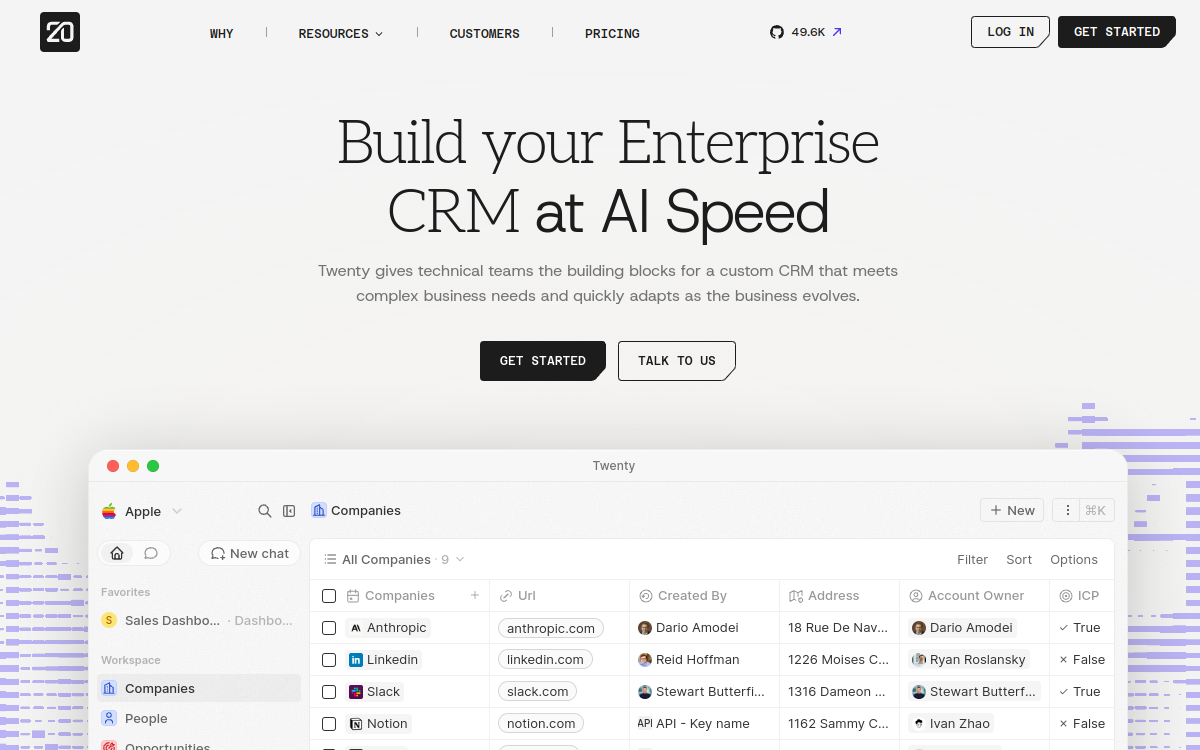
The CRM market has been dominated for years by heavyweight players: Salesforce, HubSpot, Microsoft Dynamics. All powerful, but often costly, complex and proprietary. Twenty offers a radically different answer: a modern open-source CRM, built in TypeScript and designed for teams that want to regain control of their data and their stack. The promise is ambitious: offer a Figma-level user experience, complete features and an accessible cost, while staying fully open source. With more than 44,000 GitHub stars, the project finds an immediate echo in the tech community. For startups, SMBs and product-oriented teams, it’s a credible alternative to the legacy solutions, particularly relevant at a time when AI agents are redefining the customer relationship.
What is Twenty CRM?
Twenty is an open-source CRM released under the AGPL-3.0 license and available self-hosted or as a managed cloud. It offers all the blocks of a modern CRM: customizable objects, multiple views, no-code workflows and real-time collaboration. The platform is built with a modern stack (React, NestJS, PostgreSQL) and has an exceptionally polished UI. Twenty natively integrates AI agents, an MCP server and a chat experience to interact with the data.
Key features
Twenty covers all the needs of a modern CRM. Object management lets you freely create entities (contacts, companies, opportunities, deals, projects…) with custom fields. Multiple views (kanban, table, list) make navigation easier. No-code workflows let you automate recurring tasks without code. The Apps framework lets you add custom extensions in TypeScript, with React components that display in the native UI. AI integration is at the heart of the product: conversational chat over the data, agents able to execute actions, an exposed MCP server for advanced integrations. The whole thing stays extensible and accessible, with a smooth user experience.
Use cases
Twenty adapts to many contexts. A B2B startup uses it to manage its sales pipeline with deals, contacts and accounts. An agency uses it to track its client projects, proposals and follow-ups. An HR team adapts it as an ATS to manage applications and interviews. An industrial SMB uses it to track its orders and quotes. The flexibility of objects makes it possible to imagine a wide variety of uses, from the classic sales CRM to more exotic cases like community management or tracking a real-estate portfolio.
Advantages
Twenty brings several distinctive benefits. Open source guarantees data sovereignty and freedom of modification. The accessible cost ($9/user/month or free self-hosted) opens access to a modern CRM without a substantial budget. The UI quality makes adoption fast and natural for teams. The native integration of AI agents prepares the organization for the next generation of tools. Finally, the very active community ensures fast evolution and a promising trajectory.
Pricing
Twenty offers two clear options. Self-hosting is entirely free, under the AGPL-3.0 license, with no limit on users or features. The Pro cloud is $9/user/month billed annually, making it one of the most affordable cloud CRMs on the market. A quick comparison is telling: a team of 10 pays $1,080/year on Twenty Pro, less than a month of HubSpot Sales Pro for the same team.
Conclusion
Twenty embodies the new generation of CRMs: open source, modern, AI-ready and radically more accessible. For startups, SMBs and product teams, it’s a credible and even superior alternative to the legacy players on many criteria. Worth testing without hesitation, self-hosted or in the cloud, to discover a new way to manage your customer relationships.