


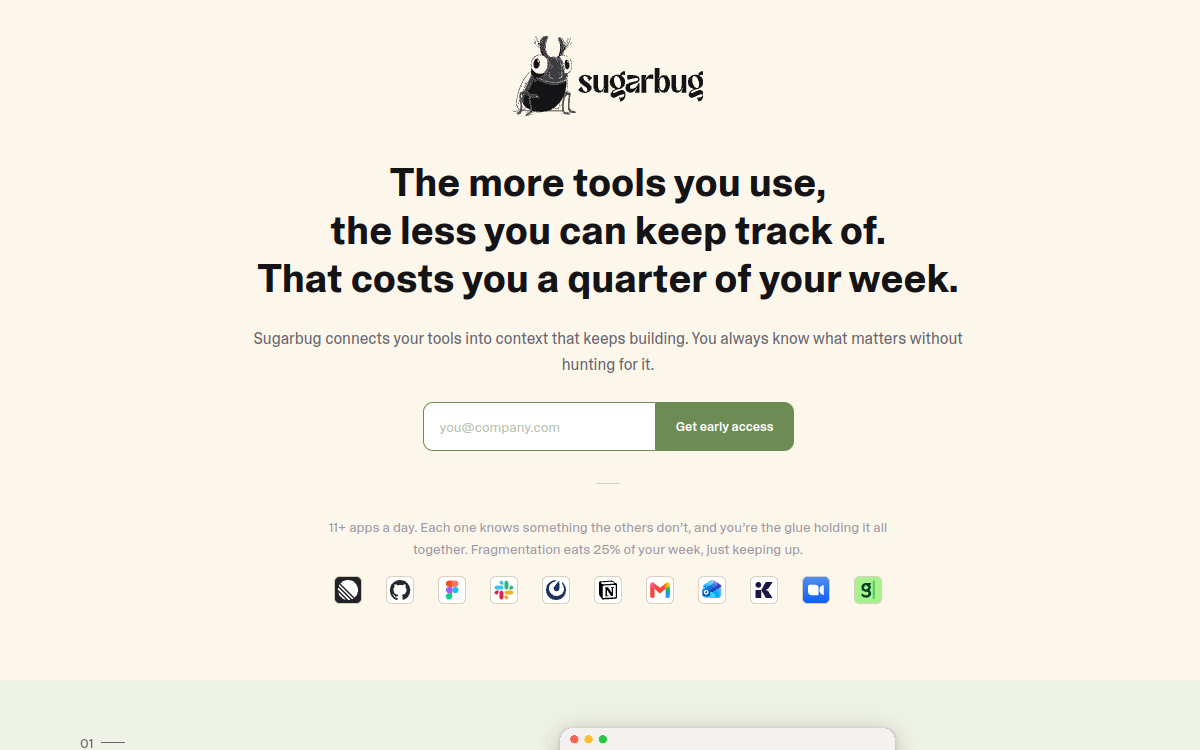
Sugarbug is a __context aggregator__ powered by AI that plugs into your existing tools to build a unified view of your professional day. The platform syncs __meetings__, __tasks__, and __people__ to offer every colleague a shared __long-term memory__. No more juggling between Slack, Notion, Google Calendar, or Linear to prepare for a meeting: Sugarbug automatically consolidates relevant information and frees up time for high-value work.
What is Sugarbug?
Sugarbug is an AI-powered work context aggregation SaaS platform. The tool connects to major SaaS used by modern teams (messaging, calendar, project management, knowledge bases) to automatically reconstruct a team's collective memory. Sugarbug positions itself between personal assistant and team tool, capable of helping each colleague enter meetings prepared, track project progress, and understand context from each conversation partner without manually diving into ten different tools.
Key Features
Sugarbug's features center on aggregation and memory. Native integrations allow connecting in a few clicks the tools teams use daily. Once connected, Sugarbug automatically compiles conversations, notes, tasks, and events related to each topic or person. Meeting preparation is one of the flagship functions: before each meeting, the user receives a synthetic brief presenting recent exchanges, ongoing topics, and points of attention. Long-term memory preserves all historical context, allowing quick retrieval of past decisions or commitments. Consolidated task tracking offers a unified view of ongoing actions regardless of which tool they were created in. Finally, person-by-person profiles help quickly understand who you're communicating with and on what topics.
Use Cases
Sugarbug primarily addresses product, engineering, and operations teams juggling many SaaS tools. A product manager can use the platform to prepare weekly syncs, find decision history on a feature, and track meeting commitments. A senior engineer uses it to quickly reconstruct context on a complex ticket. An operations manager finds unified visibility into cross-functional project progress. Startup founders appreciate Sugarbug's ability to preserve company memory despite team changes. Sales teams can enrich customer prep by consolidating exchange history and specific points of attention.
Benefits
Sugarbug's main benefit is time saved on information search. Rather than digging through Slack, Notion, or Drive before each meeting, the brief is auto-generated. This improvement has cumulative effect: over a week, several hours are freed for high-value work. Exchange quality increases because participants enter meetings better prepared, reducing back-and-forth loops. Long-term memory strengthens organizational resilience against turnover and tool changes. Finally, systematic aggregation limits the risk of forgotten commitments or critical information, improving team operational reliability.
Pricing
Sugarbug offers a free or freemium entry plan to discover the tool, followed by paid plans starting around $19 per month depending on usage scope. Higher tiers expand active integrations, data volume processed, and advanced features like cross-team analysis. Enterprise plans are also offered for larger teams with annual commitments and centralized admin features. The time-savings promise easily justifies the entry cost, particularly for high-value hourly roles.
Conclusion
Sugarbug enters an emerging category of tools that don't seek to replace existing SaaS but to unify them in a single experience. The value proposition is clear and immediately understandable to any knowledge worker facing context fragmentation. The platform remains young and some points must mature, particularly integration coverage and compliance communication. For modern product, ops, and engineering teams, Sugarbug definitely deserves testing, ideally at a small group scale to measure concrete productivity gains before wider rollout.