



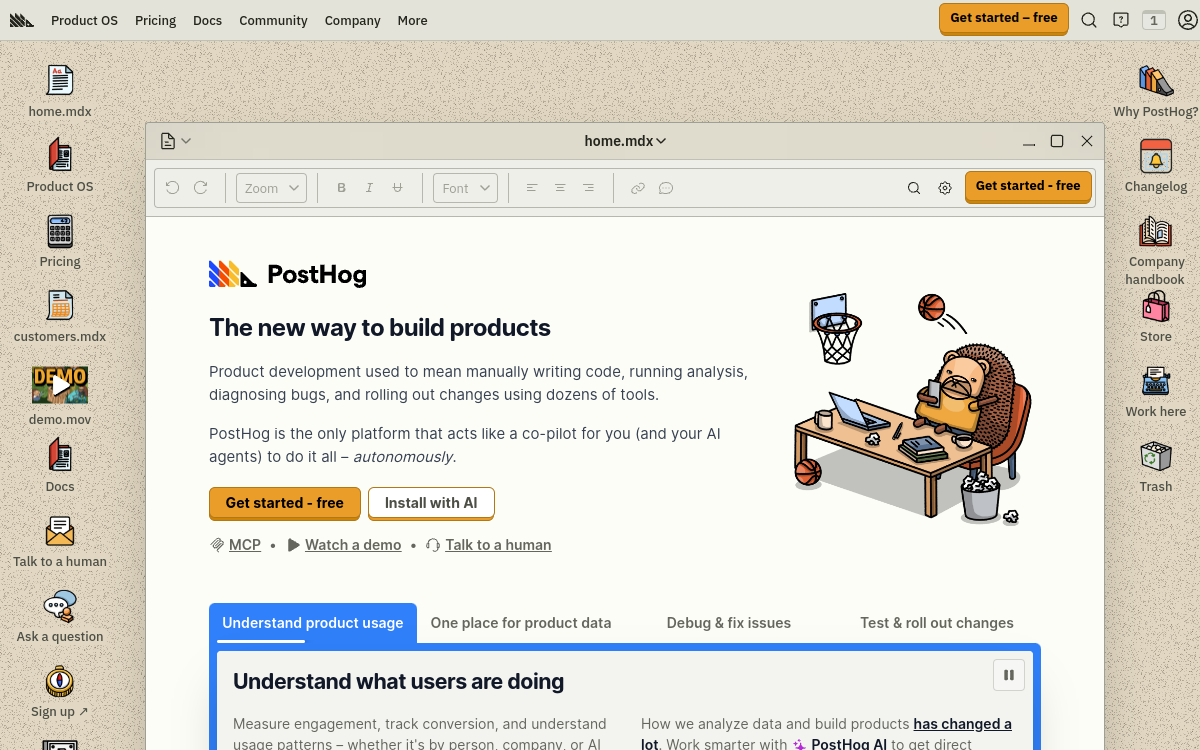
PostHog is an open-source product analytics suite that combines analytics, session replay, feature flags, A/B testing, surveys and a data warehouse in a unified platform. The tool targets product, growth and engineering teams that want to understand user behavior and experiment quickly. With its generous free tier (1 million events per month), PostHog has become a credible alternative to Mixpanel, Amplitude and Heap. Its usage-based pricing and open-source code make it particularly popular with tech startups and scale-ups.
What is PostHog?
PostHog is an open-source product analytics and experimentation platform designed for product, growth and engineering teams. The solution combines several blocks traditionally sold separately: event analytics, session replays, feature flags, A/B testing, surveys, error tracking and a data warehouse. PostHog mainly targets startups, scale-ups and tech companies that want to understand user behavior and experiment quickly without multiplying SaaS tools. The platform is available in the cloud (US and EU) or self-hosted via Docker or Kubernetes for organizations that want to keep their data on their own infrastructure. PostHog stands out for its transparent business model and its open-source code under the MIT license.
Main features
PostHog is built around several complementary functional blocks. Product analytics lets you track events, create funnels, measure retention, segment users and build dashboards. Session replay records user sessions to understand journeys and identify UX friction. Feature flags let you roll out features progressively, by segment or in an A/B test. Built-in A/B testing lets you measure the statistical impact of experiments directly in the platform. In-app surveys collect contextual user feedback. Error tracking monitors JavaScript and backend errors for engineering teams. The data warehouse lets you sync external sources (Stripe, HubSpot, S3) to join product data with other business signals. Finally, PostHog offers native integrations with Slack, Webhooks, n8n, Zapier and provides a REST API and SDKs for most languages.
Use cases
PostHog is used for many use cases. Early-stage startups measure their product-market fit, activation and retention within a few days of installation. Product teams drive data-driven roadmaps based on funnels, cohorts and session replays. Growth teams deploy A/B experiments and feature flags to iterate quickly without depending on deployment. Engineering teams rely on error tracking and performance metrics to monitor product health. Customer success teams use session replays to understand the problems users report. Finally, data teams join product events with Stripe, HubSpot or Salesforce to build cross-functional analyses. PostHog is particularly appreciated by SaaS, mobile and fintech scale-ups that want a consolidated, transparent tool.
Advantages
PostHog’s main benefit is consolidation: replacing five tools with a single platform drastically simplifies the stack and reduces hidden costs. The second benefit is the transparency of the business model: unlimited seats, predictable usage-based pricing and the ability to cap costs. The third benefit is the open-source option: organizations concerned about sovereignty or control can self-host PostHog for free. The fourth benefit is the functional richness that covers the entire product lifecycle, from measurement to experimentation. Finally, the ecosystem of connectors and the open API make it easy to integrate into any modern data stack.
Pricing
PostHog applies usage-based pricing with an exceptionally generous free tier. The free plan includes 1 million analytics events, 5,000 session replays, 1 million feature flag requests, 100,000 tracked errors and 1,500 survey responses per month. Beyond that, each block is billed on usage according to a sliding scale. Product analytics starts at $0.000050/event between 1 and 2 million, drops to $0.0000343 between 2 and 15 million and reaches $0.000009/event above 250 million. All plans include unlimited seats and 1 year of retention. PostHog also offers an annual plan with 15 to 25% off and enterprise contracts for organizations with very high volumes or specific requirements.
Conclusion
In 2026, PostHog establishes itself as one of the most complete and most appreciated product analytics platforms on the market. Its all-in-one combination, pricing transparency and open-source option make it a particularly relevant choice for tech startups and scale-ups that want a modern tool without vendor lock-in. For marketing teams looking only for an ad attribution tool or for non-technical SMEs, other solutions will be more suitable. But for any product or engineering organization that wants to consolidate its data stack and accelerate its experiments, PostHog very clearly deserves its place at the top of the list.