


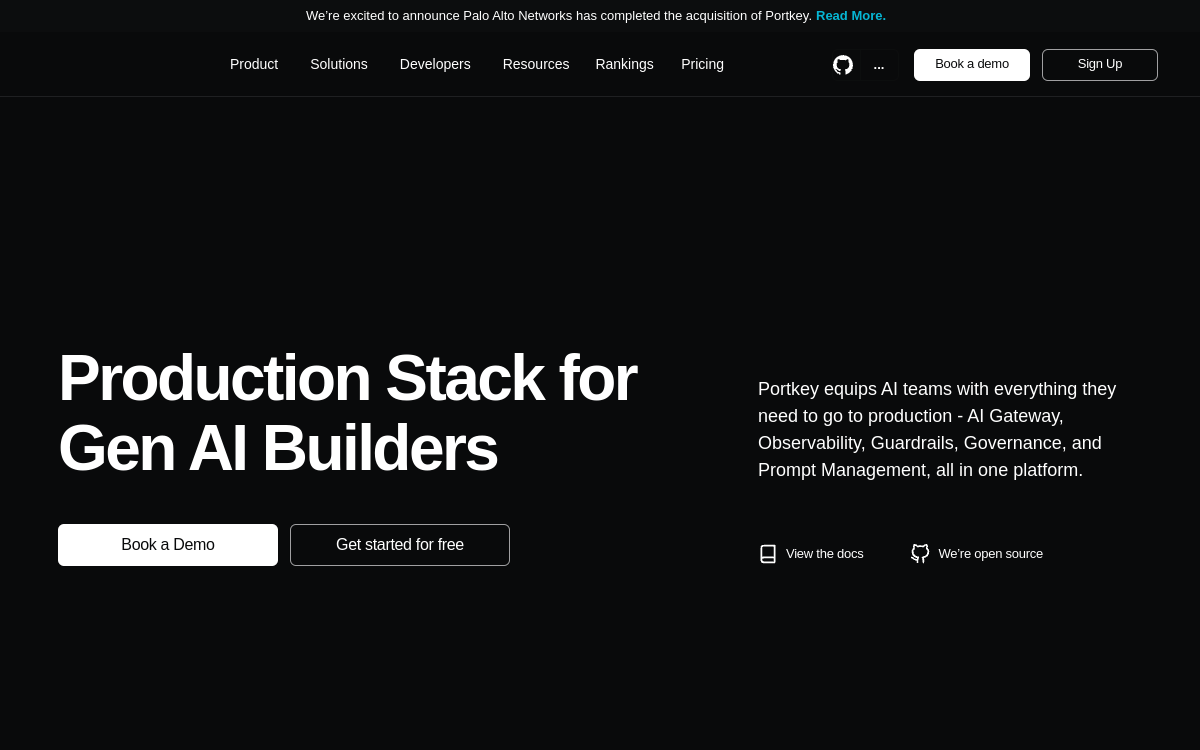
Portkey AI is an LLM gateway and observability platform designed for engineering teams building generative applications in production. The tool routes requests to more than 1,600 models (OpenAI, Anthropic, Google, open source) through a unified API, with built-in fallback, cache, retries and guardrails. Portkey adds a rich observability layer that traces every request (latency, cost, quality, errors) and gives ML and product teams the visibility they need to make their LLM apps reliable in production.
What is Portkey AI?
Portkey AI is a SaaS platform that combines an LLM gateway, observability, guardrails, cache and prompt management. The gateway exposes a unified OpenAI-compatible API capable of routing requests to more than 1,600 models: OpenAI, Anthropic, Google Gemini, Mistral, Cohere, Meta Llama, Azure OpenAI, AWS Bedrock and many open-source models. Observability records every request with its metadata (cost, latency, tokens, model, user, custom metadata) and provides rich dashboards to analyze performance, quality and costs. Portkey mainly targets engineering, ML and product teams that build and operate LLM applications in production. The platform offers a SaaS cloud hosted in the US and EU, as well as a self-hosted option for organizations subject to sovereignty or security constraints.
Main features
Portkey AI structures its offering around several functional blocks. The Gateway is the heart of the platform: it exposes a unified API to 1,600+ models with intelligent routing, automatic fallback (if a model is unavailable, it switches to another), load balancing and configurable retries. The Cache stores identical LLM responses to reduce costs and improve latency. Guardrails automatically apply rules to inputs and outputs: PII detection, toxic-content filtering, JSON format validation, hallucination control, or custom business rules. Observability records every request with 40+ metadata fields (latency, cost, tokens, user, prompt version, triggered guardrails) and feeds configurable dashboards. Prompt Management centralizes prompts with versioning, A/B testing and progressive rollout. Portkey also offers an Evaluations module to measure the quality of LLM responses, and an Agents module to orchestrate multi-step workflows. The platform integrates with LangChain, LlamaIndex, Hugging Face and many AI frameworks, and provides Python, Node.js, Go and Java SDKs.
Use cases
Portkey AI is used for many use cases. SaaS startups integrating a generative AI feature use it to route intelligently between several providers based on cost or quality. Enterprise ML teams use it to monitor production LLM apps and identify sources of degradation. Product teams drive multi-model experiments through prompt management and A/B testing. Sovereignty-focused IT departments deploy Portkey self-hosted to keep full control of their requests. AI agencies offer their clients a standardized observability layer without reinventing the wheel. Finally, researchers and data scientists use Portkey to quickly compare several models on their datasets. All these uses share a common logic: industrializing the use of LLMs while keeping economic and quality control.
Advantages
Portkey’s main benefit is resilience: thanks to multi-provider routing and automatic fallback, an application stays available even if a provider goes down or slows down. The second benefit is cost control: fine-grained observability, built-in cache and the ability to route to the cheapest model for each request can cut the LLM bill by half or two-thirds. The third benefit is security thanks to guardrails that protect against PII leaks, prompt injection and toxic content. The fourth benefit is team productivity: prompt management and evaluations speed up iterations. Finally, Portkey eliminates vendor lock-in and makes it possible to experiment with new models without rewriting application code.
Pricing
Portkey AI offers usage-based pricing centered on recorded logs. The Free plan offers up to 100,000 requests per month with access to the Gateway and basic observability. The Pro plan at a flat $25/month offers unlimited requests and more recorded logs, ideal for most teams in production. The Production plan moves to usage-based pricing on logs, with volume discounts. Finally, the Enterprise plan (custom quote) adds self-hosting, SSO, audit log, data residency and a dedicated account manager. Note: if you exceed your log quota, the Gateway keeps working, but requests are no longer recorded in observability.
Conclusion
In 2026, Portkey AI establishes itself as one of the essential references in generative AI production stacks. Its combination of LLM gateway, observability, guardrails and prompt management makes it a particularly valuable tool for engineering teams building serious AI products. The cost control, resilience and security the platform brings often translate into a very fast ROI. For purely experimental or single-model projects, the tool may seem oversized, but for any LLM application in production, Portkey is a particularly relevant investment to consider.