


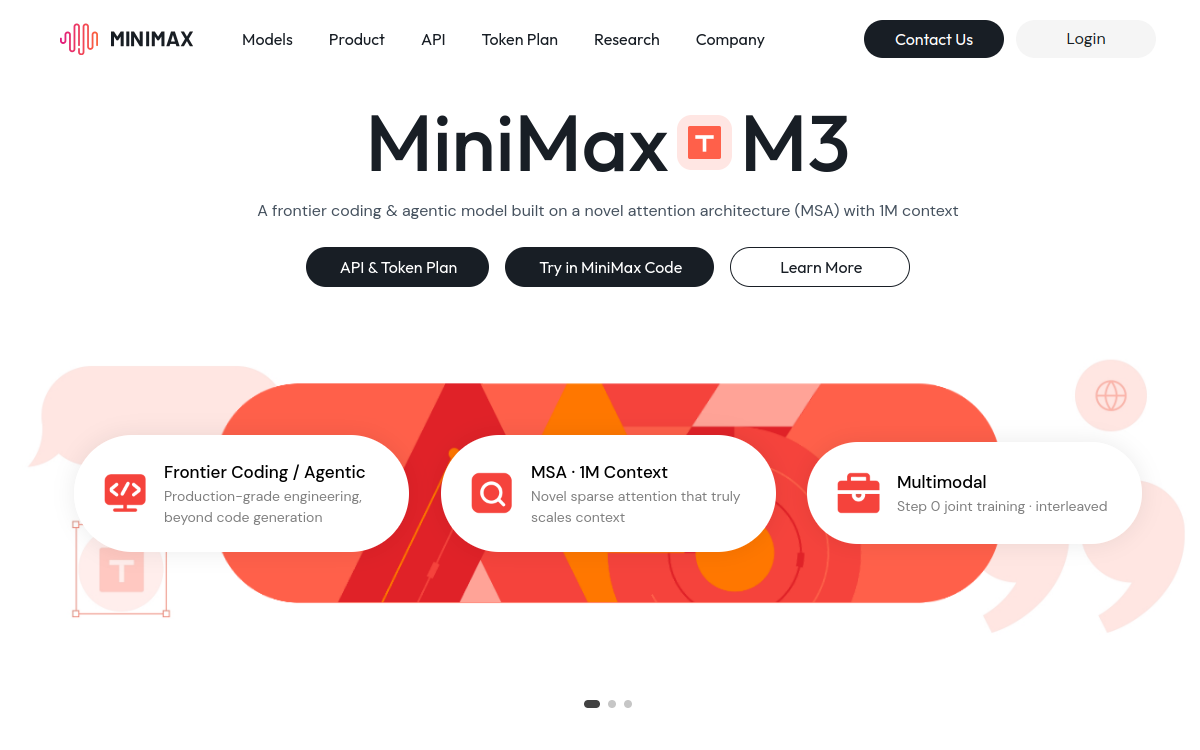
MiniMax is a multimodal platform oriented to developers and creators, with APIs for video (Hailuo: text-to-video / image-to-video) and audio (TTS and voice-over). It targets production at scale: quotas, pay-as-you-go pricing, and monthly plans to standardize content workflows. A solid choice if you’re seeking an API to automate video and audio creation.
What is MiniMax?
MiniMax is an AI editor proposing platform of models and APIs to create applications and AI-based automations. Its offering covers multiple modalities: text (LLM), audio (voice synthesis) and video (clip generation). The objective is providing services exploitable in production, with plans and pricing adapted to volumes. The video part is carried by Hailuo, which enables generating videos from text prompt, image, or constraints like “first/last frame”. The audio part focuses on voice generation and voice synthesis to create narrations and voice-overs. Everything is designed to integrate into products via API or be used in production pipelines. MiniMax therefore primarily addresses teams prioritizing integration, repeatability and scaling up, rather than simple one-off interface usage.
Key Features
MiniMax proposes structured multimodal offering around APIs. In video, Hailuo allows creating clips from text (text-to-video) or image (image-to-video), with useful variants for consistency: first and last image, or reference image to stabilize a subject. This modularity is valuable for creating content series, ad variations or animations from existing assets. In audio, the platform provides production-oriented voice synthesis capabilities: voice generation, voice-overs and quality/speed parameters depending on plans. For content teams, this facilitates creating narrations for short videos, product demos, social ads or e-learning. On exploitation side, the interest lies in flexible pricing and control: monthly plans, pay-as-you-go, throughput limits and quotas. This lets you test quickly, then increase capacity when needs grow, without changing stack.
Use Cases
MiniMax is relevant for products wanting to automatically generate short videos: ad variations, social media content, marketing demos, or image animations. The image-to-video mode is particularly useful if you start from brand visual and want producing coherent sequence without starting over. For audio, use cases revolve around narration and voice-over: marketing videos, presentations, e-learning modules, short podcasts, or multilingual content. Teams can automate voice production from scripts, then assemble them in a pipeline. Technical teams also use it as AI building block in an application: on-demand generation, processing queues, per-user quotas, and consumption monitoring. Finally, for agencies, MiniMax can help standardize deliverables in volume, provided you have brief, validation and quality control process.
Advantages
MiniMax’s main benefit is moving from prototype to production. APIs, quota management and scalable pricing make the tool suited to real volumes, where some generators remain limited to manual use. Second benefit: multimodality. Being able to combine video and audio in same platform logic simplifies stack, especially if producing narrated clips or campaign variations. Third benefit: variety of video modes, useful for consistency and asset reuse. Starting from image or frame set reduces randomness and accelerates iteration. Finally, API approach facilitates automation: batch generation, orchestration, per-user personalization and integration into internal tools or SaaS products.
Pricing
MiniMax combines multiple pricing models: monthly plans (for example for “coding plan” access on text side) and pay-as-you-go by API and model. Audio part can also be offered in subscription with monthly credit volumes. In practice, this lets you start with controlled entry cost, then increase capacity as production intensifies. To choose, start from your need: monthly generated videos, duration and expected quality, audio volume (narration minutes), and production cadence. If in testing phase, entry plan + pay-as-you-go budget usually suffices. For app in production, securing throughput limits, quotas and per-content unit cost is important. As always, test on your real prompts, brand constraints and validation process.
Conclusion
MiniMax is solid platform for those wanting to generate video and audio via AI through API, with production and scaling-up logic. Hailuo addresses clip generation and variation needs, while audio offering enables creating narrations and voice-overs at scale. The tool is particularly relevant for product teams, agencies and studios automating pipelines. However, it requires good brief mastery and quality control, and commercial usage rights must be framed. If your priority is integration and scalability rather than simple no-code tool, MiniMax deserves benchmarking among most pragmatic multimodal platforms.