



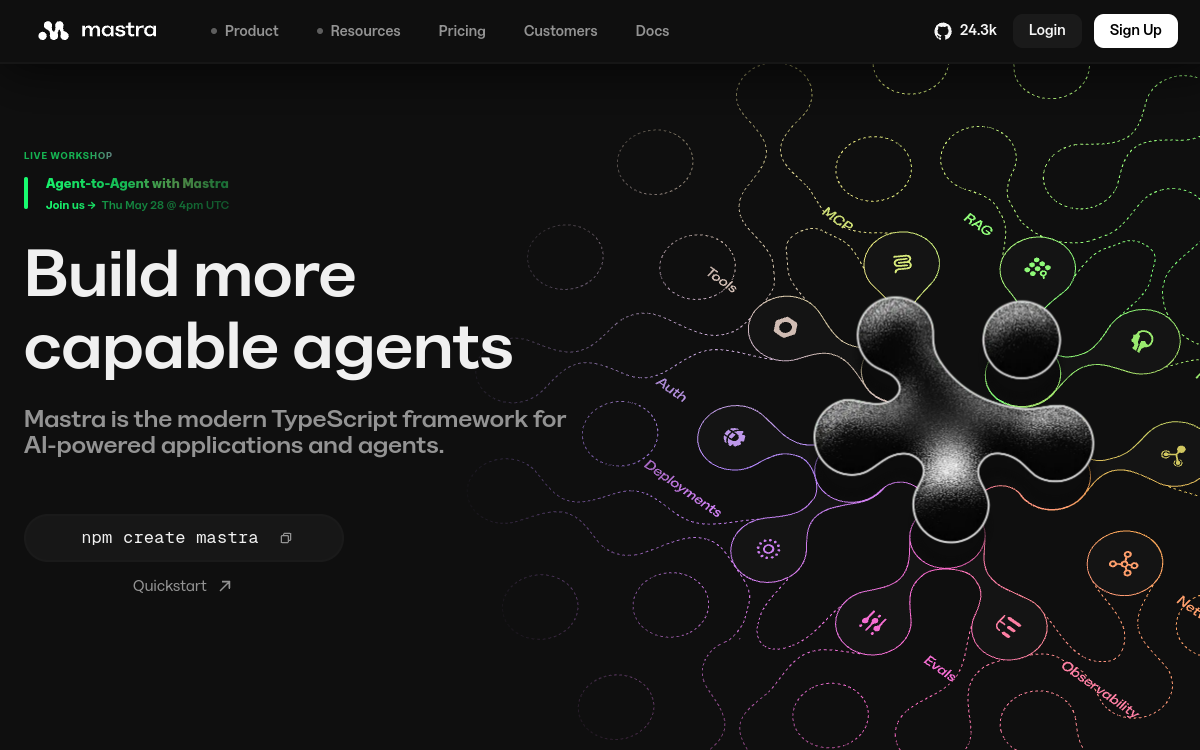
Building an AI agent in production remains a technical challenge: you have to manage memory, tools, caching, observability and security. Most existing frameworks impose a language and an ecosystem — often Python. Mastra changes the game by offering a modern TypeScript framework, designed by the creators of Gatsby, that brings together the entire stack needed for a production-ready AI agent. With a $36 million raise and the backing of Y Combinator, Mastra has established itself in a few months as a reference for JavaScript teams. Its approach is clear: let developers code high-performing agents without reinventing the infrastructure, while staying fully open source. All with remarkable engineering quality, inherited from Gatsby’s standards.
What is Mastra?
Mastra is an open-source framework written in TypeScript and released under the Apache-2.0 license. It provides the essential building blocks to build AI agents: tool management, long-term memory, multi-step workflows, output evaluation and fine-grained observability. It’s used as an npm package and integrates easily into any Node.js project. In addition, the publisher offers Mastra Platform, a hosted service that adds Enterprise features: access controls, SSO, audit logs and hosting in a private VPC.
Key features
Mastra’s features cover the entire lifecycle of an AI agent. The Tools module lets you define functions callable by an LLM with input and output validation via Zod. The Memory module manages short and long-term memory, with semantic-retrieval strategies to keep useful context. The Workflows module lets you chain several steps, parallel or conditional, to orchestrate complex flows. It provides an automated framework for evaluating responses, essential to measure agent quality in production. Native observability relies on OpenTelemetry and makes debugging easier. The framework is compatible with OpenAI, Anthropic, Google and most major LLMs, and can be deployed on any host or on the Mastra Platform to benefit from advanced controls.
Use cases
Mastra is used to build a wide variety of AI agents and assistants. Product teams build conversational chatbots with memory for their SaaS application. Engineers create internal agents able to query knowledge bases and execute actions on third-party APIs. Startups quickly stand up an MVP of a vertical assistant without depending on a proprietary provider. Dev-tool publishers integrate copilots specific to their product. Mastra is also used to orchestrate multi-role agents in research, customer support or content-generation use cases.
Advantages
Mastra’s main benefit is structuring the work of JS/TS teams around a coherent, open-source stack. This avoids the technical debt linked to assembling disparate modules and significantly speeds up bringing reliable AI agents to production. The complete stack (tools, memory, evals, observability) covers the essential needs without heavy dependence on a single provider. The cloud platform brings Enterprise guarantees (security, compliance, performance) appreciated by large accounts. Finally, the active ecosystem and the freedom offered by the Apache license reassure teams that want to remain in control of their architecture.
Pricing
Mastra is entirely free as open source. The code is available on GitHub and can be hosted at no cost on any infrastructure. The Mastra Platform, the hosted version, offers paid plans with Enterprise features (RBAC, SSO, VPC, audit logs, dedicated support) and pricing tailored to the volume and retention desired. Detailed pricing is provided on request to the sales team.
Conclusion
Mastra embodies the new wave of modern, open-source AI agent frameworks designed for JavaScript developers. Its engineering quality, complete stack and openness make it an excellent choice to build robust AI products. If your team knows TypeScript, Mastra is probably the best foundation to adopt today.