


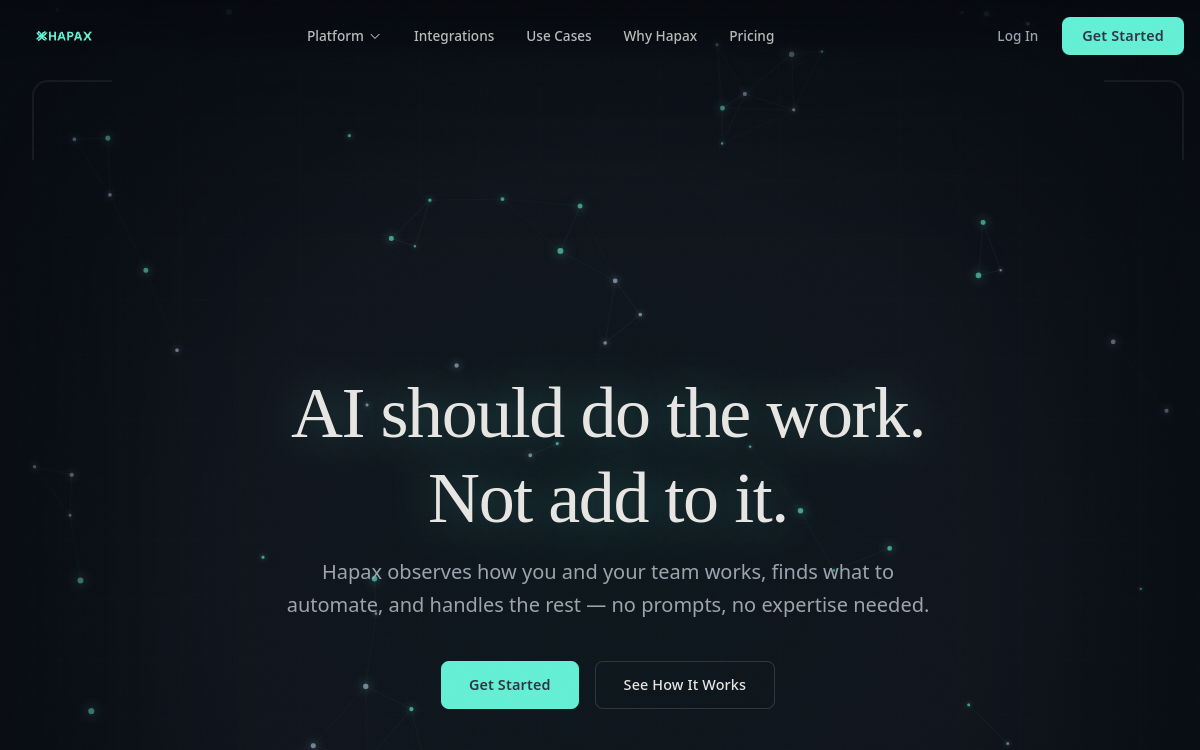
Hapax is a __proactive artificial intelligence__ platform that goes far beyond traditional chatbots. It detects triggering events within your organization, analyzes downstream impacts, and deploys __autonomous AI agents__ to manage appropriate responses, all in just a few hours and without any technical development. Hapax adapts to your way of working rather than imposing a generic tool, enabling remarkable adoption gains — some clients have gone from __15% to 78% AI adoption__ in just three months.
What is Hapax?
Hapax is an enterprise artificial intelligence platform based on a novel concept: rather than asking the user to configure workflows, Hapax observes the stimuli that trigger work within the organization, analyzes their cascading effects, and automatically builds AI agents to respond to them. Unlike AI chat tools or document storage platforms, Hapax acts autonomously to create what the vendor calls “AI collaborators” — specialized agents that handle specific tasks without continuous human intervention.
Key Features
The core of Hapax is its proactive process detection engine. The platform maps recurring events in the organization — a document submission, a customer request, an incoming report — and identifies the actions that result from them. Based on this analysis, it builds and deploys adapted AI agents capable of managing these responses autonomously. The platform requires no development or technical configuration from users. Onboarding is accompanied to ensure accurate mapping of existing business processes. Deployed agents can be adjusted and supervised through a dedicated interface, without programming skills. Hapax also places strong emphasis on data privacy and security, a critical point for large organizations subject to regulatory constraints.
Use Cases
Hapax use cases span many sectors. In consulting and audit firms, the platform reduces junior analyst work review time by 80%, as testified by the vendor’s customers. In customer service, it automates incoming request processing and ticket tracking. In human resources, it manages validation flows and communications around recruitment and onboarding processes. For sales teams, it handles follow-ups and prospect tracking.
Advantages
The main benefit of Hapax is democratizing AI within organizations. By removing the need to train every employee on complex tools, the platform boosts AI adoption from 15% to 78% according to customer feedback. Managers save considerable time on oversight, potentially reducing by five the hours dedicated to team work review. Fast implementation — a few hours versus several weeks for competing solutions — is also a decisive advantage.
Pricing
Hapax does not display public pricing on its website. The platform is primarily aimed at medium and large companies, with a business model adapted to their specific needs. A personalized demo can be requested directly on askhapax.ai to obtain a pricing proposal adapted to your organization’s size and processes.
Conclusion
Hapax redefines what it means to deploy AI in the enterprise. By replacing manual configuration with a proactive, automated approach, the platform removes the main barriers to adoption. For ambitious organizations looking to transform their relationship with AI, Hapax represents a promising solution worth evaluating now.