



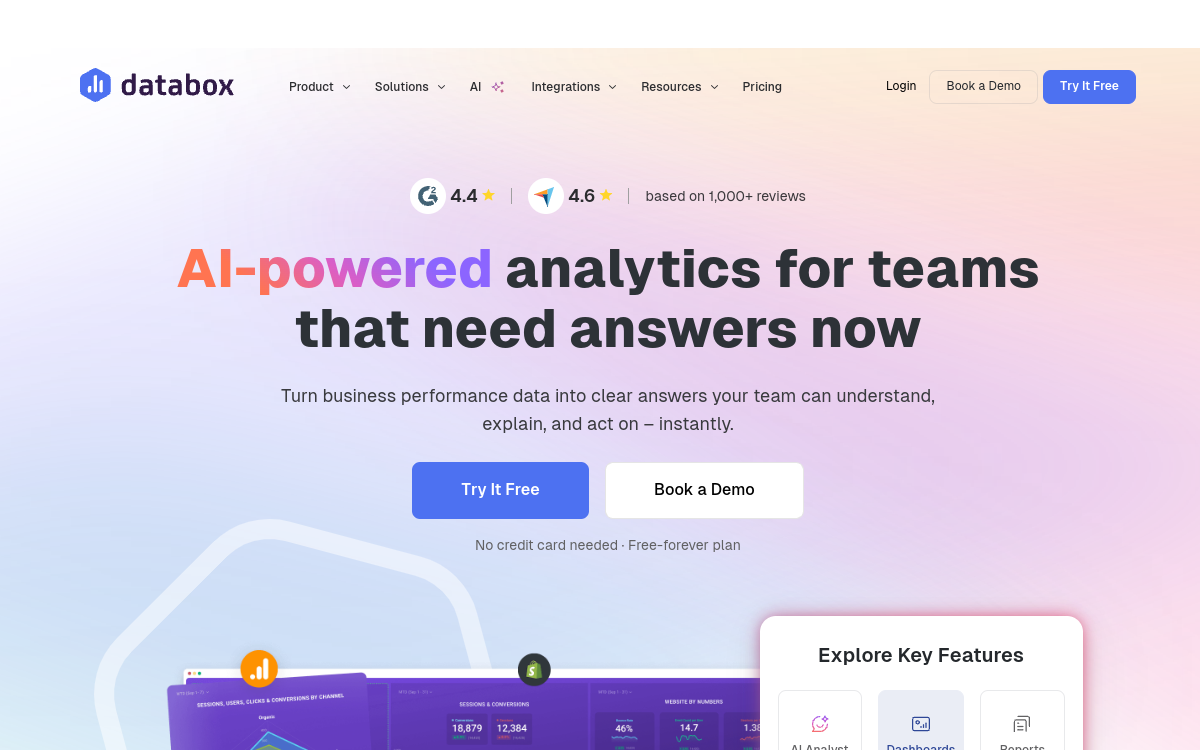
Databox is a __business dashboard__ platform that centralizes KPIs from hundreds of marketing, sales, finance, and product tools. The tool offers native integrations, ready-to-use templates, and a __no-code__ builder to create visual, shareable dashboards. An AI layer helps generate summaries and detect trends. Ideal for marketing, sales, and management teams who want to drive their activity with reliable data without heavy __BI__ projects.
What is Databox?
Databox is a SaaS dashboard and business reporting platform. It aggregates data from over one hundred marketing, sales, finance, product, or support tools, then presents this data in visual dashboards. Each KPI can be tracked with goals, benchmarks, and alerts. An artificial intelligence layer makes it easier to create dashboards from a natural language brief, generates executive summaries, and detects anomalies. Databox also offers a mobile app, TV mode for offices, and collaborative features for teams. The platform primarily targets marketing, sales, and management teams, complementing heavier BI tools or as a lightweight alternative for organizations that don’t have one.
Key Features
Databox offers a very extensive catalog of native integrations, covering Google Analytics, HubSpot, Salesforce, Stripe, Meta Ads, Google Ads, Mailchimp, ClickUp, and many others. The dashboard builder is fully no-code and allows you to assemble charts, tables, and indicators in minutes. A template library covers common use cases by function and tool. The Goals feature lets you set objectives and track performance over time. Industry benchmarks let you compare your own performance to similar companies. The AI layer helps compose a dashboard from a brief, summarize the current week, and flag anomalies. For collaboration, dashboards can be shared for viewing, exported to PDF, or emailed on a regular schedule. The mobile app and TV mode offer a seamless experience away from the office.
Use Cases
Databox primarily serves marketing teams tracking paid campaign performance, organic channels, SEO, and email campaigns in a unified view. Sales teams use it to drive pipeline and CRM metrics in real time. Executive teams consolidate key company KPIs in a single cockpit: revenue, churn, NPS, productivity, etc. Digital agencies particularly appreciate the ability to create dashboards by client, share them easily, and attach explanatory comments. SaaS companies track growth, MRR, ARR, churn, and product metrics in a shared view. Finance teams use it alongside accounting tools to communicate key figures across the organization. Finally, early-stage founders find in Databox a ready-made cockpit to stay focused on their metrics.
Advantages
The main benefit is time saved: KPIs are consolidated automatically, which eliminates several hours of manual work per week. The second benefit is shared visibility: a dashboard accessible to the entire team immediately aligns conversation around the right numbers. The third benefit is rigor: with goals and alerts, teams stay focused on priority indicators. The fourth benefit is autonomy: no need to mobilize a BI analyst for each report. Finally, the mobile app and TV mode truly democratize access to KPIs, transforming data culture in the organization.
Pricing
Databox offers a free plan to get started with a limited number of sources and dashboards. Above that, several paid plans unlock more connectors, users, dashboards, AI features, and data refresh frequency. Prices start around fifty dollars per month and remain competitive. For agencies, specific tiers allow managing multiple client accounts and sending automated reports. For demanding organizations, an Enterprise plan brings SSO, audit controls, and dedicated support. The price-to-value ratio is very favorable once a team checks its KPIs at least daily.
Conclusion
Databox is today one of the most relevant solutions for democratizing KPI access in a modern organization. Its simplicity, integrations, and AI layer make it a productive daily tool, without heavy BI projects. For marketing, sales, and management teams who want a clear, shared, and always up-to-date cockpit, Databox deserves to be evaluated as a priority against more rigid BI tools.