


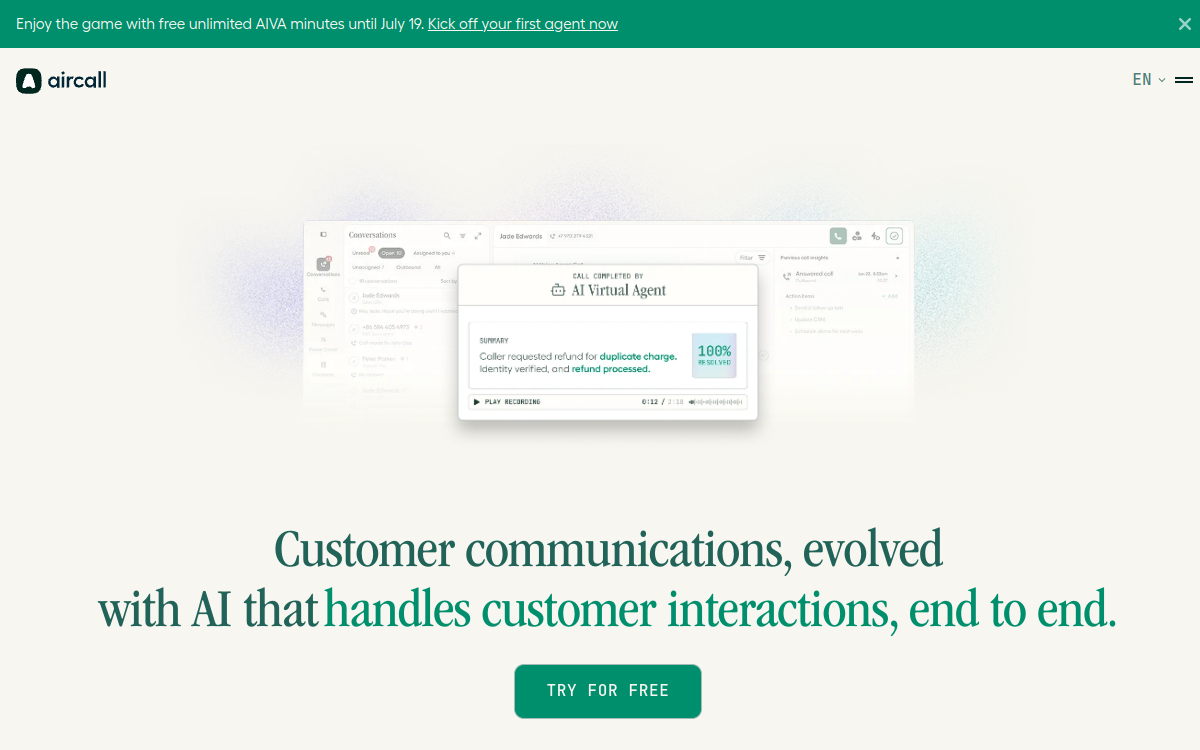
Aircall is a __cloud telephony platform__ designed for sales and support teams. It combines calls, SMS, WhatsApp, and social messaging in a unified console enriched by __Aircall AI__: call summaries, transcription, and sentiment analysis. With __over 250 native integrations__ (Salesforce, HubSpot, Zendesk), Aircall fits into modern stacks and gives teams a 360° view of each customer conversation.
What is Aircall?
Aircall is a cloud phone system designed for sales teams, customer support, and operations. Founded in 2014 in Paris, the company now serves over 17,000 customers worldwide and ranks among the leaders in the SaaS business telephony market. Its positioning combines ease of deployment, CRM integrations, and advanced features like recording, intelligent routing, and an artificial intelligence layer. Where a traditional PBX requires hardware and technical expertise, Aircall installs in minutes via a browser, desktop or mobile app, and works on any connected computer. The platform serves hypergrowth startups as well as mid-market companies modernizing their phone infrastructure without disruption to users.
Key Features
Aircall offers a wide range of features designed for professional conversations. The base layer includes unlimited calls to the US and Canada, local numbers in over 100 countries, recording, IVR, and intelligent transfer. Higher plans add a power dialer to automate dialing, voicemail drop functionality, advanced analytics, and two-way CRM integrations. On the artificial intelligence side, Aircall AI provides automatic call summaries, sentiment analysis, key topic recognition, talk-time ratio, and a transcription search engine. The AI Voice Agent tier automates qualification of inbound calls, while AI Assist accompanies agents before and after each conversation. The platform natively integrates with over 250 tools, including Salesforce, HubSpot, Zendesk, Pipedrive, Intercom, Slack, and Microsoft Teams, syncing contacts, calls, notes, and follow-up actions in the ecosystem already used by your team without additional data entry.
Use Cases
The first use case covers sales teams in outbound and inside sales, multiplying prospecting calls. The power dialer, integrated scripts, and CRM sync allow chaining conversations without manual data entry. The second use covers multichannel customer support centers: advisors manage calls, SMS, and WhatsApp messages from a unified console with intelligent routing. Aircall also serves customer success teams, HR operations with candidate lines, and legal functions. International startups appreciate the speed of opening a local number. Agencies and firms use it to deliver professional customer experience even in remote work, thanks to iOS and Android mobile apps.
Advantages
The primary benefit lies in the ability to transform the phone into a measurable and automatable channel. Analytics provide metrics like answer rate, average call duration, or agent performance. Native CRM integration eliminates double entry and ensures every conversation enriches the customer record. AI functions save precious minutes per call through automatic summaries and transcriptions. On mobility, mobile apps and USB headset compatibility allow teams to work anywhere without experience degradation. Finally, being SaaS, updates are automatic and infrastructure is scalable, eliminating hidden costs of traditional PBX.
Pricing
Aircall offers three main plans. Essentials, at $30 per user per month with annual billing, includes unlimited US/Canada calls, one number, basic IVR, recording, and 6 months of analytics. Professional, at $50, adds power dialer, advanced analytics, voicemail drop, and deeper CRM integrations. Custom, quoted individually, is for companies with over 25 users. Aircall AI features are available as an add-on starting at $9 per license. All plans require a minimum of 3 licenses except Custom. A demo and trial are available upon request.
Conclusion
Aircall is a serious option for sales and support teams wanting to combine phone productivity, CRM traceability, and intelligent conversation analytics. Its strength lies in the combination of refined user experience, broad integrations, and an expanding AI layer. Organizations already equipped with modern CRM and handling significant call volume will find excellent daily ROI.