



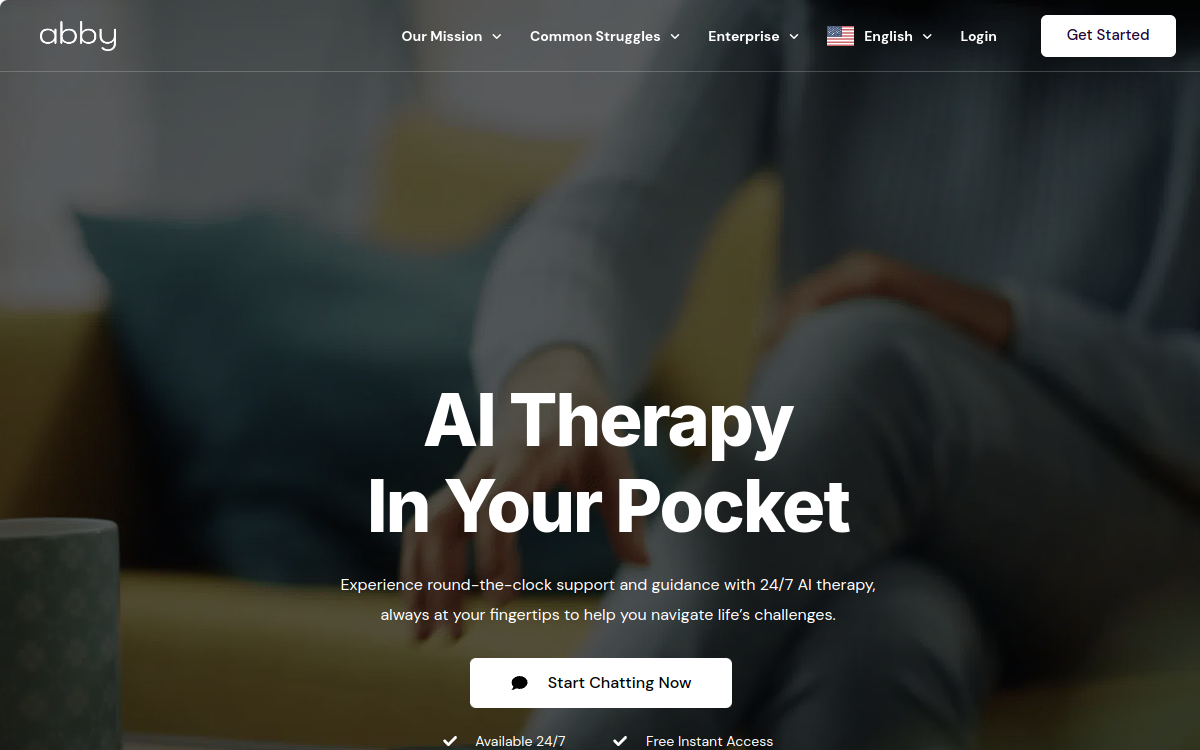
Mental wellbeing holds a growing place in public debate, and artificial intelligence brings its own answers, sometimes useful, sometimes debatable. Abby AI positions itself in this field as a conversational companion designed to offer a caring space to talk, with no appointment, no cost and accessible at any time. The tool does not seek to replace psychotherapy, but to offer a first point of listening for users who feel the need to verbalize, step back or simply be heard. In a context where access to a professional remains long, costly and unequal across regions, this type of service fills a real gap, with the nuances that implies. In this article, we break down what Abby AI is, what it lets you do, its use cases and its limits, to help everyone decide whether this tool has a place in their digital toolbox.
What is Abby AI?
Abby AI is a conversational assistant based on large language models, whose use is centered on emotional support and personal reflection. The user opens a conversation from a browser, with no installation, and chats freely with the AI, which adapts its tone and follow-ups according to the thread. The service highlights its free, anonymous and 24/7 nature, and it targets a broad audience: people going through a difficult period, users curious to experiment with a listening AI, or individuals already in care who want a complement between two sessions. Abby does not make a diagnosis, does not prescribe and directs users to professionals when the situation requires it.
Key features
The experience rests on a few simple pillars. A clean chat interface invites you to enter the conversation directly, without a complex form. The tool keeps a medium-term memory of exchanges, which lets you pick up a thread, refer to a topic raised earlier and avoid re-explaining everything each session. The responses aim to rephrase, validate, ask open questions and offer avenues for reflection rather than give injunctions. Several safeguards are built in: a regular reminder of the tool’s non-medical nature, redirection to emergency or helpline numbers in case of concerning signals, and an explicit invitation to consult a professional for situations that require it. The discussion can cover a wide variety of themes: stress management, relationship conflicts, professional doubts, sleep, motivation, or simply existential reflection. The tool is not intended to substitute for cognitive or behavioral therapies, but can extend certain simple journaling or self-observation exercises.
Use cases
Abby AI finds its place in several very different situations. A working person under pressure can use it as a decompression airlock at the end of the day to sort through their thoughts. A student can use it to structure their doubts before an exam or a course choice. A person already followed by a therapist can use it as a logbook between two sessions, to note observations and prepare appointments. Users who are geographically isolated or uncomfortable with the idea of consulting may find in it a first step toward a possible request for help. Finally, some support professionals use this type of tool as an object of study or comparison to better understand the public’s expectations of generative AI.
Advantages
Abby AI’s main contribution lies in the radical accessibility it offers: no schedule, no cost, no waiting, no credit card. This absence of friction encourages people to speak earlier, while the situation is still light, which can defuse certain spirals. The conversational format, more interactive than a journal or a meditation app, also helps verbalize vague thoughts. For people intimidated by the idea of consulting, the AI can serve as a gentler entry step toward a formal request for help. Finally, the perceived anonymity of the exchange can free up speech on subjects one dares less to raise in front of a loved one or a professional with a busy schedule.
Pricing
The core of the Abby AI experience is free and does not require a credit card to start. Complementary features may be offered via paid options, for example extended history or specific discussion modes. The zero entry ticket clearly places the tool in the freemium category, with no commitment, which reduces the psychological barrier to trying it. In use, it is recommended to regularly check the terms of use and the privacy policy in order to understand how conversations are stored and used, especially if you share very personal information.
Conclusion
Abby AI is a useful conversational companion, with no therapeutic pretension, that can accompany moments of doubt, fatigue or a need to be heard. Its accessibility, its free nature and its caring tone make it a relevant supplementary tool for many users, provided you keep its limits in mind: it does not make a diagnosis, does not handle crises, and does not replace human care. Well used, alongside other resources, it can fit harmoniously into a modern mental hygiene.