


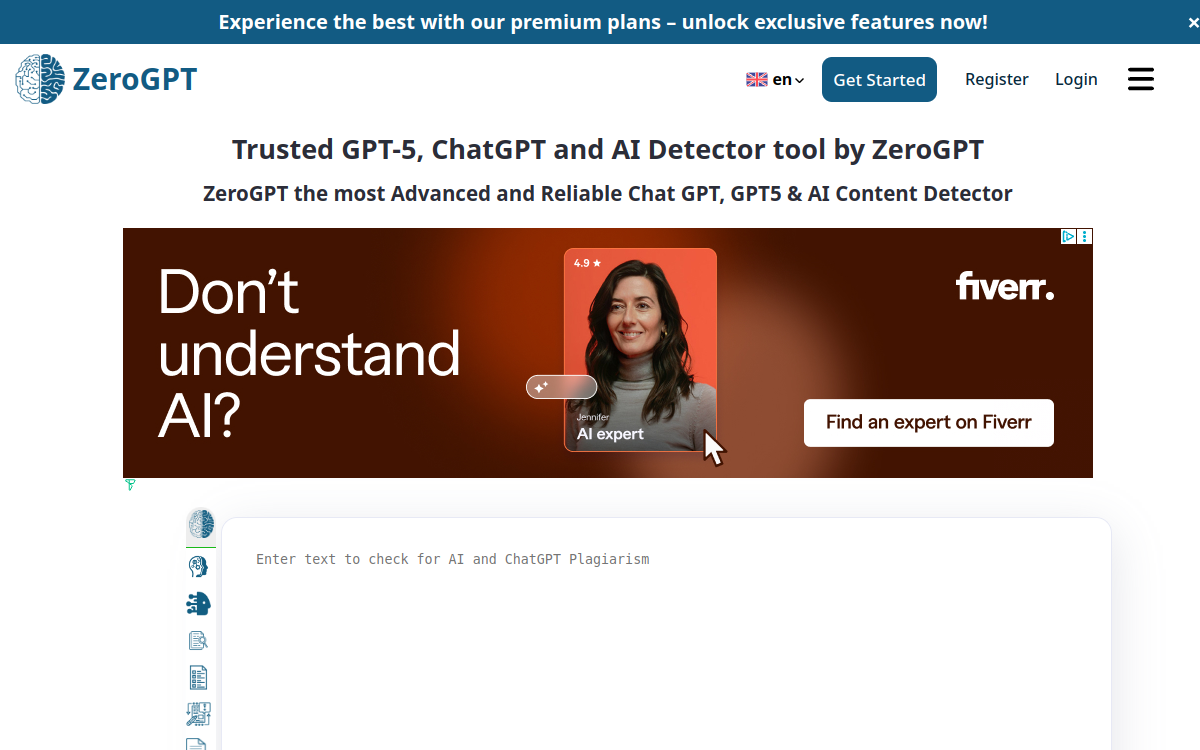
With the generalization of language models, determining whether a text was written by artificial intelligence has become a concern for teachers, writers, and recruiters. ZeroGPT became known as one of the most widely used AI content detectors, but today the tool goes far beyond simple detection. The platform brings together in a single interface a multi-model detector, a text humanizer, a plagiarism checker, a paraphraser, a grammar corrector, a summarizer, and a translator. The stated objective is to cover the entire proofreading and text verification chain, from origin control to final cleanup. The main detector relies on proprietary technology called DeepAnalyse, which examines text at multiple levels and highlights passages deemed to be generated by AI. This article reviews what ZeroGPT actually does, its named features, concrete use cases, pricing model, and limitations, to help you judge whether this toolkit meets your content verification and editing needs.
What is ZeroGPT?
The essentials
ZeroGPT is a web platform combining an AI content detector and a series of associated writing tools. Its detection engine, called DeepAnalyse, analyzes text at both the overall and sentence-by-sentence level, then assigns an estimated percentage of AI-generated content. Each suspicious sentence is highlighted and a gauge summarizes the verdict, with the ability to export a PDF report. The detector covers content from the main models on the market: ChatGPT, GPT-3, GPT-4, GPT-5, Gemini, Grok, Perplexity, Claude, DeepSeek, and LLaMa. Beyond detection, the platform offers a humanizer, plagiarism checker, paraphraser, grammar corrector, summarizer, translator, word counter, dictionary, and citation generator. Everything is accessible directly from the browser, with no software to install.
Key features
The flagship feature is the AI detector: it accepts up to 15,000 characters per analysis and provides a score with sentence-by-sentence highlighting, allowing you to precisely identify problematic passages rather than a simple overall verdict. The text humanizer rewrites content to make it more natural and less detectable, while the plagiarism checker compares the text to existing sources. The paraphraser reformulates, the grammar corrector catches errors, and the summarizer condenses long documents. A multilingual translator, word counter, dictionary, email assistant, and citation generator complete the suite. The platform also offers ZeroCHAT, an integrated chatbot, as well as an AI image detector and background removal tool. For organizations, API access is available, as are WhatsApp and Telegram bots to launch verifications from these messaging services. Automatically generated PDF reports facilitate audit trails for analyses, particularly in educational or editorial contexts.
Use cases
Teachers and evaluators are ZeroGPT’s historical audience: they use it to spot potential assignments or papers written by AI, then support discussion with the student through the detailed report. Writers and editorial managers use it to check an article before publication, verify that it doesn’t trigger alerts, and rework it if necessary. Students use it in the opposite way, to proofread their own texts, correct grammar, check for plagiarism, and generate citations. Translators and community managers benefit from the translator and paraphraser to quickly adapt content. Finally, organizations with large volumes can use the API or batch file processing plans to automate their verifications. The presence of messaging bots also opens up mobile uses, such as checking a message received directly from WhatsApp.
Advantages
ZeroGPT’s main advantage is the concentration of many tools in one place: rather than juggling between separate detector, corrector, and plagiarism checker, the user finds everything in the same interface. Sentence-by-sentence highlighting and percentage gauge make results readable, even for non-technical audiences. Coverage of recent models, including GPT-5 and Claude, keeps you up to date with the rapid evolution of generative AI. The free tier, requiring no credit card or blocking registration, allows serious testing before any commitment, which reduces risk. PDF reports provide concrete evidence to justify a decision or open discussion. Finally, API access and messaging integrations expand possibilities beyond simple browser use.
Pricing
ZeroGPT operates on a freemium model. The free plan costs $0 and requires no credit card, with access to main tools and a character limit. Paid plans start at the PRO plan at $9.99/month, which removes ads and raises detection to 100,000 characters. The PLUS plan at $19.99/month adds batch processing and more plagiarism checker capacity. The MAX plan at $26.99/month offers the highest limits and access to WhatsApp and Telegram bots. Annual pricing offers approximately 30% discount compared to monthly payment. For larger organizations, an Enterprise offer on request includes user management, enhanced security, and integrations, and a pay-as-you-go API model is offered to developers.
Conclusion
ZeroGPT is a complete and accessible toolkit for anyone wanting to analyze, verify, and edit texts without multiplying subscriptions. Its multi-model detection, clear highlighting, and free tier make it a good starting point for teachers, writers, and students. However, keep in mind that no AI detector is infallible: results should be interpreted as an indicator, not as definitive proof, especially when an important decision is at stake.