


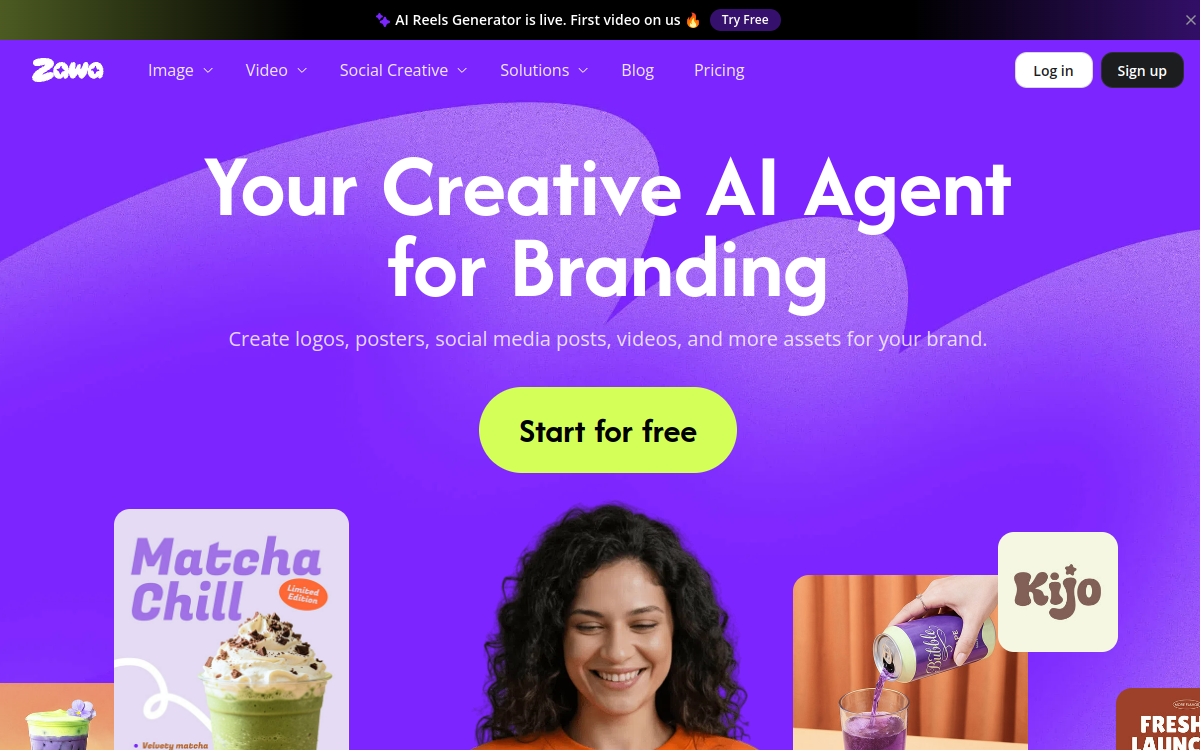
Launching a brand typically requires a logo, brand guidelines, product visuals and consistent presence across networks. For a small business without a designer, this represents considerable budget and time. Zawa, formerly known as X-Design, offers a solution to this problem by bringing these tasks together within a single AI agent. The tool starts from a simple idea or description and generates a complete visual identity, then applies it automatically to everyday materials: product photos, storefronts, packaging and social media posts. The stated objective is clear: to allow a merchant, restaurateur or creator to quickly have professional and consistent visuals without going through an agency. In this presentation, we detail what Zawa really is, its main features, concrete use cases, its advantages, its pricing model and our conclusion on its relevance depending on user profiles.
What is Zawa?
The essentials
Zawa is an AI-assisted design platform focused on branding. Rather than limiting itself to generating a single isolated image, it adopts an agent logic: it first builds a coherent brand identity (logo, color palette, typography, style guidelines) then stores these elements in a brand kit. This kit then serves as a reference for producing all subsequent visuals, guaranteeing visual consistency from one medium to another. Formerly marketed under the name X-Design, the solution is primarily aimed at small structures and freelancers who have neither the budget nor the skills to engage a graphic design studio. It combines creative generation and image editing tools within the same workspace.
Key features
The heart of Zawa rests on an AI-driven branding workflow: logo generation, creation of guidelines, palettes and typographic rules, all preserved in a reusable brand memory. The platform then allows fine editing of creations: moving elements, rewriting text, cutting out or extending an image. It covers many creative formats, from posters to menus through packaging, mockups and video tools. A major advantage concerns product photography: Zawa transforms a phone snapshot into clean, professional visual, changes the background and adapts the rendering to different platforms. The platform also integrates a wide catalog of editing tools (background removal, upscaling, image enhancement, recoloring) and relies on several generative models such as Nano Banana, Midjourney, Flux Kontext, GPT Image and the Seedream family. This diversity of models allows you to adjust style and quality based on the type of rendering desired.
Use cases
Zawa targets very concrete scenarios related to small businesses. A restaurant or café can update its menus, create seasonal promotions and produce packaging visuals consistent with its identity. A retail store or physical shop uses it to generate posters, signage and brand kit. E-commerce sellers use it to enhance their product photos and create visuals adapted to marketplaces and social networks. Creators and small marketing teams find a way to quickly explore ideas while maintaining a constant brand identity. In all these cases, the sought benefit is the same: to produce professional-quality materials without resorting to an external provider.
Advantages
The main advantage of Zawa is time savings: a brand identity that would take days to establish with an agency is generated in minutes. Visual consistency is another strong asset, since the brand kit automatically applies the same graphic codes across all visuals. The diversity of formats and models avoids juggling between multiple applications, which simplifies an entrepreneur’s daily routine. Finally, the ability to enhance ordinary product photos makes the tool particularly useful for online sellers, whose visuals directly influence conversion rates. Everything remains financially accessible compared to the cost of a designer or studio.
Pricing
Zawa offers a free trial providing access to features with variable limits depending on each tool. To go further, paid plans unlock more credits, better output quality and enhanced uses. The Plus plan, chosen by the vast majority of users, starts around $5.83 per month on annual billing and includes 200 monthly credits, of which 100 agent credits, up to 150 image generations and 15 video generations. A Pro plan exists above, with more credits, higher daily video limits and extended access to certain models. Note: the credit-based operation requires estimating your consumption, as intensive use of images and videos quickly exhausts the monthly allowance.
Conclusion
Zawa is a convincing solution for small businesses, local shops and creators who want a professional brand identity without agency budgets. Its agent logic and memorized brand kit guarantee rare consistency at this price point, and the quality of product photos is a real argument for e-commerce. Credit-based pricing deserves attention if your needs are substantial, and experienced designers will find less control than with traditional vector tools. To quickly launch or refresh a brand, the free trial lets you judge for yourself before committing.