


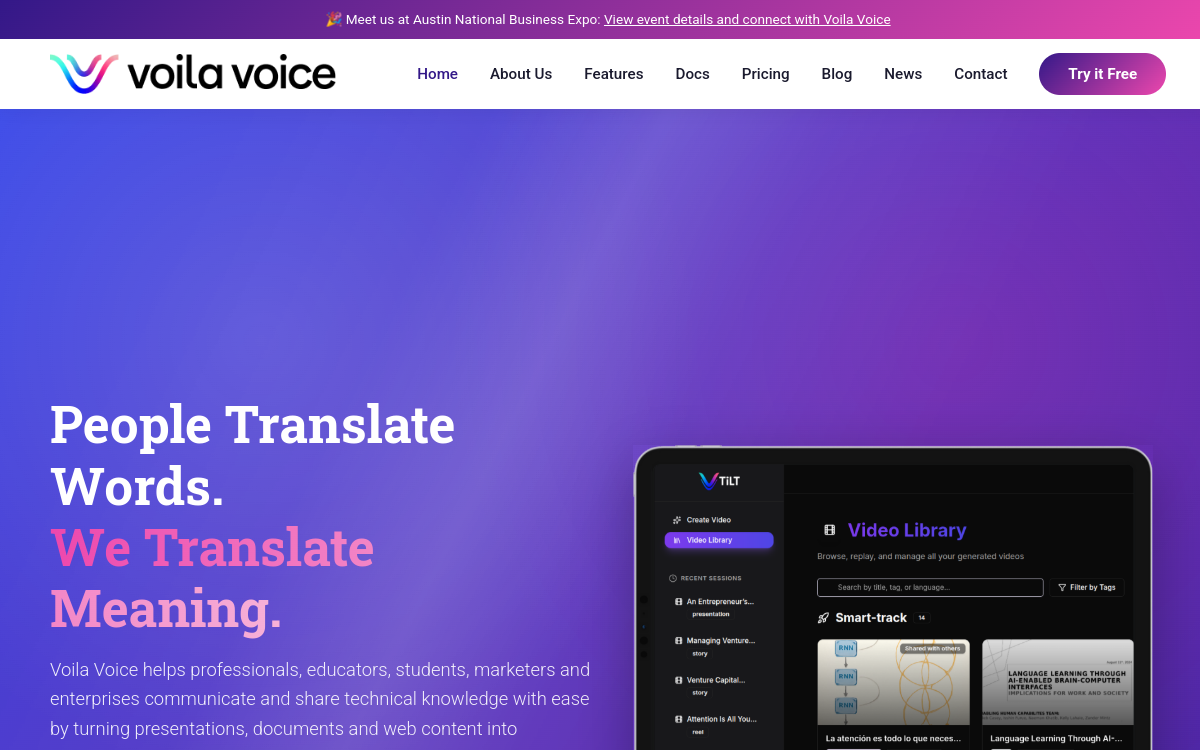
Voila Voice is a multimedia translation and voice cloning platform that transforms a video, presentation or document into a ready-to-distribute multilingual experience. The tool targets over 20 languages and dialects with a strong promise: contextual localization that goes beyond literal translation. Among its flagship functions: voice-over generation, automatic subtitling, quiz and flashcard creation, and an educational AI assistant. Designed for educators, marketers and businesses, the solution democratizes a localization experience previously reserved to specialized studios.
What is Voila Voice?
The essentials
Voila Voice is a web platform for multimedia translation and voice cloning that transforms monolingual content into a multilingual experience. The user uploads a video, presentation or document, selects target languages and the platform produces in minutes a translated version with coherent voice-over, subtitles and adapted styling. The service emphasizes contextual translation: rather than word-for-word translation, AI analyzes meaning, tone and intent to deliver natural localization. Voila Voice primarily targets educators, marketers and businesses seeking to distribute content to an international audience. Available with a 30-day trial and paid plans, the platform is part of a strong trend of AI applied to large-scale localization.
Key features
Voila Voice’s flagship module is its multimedia translator capable of taking as input a video, audio file, presentation or text document. The platform transcribes the content, translates it contextually and generates a new voice-over in the target language. Voice cloning allows preserving the identity of the original creator, making the translated version more authentic. Voila Voice also offers a quiz, flashcard and interactive game module generated directly from uploaded content, transforming passive video into active learning support. The AI assistant answers learner questions based on available material. The platform supports over 20 languages and dialects, including regional languages often underserved by competing tools. On usage, Voila Voice offers two modes: Reel mode for short high-engagement content and immersive mode for longer sessions. User experience remains smooth thanks to a guided wizard and pre-configured templates for most frequent use cases.
Use cases
Voila Voice addresses several profiles. Educators and schools use it to make their courses accessible to students of different nationalities, generating both voiceover and interactive support. Universities and continuing education organizations exploit the platform to internationalize their educational content without recruiting dedicated translation teams. In-agency or in-house marketers use it to localize advertising creatives across multiple markets while respecting voice identity of their spokespersons. Companies with distributed teams use Voila Voice to produce multilingual internal materials — training, communication, product presentation — without multiplying studios. Independent coaches and trainers see it as a way to expand their international audience without investing in professional dubbing. Finally, NGOs and associations use the tool to broadcast their messages in languages spoken by their target audiences.
Advantages
The main benefit of Voila Voice is accelerated international distribution. Where traditional localization can take weeks, the platform delivers a multilingual version in minutes. The second benefit is voice consistency: by cloning the original voice, Voila Voice avoids the identity breaks that traditional dubbing often creates. The third benefit is educational relevance of complementary modules — quizzes, flashcards, AI assistant — that transform passive content into active learning experience. The fourth benefit is multilingual coverage, particularly useful for languages often neglected by competing solutions. Put together, these advantages make Voila Voice a valuable companion for anyone targeting an international audience.
Pricing
Voila Voice operates with a free 30-day trial allowing evaluation on your own content before subscribing. Paid plans adapt to different profiles: independents, education teams, businesses with personalized support. Pricing aligns with the AI localization tools market and remains significantly lower than traditional dubbing studios. For very high-volume content or enterprise projects, custom agreements can be negotiated. As with any solution involving synthetic voice, users should remain attentive to rights issues, particularly when cloning their own voice or that of a spokesperson.
Conclusion
Voila Voice illustrates the new wave of AI localization tools that democratize multilingual distribution. For educators, marketers and businesses with international ambition, it’s a valuable companion that drastically reduces the cost and time of multilingual production. The platform remains to be complemented by premium dubbing solutions for the most demanding broadcast uses, but on its niche, it holds a particularly convincing position for 2026.