


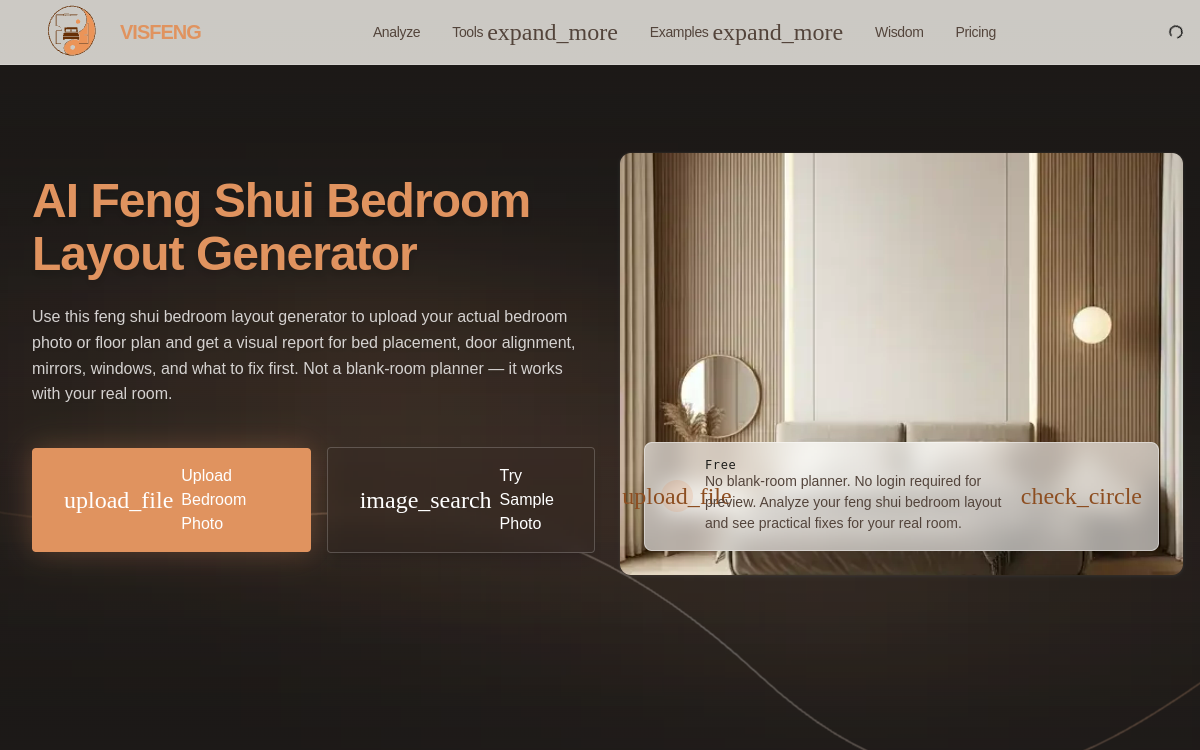
Redecorating a bedroom often raises the same questions: where to place the bed, should I move this mirror, is it disruptive to have the window right above the headboard? visfeng provides a concrete answer to these questions by leveraging artificial intelligence and Feng Shui principles. Rather than starting from a blank floor plan or complex modeling software, the tool works directly from a photo of your existing bedroom. You import an image or plan, and it generates a visual report that highlights the sensitive points in the layout. This approach makes it immediately useful for individuals who want to improve their sleeping space without prior technical knowledge. The analysis covers the most discussed elements in Feng Shui applied to bedrooms: the position of the bed relative to the door, the presence of mirrors facing the bed, or the sense of stability when the bed is positioned under a window. The result is meant to be actionable, with a clear ranking of priorities. visfeng addresses both homeowners and renters, as it offers solutions adapted to each situation.
What is VisFeng?
The essentials
visfeng is an online analysis tool that evaluates bedroom layout according to Feng Shui principles. It works by uploading a photo of the room or a floor plan, from which the AI maps the spatial relationships between furniture, openings, and key elements like the bed or mirrors. Unlike a classic interior planner, it doesn’t ask you to draw the room from scratch: it analyzes a real, already-furnished space. The product thus positions itself as a diagnostic assistant rather than a design software. It targets people who want to understand what isn’t working in their bedroom layout and get concrete recommendations to fix it, without consulting a Feng Shui expert.
Key features
visfeng’s core feature is annotated visual analysis: the AI overlays markers directly on the imported photo that flag identified issues. Several specific checks are performed. Bed placement evaluation examines command position, alignment with the door, and headboard support. Mirror detection identifies those facing the bed, whether they’re closet doors, vanities, or wall mirrors. Door line mapping highlights any direct alignment between the bed and the entrance. Window pressure control analyzes the sense of stability when the bed is positioned under a window. This is supplemented by an evaluation of room flow and furniture arrangement. Each report results in a layout score between 0 and 100, a top 3 of problems, annotated images, and before/after suggestions. Priority ranking indicates what to fix first, with practical trade-offs. Finally, non-invasive alternatives are proposed for renters who cannot make permanent modifications to their home.
Use cases
visfeng finds utility in several everyday situations. Someone moving can test their bedroom layout before permanently setting furniture placement, for example spotting a poorly positioned mirror or a bed aligned with the door. A renter facing a room constrained by housing limitations can seek simple adjustments, without renovations, to improve comfort. Feng Shui sleep enthusiasts have a tool to quickly verify the coherence of their setup. Finally, anyone curious about why their bedroom doesn’t feel restful can get an immediate visual diagnosis. The free preview, accessible without registration, lets you test the analysis relevance on your own room before committing.
Advantages
visfeng’s primary benefit lies in its simplicity: a single photo gets you a structured diagnosis, whereas a traditional Feng Shui consultation requires a visit and much higher costs. The annotated report makes recommendations immediately understandable, as each problem is pointed out directly on the bedroom image. The numerical score and priority ranking prevent confusion: you know what to address first. The approach designed for renters broadens the audience, since suggestions account for the inability to do renovations. The single-use credit model, without subscription, suits a one-time need: you pay once for the number of analyses you want, with no recurring commitment. It’s a time and clarity gain for those who want to act fast.
Pricing
visfeng offers a free preview without registration that includes layout score, top three problems, and a low-resolution annotated image. The full report, with HD images and detailed recommendations, requires credits, each report costing 10 credits. Three packs are available as one-time purchase, with no expiration or subscription: Starter at $9.99 for 1,000 credits (roughly 100 analyses), Creator at $24.99 for 3,000 credits (roughly 300 analyses), and Pro at $49.99 for 7,000 credits (roughly 700 analyses), the latter adding detailed notes and priority support. Cost per analysis drops to around $0.07 on the largest pack.
Conclusion
visfeng fulfills a precise mission and does it well: turning a simple bedroom photo into a clear, visual, and actionable Feng Shui report. Its free preview, numerical score, and renter-friendly suggestions make it an accessible tool for individuals and the curious alike. Its limitations mainly stem from its deliberately narrow scope restricted to bedrooms and lack of 3D design. For a quick and affordable diagnosis before reorganizing your sleeping space, it’s a relevant and easy-to-use option.