



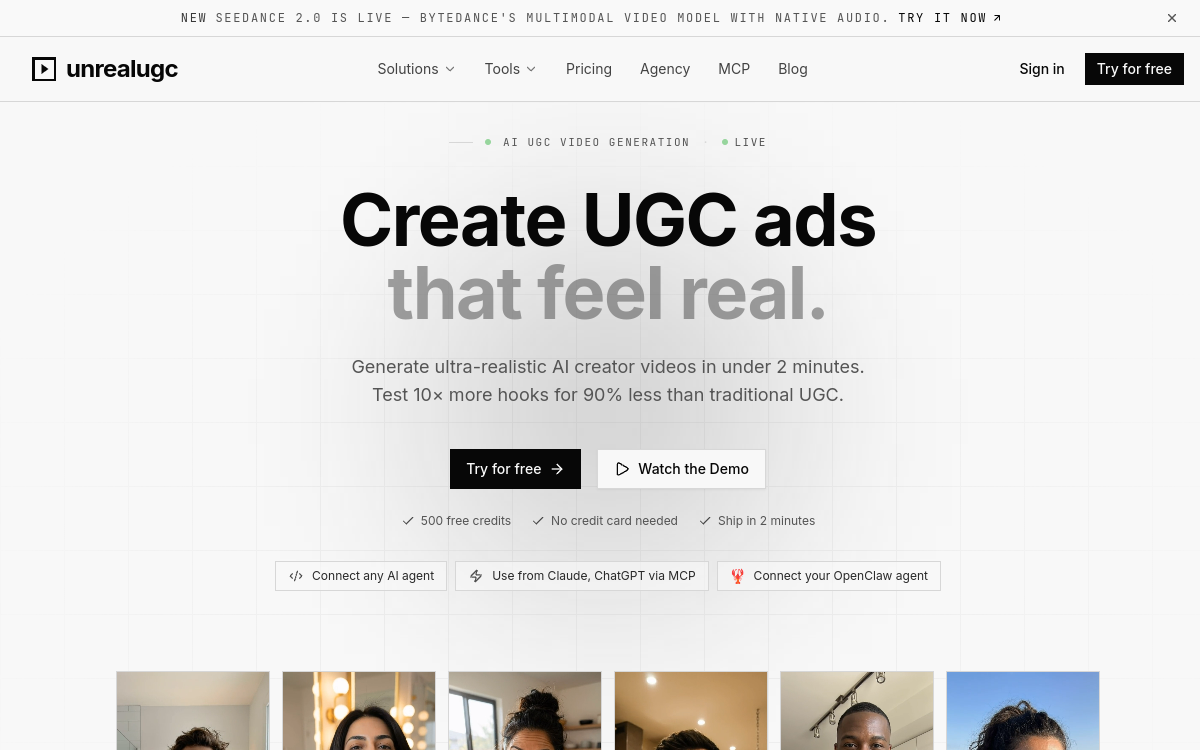
Producing UGC videos (user-generated content created by creators) has become a pillar of social media advertising. The problem: filming with real creators is expensive, time-consuming, and limits the number of testable variants. UnrealUGC offers a radical solution to this bottleneck by generating creator videos entirely through artificial intelligence. The idea is straightforward: enable advertisers to test far more creative hooks, faster, and for a fraction of the usual budget. The platform’s stated promise is to produce advertising-ready videos in under two minutes, with realistic personas and output optimized for vertical formats on Meta, TikTok, and YouTube. In this overview, we detail what UnrealUGC actually is, how it works, its main features, concrete use cases, advantages, pricing, and who benefits most. The goal is to provide a factual and useful perspective for marketing teams considering integrating AI-generated UGC video into their acquisition and creative testing strategy.
What is UnrealUGC?
The essentials
UnrealUGC is an online platform for generating UGC videos through artificial intelligence. In practice, the user selects a virtual creator from a catalog of over 200 personas, writes or generates a script, chooses a voice and duration, then launches rendering. The platform produces a vertical MP4 video in 1080×1920 format, optimized for social advertising placements. Where traditional UGC production requires recruiting creators, coordinating a shoot, and editing footage, UnrealUGC automates the entire process. The tool targets advertisers, agencies, founders, and e-commerce brands that need creative volume. Its positioning is built on speed and cost: test more variants to validate advertising angles before investing in media.
Key features
UnrealUGC relies on a multi-model video engine combining several cutting-edge technologies: Kling 3.0, Veo 3.1, Sora 2 Pro, Seedance, and Wan. This diversity allows you to adjust style and rendering quality based on the project. The catalog includes over 200 AI creators with varied profiles, covering different ages, styles, and contexts. Audio lip-sync is native and works in over 99 languages, making it easy to localize campaigns across international markets. The platform also integrates AI-assisted script generation, voice cloning, and the ability to upload custom avatars. On the output side, videos are exported as vertical MP4s ready for Meta, TikTok, and YouTube. For technical teams, UnrealUGC offers a REST API and MCP server, with integrations to Claude, ChatGPT, OpenClaw, Hermes Agent, and Claude Code, making the tool scriptable within automated pipelines. Overall, it aims to reduce the time between hook concept and testing.
Use cases
The primary use case for UnrealUGC is large-scale creative testing. A media team can quickly generate ten variants of the same hook, each with a different creator or tone, to identify which performs best before spending significant advertising budget. E-commerce brands use it to present products via engaging UGC formats. SaaS publishers and mobile apps use it for short, localized demonstrations. Fitness, beauty, and tech sectors are among the cited domains. Agencies integrate it into their production to deliver more creative work to clients without multiplying shoots. Thanks to multilingual lip-sync, the same campaign can be adapted into multiple languages for different markets, accelerating ad internationalization.
Advantages
The central benefit of UnrealUGC is speed: an advertising-ready video in under two minutes transforms creative testing dynamics. Where traditional production takes days and thousands of dollars, the tool lets you multiply variants for a fraction of the cost, with a price per video starting at $4. The diversity of video models and creators offers real stylistic flexibility, while lip-sync in 99+ languages opens the door to international campaigns without reshooting. API and MCP integrations provide an advantage for technical teams wanting to automate generation. Finally, commercial usage rights are included in all plans, simplifying the distribution of videos in paid advertising.
Pricing
UnrealUGC operates on a monthly subscription with a credit system. The Starter plan costs $69 per month ($58 with annual billing), with 6,000 credits and approximately 21 videos per month. The Pro plan, positioned as the most popular, is $149 per month ($125 annually) for 14,000 credits and about 50 videos. The Agency plan reaches $349 per month ($292 annually) with 39,000 credits and approximately 139 videos. All plans include access to all video models, 300+ creators, custom avatars, and commercial rights. Credit cost varies by chosen model, and a 7-day satisfaction guarantee accompanies new subscriptions. There is no free plan.
Conclusion
UnrealUGC clearly targets teams that prioritize social advertising and need to quickly test many creative angles. Its strength lies in the combination of recent video models, a wide choice of creators, and output localizable in multiple languages. The absence of a free plan and the variable credit system require minimal budget tracking, but the speed-to-cost ratio remains convincing for volume testing. For an advertiser or agency looking to industrialize UGC video production, the tool merits a trial, especially with the 7-day money-back guarantee.