



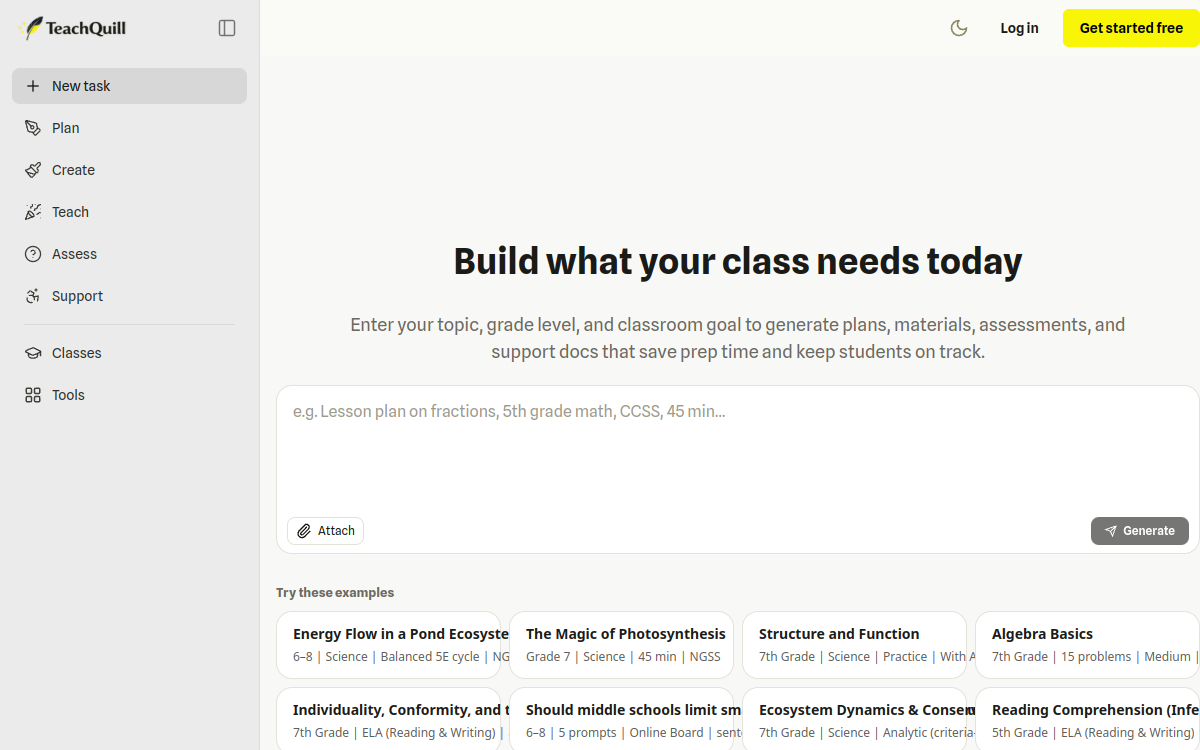
TeachQuill has emerged as a central player in AI EdTech for American teachers. Its promise: to centralize over a hundred AI tools in a single platform to prepare, differentiate, and assess in the classroom. At a time when teachers spend a disproportionate amount of their time on administrative prep, the idea of a standards-aligned pedagogical copilot is highly attractive. In this review, we explore what the platform actually offers, its positioning against other tools, and its limitations. We focus on concrete challenges: alignment with frameworks, special education, regulatory compliance, and institutional adoption. The goal is to give you the information to decide if TeachQuill deserves a place in your toolkit or in your school’s AI deployment.
What is TeachQuill?
The essentials
TeachQuill is a web platform that aggregates over a hundred pedagogical AI tools. Teachers describe a need in natural language, and the platform produces the appropriate content: lesson plans, quizzes, exercises, IEP goals, report card comments, social stories, and more. The generated content is based on major US educational standards, making it immediately usable in a US K-12 context. The platform emphasizes FERPA and COPPA compliance, two key regulatory frameworks for US schools, as well as the ability to deploy district-wide with SSO and an administrative dashboard.
Key features
TeachQuill offers a wide variety of generators: reading, math, science, social studies, arts, languages, special education, and behavioral support. Special education teachers will find generators for IEP goals, 504 plans, BIPs, and social stories tailored to their students’ needs. PDF export, copy-paste, and history features make daily integration easy. The platform offers an onboarding process that guides users to the most relevant tools based on the teacher’s profile. Security, with FERPA and COPPA compliance, is highlighted for school deployments.
Use cases
Three main use cases stand out: weekly lesson prep, differentiation for students with specific needs, and assessment with the generation of quizzes, report card comments, or reports. For IEP coordinators, the dedicated module significantly reduces the time spent writing goals and helps standardize quality. For schools, district-wide bulk purchasing simplifies deployment and allows usage tracking.
Advantages
The time savings are massive on repetitive tasks like report card comments or differentiation exercises. Quality remains high thanks to standards alignment. Unifying over a hundred features avoids scattering work across ten different tools. Finally, regulatory compliance unlocks institutional adoption that would often be impossible with more generic tools.
Pricing
TeachQuill offers a free plan, a monthly Pro plan at $25, an annual Pro plan at $15 per month billed annually, and custom school and district plans. Daily and monthly credits structure usage: power users will need to monitor their consumption. For schools, the custom quote includes seats, SSO, and support.
Conclusion
TeachQuill is a solid reference for US K-12 teachers who want an AI copilot aligned with their standards and compliant with regulatory requirements. Internationally, the tool remains relevant as a source of inspiration but requires adaptations. For district deployment, it is a serious player to consider.