


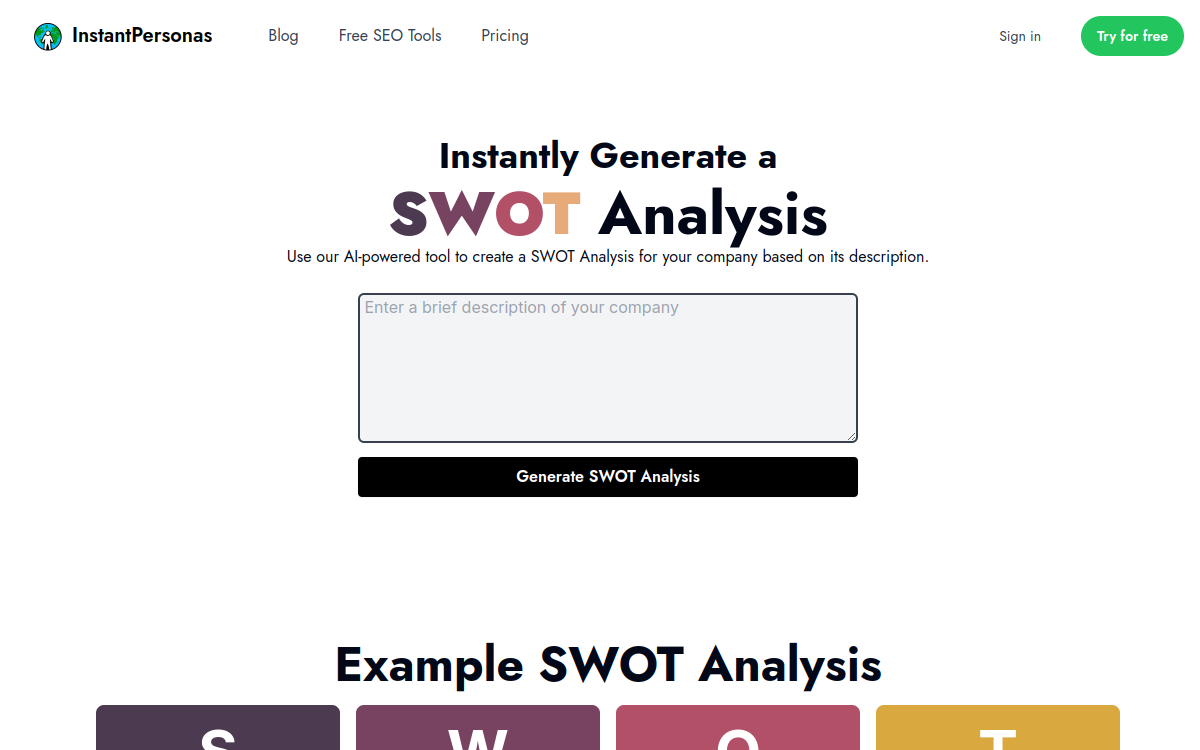
SwotAnalysis.dev is part of this new wave of highly focused AI tools that deliver value through a single, well-executed function. Its value proposition can be summed up in one sentence: generate a clean, editable, and exportable SWOT matrix in less than a minute. This is a use case that speaks to any entrepreneur, business student, or junior consultant who regularly needs to kickstart a strategic reflection. In this review, we look at what lies behind this apparent simplicity, what to expect from it, and where the service falls short. The idea is also to show you when SwotAnalysis.dev is more than enough and when it needs to be combined with other tools or more in-depth human work. We cover the features, typical use cases, concrete benefits, pricing model, and recommendations for integrating it into a coherent strategic toolkit.
What is SwotAnalysis.dev?
The essentials
SwotAnalysis.dev is an online generator dedicated to a single task: producing a SWOT analysis from a business description. The user types a few sentences describing their project, industry, or company, and the tool returns a matrix structured into four quadrants. This matrix can then be edited directly within the interface, allowing users to refine suggestions, replace elements, or add new ones. Exporting is done in image format, ideal for integrating the result into a text document, a slide, or a PDF. The service is designed for speed and accessibility.
Key features
The features are intentionally minimalist: an input field to describe the activity, AI generation, inline editing, and image export. This simplicity makes the tool immediately usable without any training. The quality of the result largely depends on the description provided: the more precise it is about the sector, target audience, and competitive context, the more relevant the matrix will be. The AI focuses on classic SWOT elements: positioning, team, resources, market, competition, and trends. To go further, users can edit each quadrant and integrate their own observations. No collaborative features, no versioning, no persistent history: SwotAnalysis.dev fully embraces its positioning as a one-off generator, with no ambition to become a strategic workspace.
Use cases
Three main use cases stand out. The first is the entrepreneur preparing a pitch or a funding application who needs a clean SWOT quickly. The second is the business school student who has to deliver a case study and wants a baseline to challenge. The third is the junior consultant starting a project with a client workshop and using the tool to provide a common starting point. In each of these contexts, the goal is not to obtain an exhaustive analysis but to produce an actionable structure in a very short time.
Advantages
The main benefit is speed. In just a few seconds, the tool provides a solid working foundation that would have taken fifteen minutes or more for an unprepared human. Next is the quality of the structure: the four quadrants are balanced, avoiding lopsided SWOTs with one side overly detailed and another empty. Finally, the free accessibility allows for risk-free testing, ideal for freelancers and self-employed individuals with tight budgets.
Pricing
SwotAnalysis.dev operates on a free model. No credit card is required to generate a matrix and export it. Any potential upgrades to a premium plan are not central for the basic user, who already has everything they need. This lack of friction is a major reason for the tool’s popularity and ensures its regular use within the entrepreneurial community.
Conclusion
SwotAnalysis.dev is an excellent habit to build into your strategic toolkit. It is not a substitute for deep thinking, but it is a valuable accelerator for kickstarting a SWOT, structuring a workshop, or feeding into a deliverable. Combine it with other tools to go further on market research, personas, or competitive strategy.