


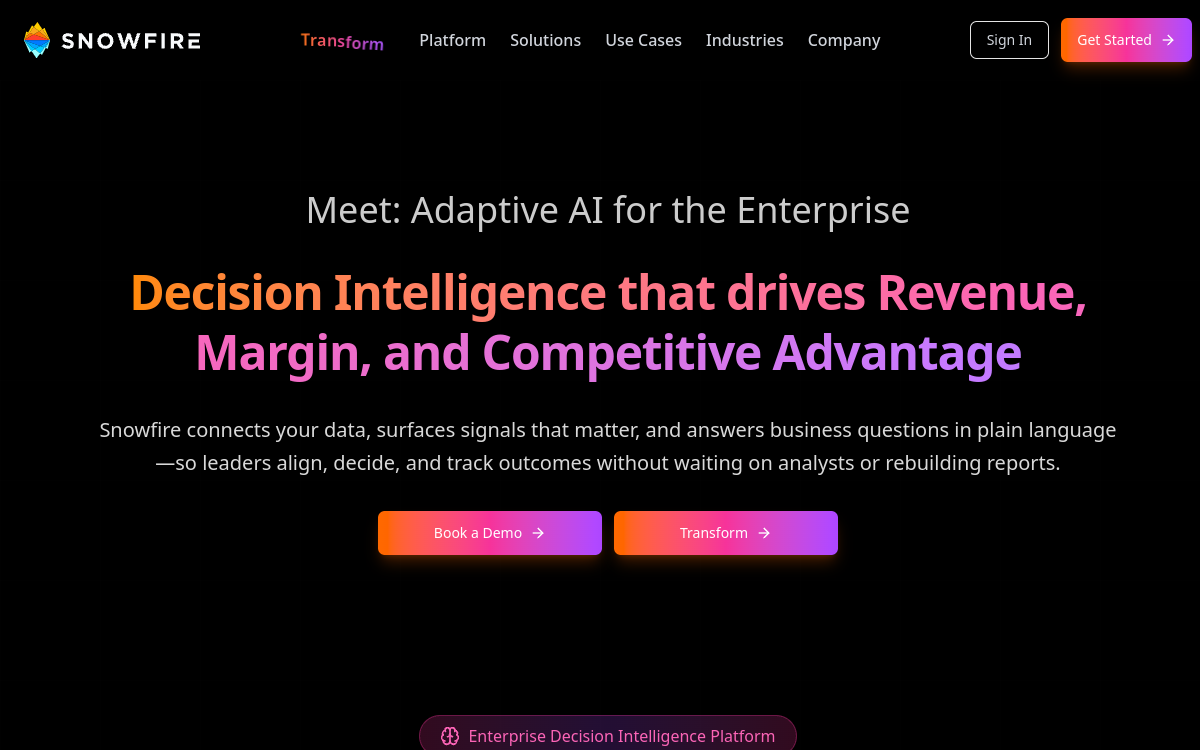
Snowfire AI is a business intelligence platform designed for business executives. The tool connects nearly 1,000 SaaS applications to transform your dispersed data into synthesized graphs and actionable insights. Through natural language queries, you interrogate your KPIs, receive real-time alerts, and get clear forecasts on your business health without any technical skills required.
What is Snowfire AI?
The essentials
Snowfire AI is a next-generation business intelligence platform, designed specifically for business executives who want to drive their activity with real-time data. Unlike traditional BI tools that require technical teams to build reports, Snowfire AI leverages generative artificial intelligence to enable direct data interrogation in natural language. The platform connects nearly 1,000 SaaS applications and internal systems to create a synthesized graph of business activity, whether CRM, marketing tools, finance platforms, or ERP. The result is a unified decision copilot that answers your strategic questions in seconds.
Key features
Snowfire AI rests on several functional pillars that make it a complete solution for executive leadership. Native connectivity is central: the platform integrates in real time with nearly 1,000 SaaS applications, eliminating data silos between teams. The AI engine offers a conversational experience where each question, asked in plain English, triggers analysis of relevant data and produces a clear answer. Users can thus understand revenue evolution, grasp acquisition channel dynamics, or anticipate churn risk without manipulating a single formula. Snowfire AI also offers a customizable alert system that automatically notifies decision-makers when a KPI crosses a critical threshold. Predictive analysis is another key strength: the solution highlights emerging trends and priority action levers. On the security side, data is stored in an isolated, encrypted environment, compliant with enterprise requirements, with strict access controls to preserve sensitive information confidentiality.
Use cases
Snowfire AI addresses many strategic use cases. Executive committees use it to have a unified executive dashboard that synthesizes commercial, financial, and marketing performance in one place. CFOs use it to track treasury, identify budget variances, and anticipate financing needs. Marketing leadership relies on AI to analyze campaign performance, compare acquisition channels, and arbitrate budgets in real time. Sales teams use predictive alerts to prioritize at-risk accounts or most promising opportunities. Investment funds and holdings see in it an efficient way to monitor multiple holdings in parallel. Snowfire AI is also useful in merger-acquisition contexts to quickly consolidate data from multiple entities.
Advantages
Adopting Snowfire AI drastically reduces time spent on reporting and manual analysis. Executives gain autonomy with their data: no need to wait for a BI team to prepare a dashboard, answers come in seconds. The platform also improves decision quality through predictive analysis that sheds light on weak signals invisible in traditional dashboards. The ability to deploy the solution in 24 hours represents a major competitive advantage, especially for companies lacking a structured data team. Finally, unifying sources breaks silos between departments and shares a common view of performance.
Pricing
Snowfire AI offers a subscription model based on features, storage volume, and the organization’s compute needs. Pricing is not published on the official website and operates on custom quotes, reflecting the enterprise positioning of the solution. To lower entry cost, the publisher regularly offers free onboarding sessions and time-limited promotions. New customers also benefit from personalized assistance for connecting their sources and training teams. To get a quote adapted to your scope, it’s recommended to request a demo directly from the publisher.
Conclusion
Snowfire AI is primarily aimed at executives and executive management who want to transform their scattered SaaS stack into a true decision copilot. Its promise of lightning-fast deployment, ability to converse in natural language, and rich integrations make it a solid option for mid-market companies and large accounts wanting to drive decisions with data without depending on a large data team. For smaller structures, the absence of published pricing remains a barrier.