


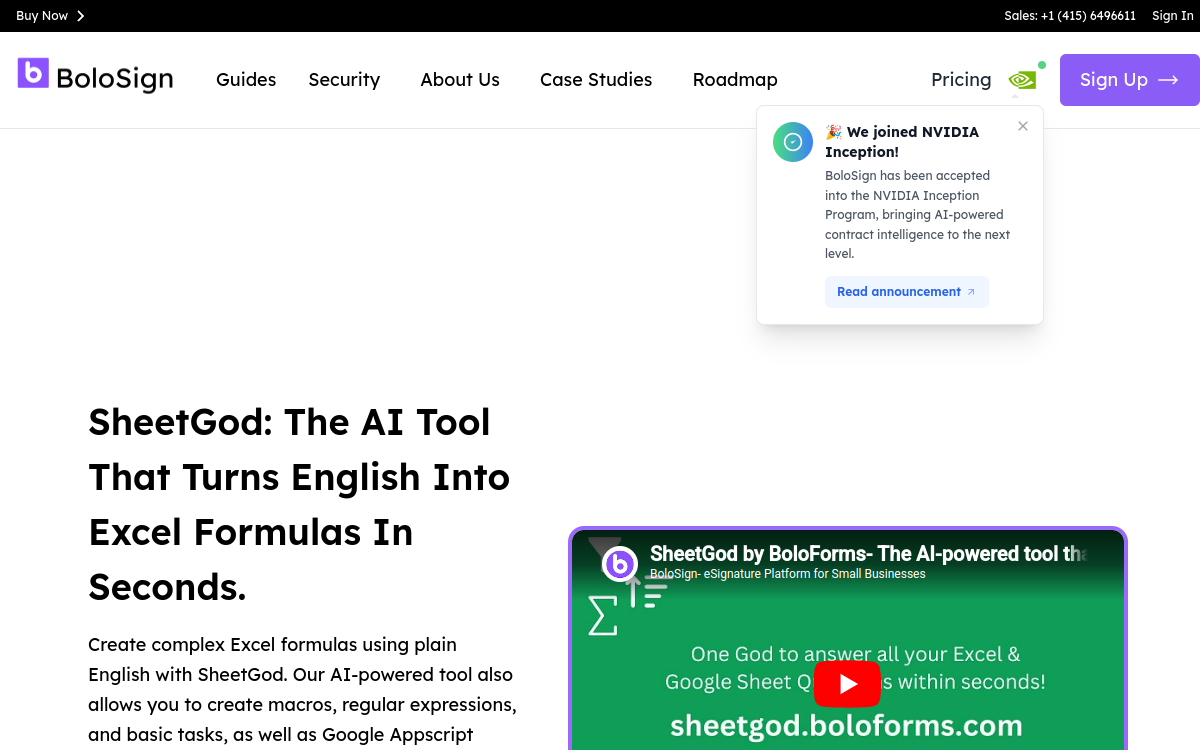
Choosing the right tool for generating Excel formulas, Google Sheets scripts, VBA and regex from a plain-English description is now a central challenge for spreadsheet users. In an environment where productivity relies heavily on artificial intelligence, SheetGod positions itself as a clear and accessible solution. Its goal: to provide a simple framework for making the most of spreadsheet automation while cutting the time spent on repetitive tasks. This detailed overview will help you understand what the tool really offers, its strengths, its limitations and the profiles it suits best. You’ll also find concrete details on its features, its use cases and its pricing model, so you can make an informed decision before investing time or budget in this platform.
What is SheetGod?
The essentials
SheetGod is a platform specialized in generating Excel formulas, Google Sheets scripts, VBA and regex from a plain-English description. The tool is primarily aimed at spreadsheet users and combines AI features with an interface built for speed of execution. In concrete terms, it automates tasks that used to take several hours, drawing on modern models and integrations suited to a professional environment. The solution deploys in just a few minutes and requires no advanced technical skills, which makes it a relevant option for teams that want to get up and running quickly.
Key features
SheetGod’s feature set is built around several pillars. The first concerns spreadsheet automation, handled through AI models that simplify the key actions and produce usable results without heavy configuration. The second pillar focuses on user experience, with a readable interface, ready-to-use templates and clear onboarding. The third pillar is the integration ecosystem: native connectors, automations, APIs and exports make it easy to fit the tool into your existing stack. Finally, the tool offers collaborative options that let several team members work together on the same projects, with access rights and a history of changes. Together, this forms a coherent suite designed to serve a wide range of professional profiles.
Use cases
Several scenarios illustrate the value of SheetGod. Independents and freelancers use it to speed up their deliverables and give their output a more professional finish. SMB teams see it as a way to structure a still under-tooled process, with a quick return on investment. Agencies fold it into their client workflows to scale up production capacity without hiring. For larger companies, the tool often serves to complement existing suites by adding a layer of AI on specific cases such as generating Excel formulas, Google Sheets scripts, VBA and regex from a plain-English description.
Advantages
Adopting SheetGod brings several concrete benefits. First, measurable time savings on recurring tasks, which quickly translates into hours saved. Next, a qualitative improvement in deliverables, thanks to AI suggestions and context-aware templates. Finally, a gradual upskilling of the team, which learns to apply the best practices tied to spreadsheet automation. For spreadsheet users, these benefits add up and enable real differentiation from competitors that haven’t yet made the move to operational AI.
Pricing
SheetGod’s pricing is structured as follows: Free trial then paid. This lets you test the tool with no commitment, then move up a tier as your needs grow. The higher tiers unlock more volume, advanced integrations and collaborative options. For larger organizations, custom enterprise plans are also available.
Conclusion
Ultimately, SheetGod is a solid choice for anyone looking to improve their day-to-day around spreadsheet automation. Its balance of simplicity, functional depth and accessible pricing makes it a serious option to consider, especially for spreadsheet users.