



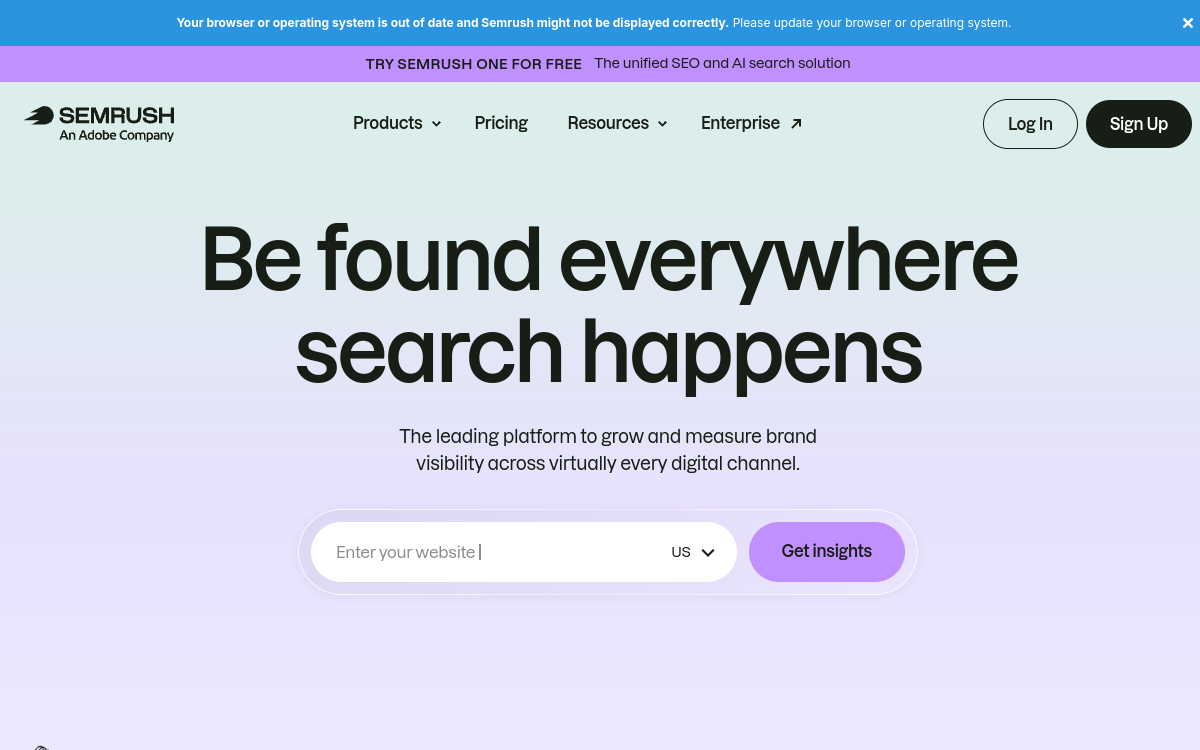
Semrush is an all-in-one SEO suite for analyzing, planning and optimizing visibility. It combines keyword research, technical audit, position tracking, competitor analysis, backlinks and reporting via dashboards. Its AI modules (recommendations, writing assistance) accelerate content production and action prioritization. Ideal for agencies, SMEs and demanding publishers.
What is Semrush?
The essentials
Semrush is a digital marketing SaaS platform, historically centered on SEO, which helps analyze a site, its competitors and growth opportunities. Its role is to provide actionable data and operational tools: keywords to target, pages to improve, technical issues to fix, links to obtain, positions to track and reports to share.Concretely, Semrush aggregates many reports: keyword research (ideas, volumes, intent, difficulty), site audit (crawl, errors, alerts), position tracking (keywords, zones, devices), backlink analysis (profile, anchors, referring domains) and competitive benchmarking.Semrush’s value comes from its “all-in-one” coverage and decision-making orientation: rather than stacking isolated tools, it offers a centralized view to plan, execute and measure an SEO and content strategy, with logic adapted to teams and clients.
Key features
Semrush stands out for the richness of its modules. Keyword research (particularly through idea generation and grouping tools) identifies high-potential queries, builds thematic clusters and prioritizes an editorial calendar. Position tracking allows daily monitoring of keyword evolution by geographic area and device, and comparison of performance with competitors.Technical audit explores the site like a crawler: errors, alerts, slow pages, indexing or structure issues. It helps prioritize fixes that impact visibility. The backlinks section analyzes link profile, identifies opportunities and tracks netlinking evolution.Semrush also offers content-oriented tools: brief creation, optimization recommendations, readability and consistency checks, and support for improving on-page SEO. Finally, dashboards and reports facilitate management: KPIs, exports, internal sharing, and client reporting. The whole is designed to transform data into concrete decisions.
Use cases
Semrush is used daily for three major objectives: finding opportunities, fixing what’s holding you back, and tracking impact. For a content strategy, it’s used to build a roadmap: themes, keywords, search intent, competition, and prioritization. Editorial teams can thus produce content better aligned with demand.On the technical side, the audit is used to quickly detect blockages: crawl errors, unoptimized pages, performance or structure issues. On the netlinking side, backlink analysis helps understand what works with competitors and structure more effective link campaigns.For agencies, Semrush is also a reporting tool: position tracking, performance by segment, KPI evolution, and demonstrating gains over a period. Finally, for e-commerce and SMEs, the platform is used to monitor the market, adjust priorities and measure the impact of optimizations on visibility.
Advantages
The main benefit of Semrush is centralization. By bringing together keyword research, audit, positions, backlinks and reporting, the tool reduces back-and-forths between solutions and provides a consistent view of performance. Second advantage: data depth, useful for identifying “long tail” opportunities, building clusters and detecting competitive moves.Semrush also helps you prioritize better. With audits and recommendations, you avoid spreading yourself thin and focus on high-impact actions: critical technical fixes, high-potential pages, link opportunities, topics to cover.Finally, the tool is very suitable for teamwork and client relationships: reports, exports and dashboards make it easy to share results, align stakeholders and follow a routine SEO (weekly or monthly). For performance-oriented organizations, Semrush becomes a real management lever.
Pricing
Semrush operates by subscription. The entry-level (often called Pro) starts around $139.95/month and covers the essentials: keyword research, audit, position tracking and reporting, with limits per project and data volume. Higher plans (Guru and Business) increase these limits and unlock advanced features, useful when managing multiple sites, a large number of keywords or regular client reporting.There are usually annual payment discounts and additional options depending on needs (volumes, users, modules). Semrush may also offer, depending on periods and offers, trials or limited activations. The right approach to choosing is to estimate the number of projects, keywords tracked and expected reporting level.
Conclusion
Semrush is a reference solution for organizations that want to manage SEO methodically: find opportunities, prioritize actions and measure impact. Its strength is being both data-rich and execution-oriented, with reports adapted to teams and clients.However, the tool requires a minimum of organization: if you don’t have a routine SEO, it can seem complex and costly. On the other hand, once a content strategy, position tracking and continuous optimization logic are in place, Semrush becomes a powerful accelerator.For agencies, ambitious SMEs, e-commerce and publishers, it’s a worthwhile investment to move from “gut feeling” SEO to clear, measurable and scalable management.