



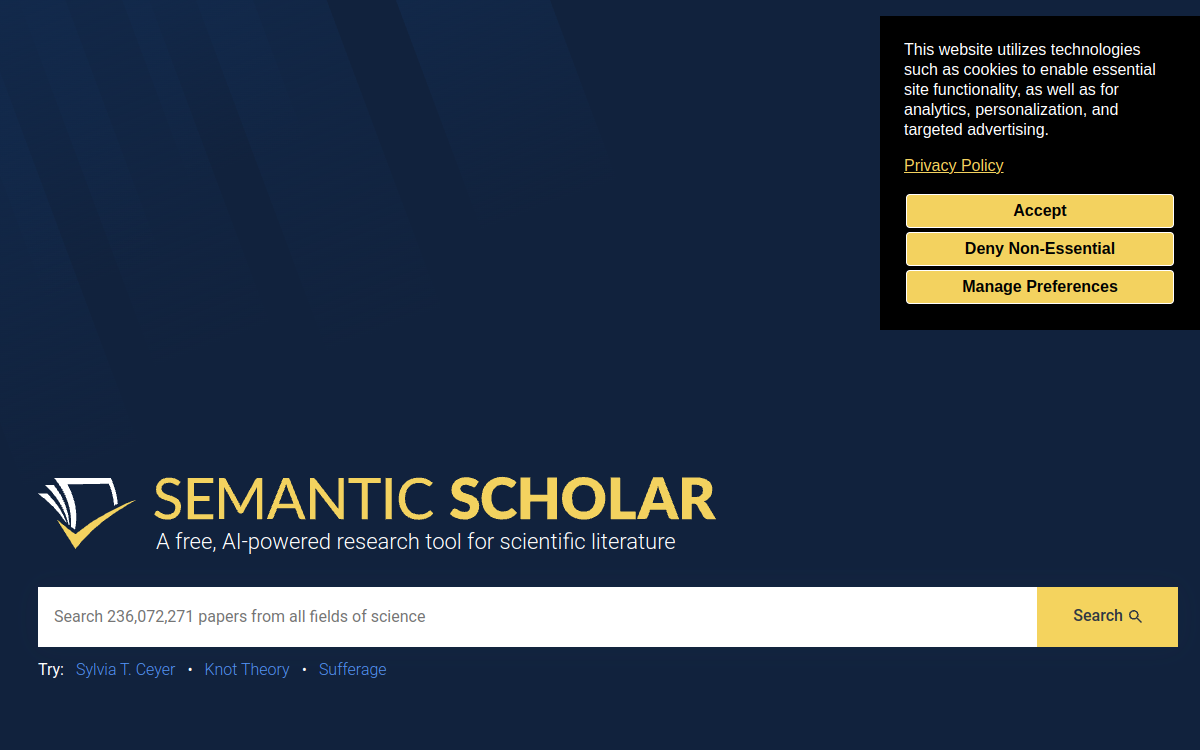
Choosing the right tool for AI-assisted academic research is now a key priority for researchers and academics. In an environment where productivity relies heavily on artificial intelligence, Semantic Scholar positions itself as a clear and accessible solution. Its objective: to provide a simple framework to fully leverage AI-assisted academic research while reducing time spent on repetitive tasks. This detailed presentation will help you understand what the tool actually offers, its strengths, its limitations, and the profiles for whom it represents the best choice. You will also find concrete information on its features, use cases, and pricing model to make an informed decision before investing time or budget in this platform.
What is Semantic Scholar?
The essentials
Semantic Scholar is a platform specializing in AI-assisted academic research. Available at https://www.semanticscholar.org/, the tool is primarily aimed at researchers and academics and combines AI features with an interface designed for speed of execution. Concretely, it allows you to automate tasks that once took several hours, relying on modern models and integrations adapted to a professional environment. The solution deploys in minutes and requires no advanced technical skills, making it a relevant option for teams wanting to quickly transition to active use.
Key features
Semantic Scholar’s feature set is structured around several pillars. The first concerns AI-assisted academic research, handled through AI models that simplify key actions and produce usable results without heavy configuration. The second pillar focuses on user experience, with a readable interface, ready-to-use templates, and clear onboarding. The third pillar is the integration ecosystem: native connectors, automations, APIs, and exports make it easy to integrate the tool into your existing stack. Finally, the tool offers collaborative options that allow multiple team members to work together on the same projects, with access rights and change history. All of this creates a coherent suite designed to serve a wide range of professional profiles.
Use cases
Several scenarios illustrate the value of Semantic Scholar. Independents and freelancers use it to accelerate their deliverables and professionalize their outputs. SME teams see it as a way to structure a process that was still poorly equipped, with rapid return on investment. Agencies integrate it into their client workflows to multiply their production capacity without hiring. For large enterprises, the tool often serves to complement existing suites by adding AI to specific cases related to AI-assisted academic research.
Advantages
Adopting Semantic Scholar brings several concrete benefits. First, measurable time savings on recurring tasks, which quickly translate into saved hours. Next, qualitative improvement of deliverables, thanks to AI suggestions and context-adapted templates. Finally, progressive skill development for the team, which learns to leverage best practices related to AI-assisted academic research. For researchers and academics, these benefits accumulate and allow real differentiation compared to competitors who haven’t yet made the leap to operational AI.
Pricing
Semantic Scholar’s pricing model follows a free approach. This allows you to test the tool without commitment, then upgrade based on your needs. The main currency is USD, with an entry point at around $0 per month on the first paid plan. Higher tiers unlock access to more volume, advanced integrations, and collaborative options. For larger organizations, custom enterprise offers are also available.
Conclusion
Ultimately, Semantic Scholar is a solid choice for those who want to improve their daily work with AI-assisted academic research. Its balance between simplicity, functional depth, and accessible pricing makes it an option to seriously consider, particularly for researchers and academics.