


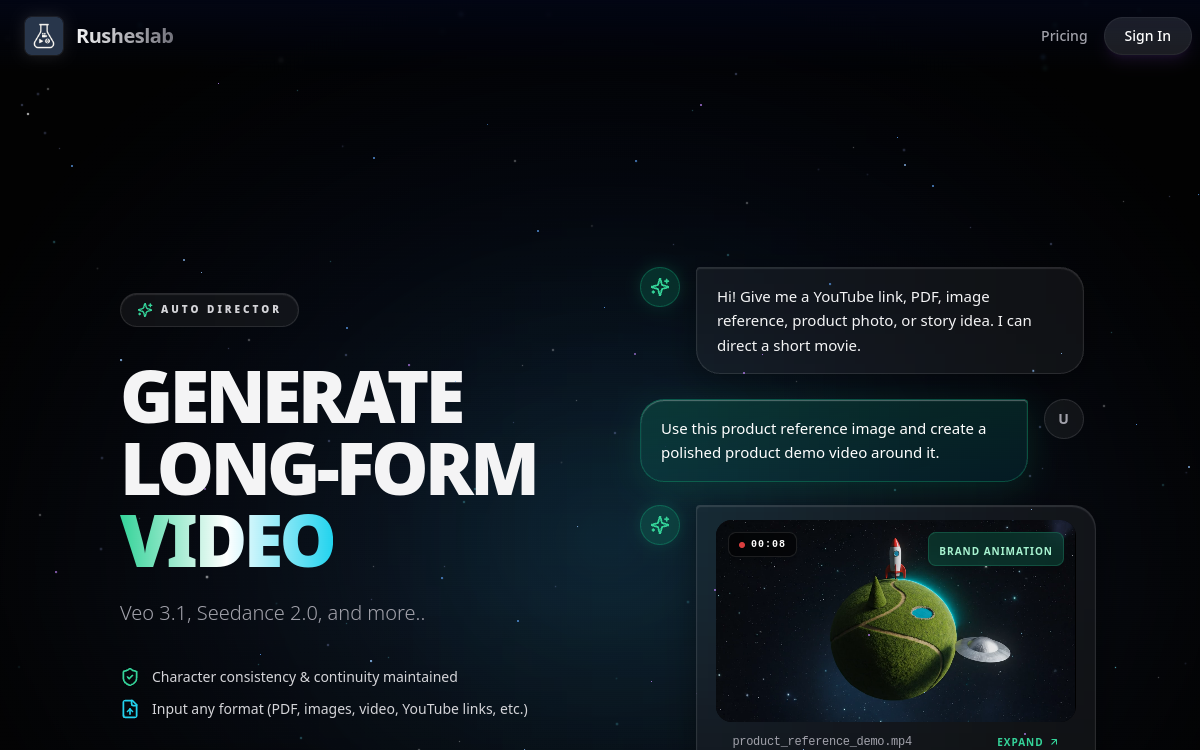
Pre-visualization is one of the most strategic stages of a film project. It allows you to validate a concept, adjust staging, and align an entire crew before shooting. However, it remains costly in terms of time and resources, often making it a luxury reserved for large projects. RushesLab wants to change this equation. By leveraging the Veo 3.1 model, the platform generates 8-second cinematic shots with remarkable consistency across characters, locations, and dialogues. Independent filmmakers can thus test a script, compare multiple angles, or prototype a narrative universe without mobilizing a crew. This article reviews the features, benefits, and limitations of RushesLab to help you determine if the platform fits your filmmaking practice.
What is RushesLab?
The essentials
RushesLab is a web-based AI video generation platform specializing in cinematic pre-visualization. The service uses the Veo 3.1 model, one of the most advanced on the market to date, to produce 8-second shots with audio, ambient music, and dialogues. The platform’s unique feature is its ability to maintain character and location consistency across multiple shots, which was previously difficult to achieve with generative models. RushesLab is aimed at filmmakers, independent directors, and video creators who want to quickly explore narrative concepts without incurring the costs of a traditional shoot.
Key features
RushesLab relies on a set of features designed for filmmakers. The first is the scene generator based on Veo 3.1, capable of producing 8-second cinematic shots with a level of detail close to photorealism. Character consistency is managed by a profile system that remembers the appearance and characteristics of each protagonist, allowing them to be maintained from one shot to another. Location consistency works on the same principle. The audio engine generates dialogues in any language, accompanied by ambient music tailored to the mood of the scene. Shot-level control allows users to adjust camera angles, movements, and soundscapes. The interface offers a guided generation mode that suggests scene concepts based on a central idea, helping users explore directions they might not have thought of. Generated videos are delivered without watermarks, allowing them to be integrated directly into a presentation or pilot without constraints. Finally, the platform is designed to integrate into an existing production workflow via export in standard video formats.
Use cases
RushesLab is useful in several contexts. An independent director can use it to produce an animated storyboard of a short film before going into production. A screenwriter can visualize their ideas to better pitch them to producers. A studio can test multiple versions of a scene to validate an artistic direction. An advertiser can prototype a commercial before mobilizing a production crew. A YouTube content creator can devise original narrative sequences for a long-form video. Finally, film schools can use the platform as an educational tool to explore the basics of directing.
Advantages
Adopting RushesLab brings several key benefits. The first is the massive reduction in the cost of pre-visualization: what previously required days of work can now be generated in a few minutes. The second benefit is the visual quality, which makes it easy to align stakeholders around a clear vision. The third advantage is the consistency offered by the platform, which is a game-changer compared to generic tools. Finally, the pay-as-you-go pricing model makes the solution accessible even for low-budget projects.
Pricing
RushesLab is free to sign up. The only associated costs are those for video generation, indexed to the official rates of Veo 3.1. This pay-as-you-go approach allows you to pay only for what you consume, with no fixed fees. For an independent filmmaker, this represents a major advantage as the budget can be adjusted based on ongoing projects. Users can test the platform with a low volume before moving on to larger series of shots.
Conclusion
RushesLab is an excellent example of what generative video AI can achieve today in cinematic pre-visualization. The combination of the Veo 3.1 model, character consistency, and multilingual dialogues makes it a powerful solution for filmmakers and independent studios. For those who want to gain creative agility without sacrificing quality, RushesLab deserves a prime spot in the toolkit.