


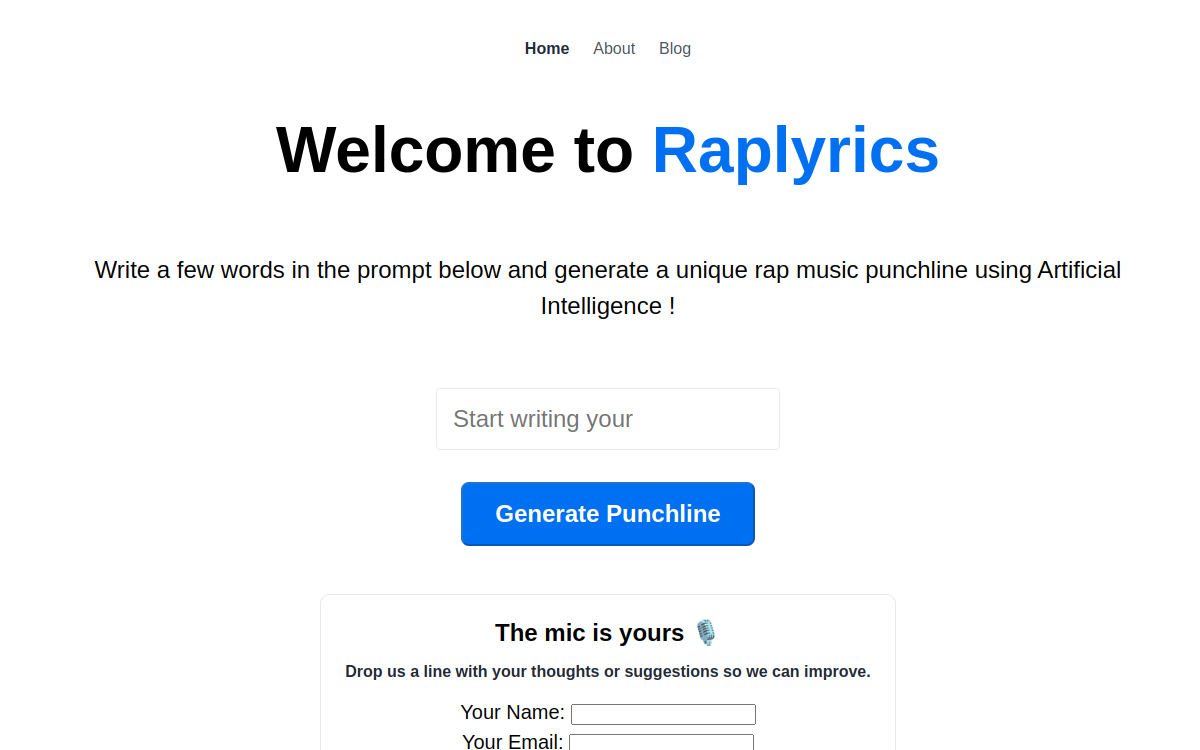
Writing rap requires constant work on punchlines, those hard-hitting bars that define a verse. But when inspiration is lacking, finding the perfect angle can become a real headache. This is precisely the need met by RapLyrics, an AI-powered rap punchline generator. The concept is minimalist and effective: you type a few words into a text field, and the tool returns an original punchline generated by a machine learning engine. No registration, no payment, no technical barriers: you arrive on the site, you write, you generate. Behind this simplicity lies a passionate developer’s project, open source and well-documented, which is worth checking out as much for its fun side as for its technical transparency. In this overview, we look at what RapLyrics really is, how it works, who it is for, and what its concrete limitations are. The goal is clear: to help you find out if this free tool can become an ally in your writing process, or if it remains a simple generator of ideas to be reworked.
What is RapLyrics?
The essentials
RapLyrics is a website that generates rap punchlines using artificial intelligence. Specifically, the user enters a prompt of a few words, and the system returns an original phrase in the spirit of rap. The core of the tool relies on a machine learning engine trained, according to its creator, on millions of songs from various artists. This massive training aims to give the model its own generative style, capable of producing original phrasing rather than simple copies. The project was developed by fpaupier and adopts a transparent approach: the frontend code is publicly published on GitHub, and technical documentation details the design of the model. RapLyrics thus positions itself at the intersection of a mainstream creative tool and an open-source demonstration project.
Key features
The core feature of RapLyrics can be summed up in one sentence: generating a rap punchline from a few words. The interface is limited to an input field and a generate button, making the tool instantly understandable, even for a first-time visitor. This minimalist design is a deliberate choice: no complex settings, no dashboard, just a prompt and a result. The technical strength lies in the underlying machine learning engine, trained on a large corpus of songs to produce outputs that are stylistically consistent with the rap universe. The project also offers a community and educational dimension: the frontend source code is accessible on GitHub, and the creator has published a technical article explaining how the generation model was designed and deployed. This openness allows curious developers to examine how the tool works, or even draw inspiration from it for their own experiments. Finally, the site hosts a blog dedicated to rap culture, which extends the experience beyond simple text generation.
Use cases
The primary use of RapLyrics is creative inspiration. An amateur rapper in the middle of a writing session can enter a few keywords related to their theme to unlock a line idea or find an unexpected angle. The tool then acts as a trigger: the generated punchline is not necessarily meant to be used as is, but to spark reflection or guide a verse. Content creators can use it to produce fun hooks on social media or to liven up a video. For those curious about AI, RapLyrics offers a concrete and accessible demonstration of what text generation can produce in a specific artistic style. Finally, because the project is open source, it interests developers who want to study a real-world case of a language model applied to a creative field, from data selection to production deployment.
Advantages
The main asset of RapLyrics is that it is completely free, combined with a lack of friction: no account, no credit card, no installation. This immediate accessibility makes it a commitment-free tool, ideal for testing an idea in a few seconds. Its open-source nature is a second advantage: code transparency and technical documentation inspire trust and allow more technical users to understand what is happening under the hood. The tool also benefits from its specialization: entirely dedicated to rap, it generates outputs consistent with this style rather than generic texts. Finally, its simplicity of use is an asset for beginners, who have no learning curve to overcome. In summary, RapLyrics combines free access, openness, and simplicity in a lightweight format that gets straight to the point.
Pricing
RapLyrics is offered for free. The site does not mention any subscription, paid tier, or premium option: punchline generation is freely accessible, without registration or payment method entry. This free model is explained by the nature of the project, which is both personal and open source, with its frontend code shared publicly on GitHub. However, it should be kept in mind that this lack of commercial offering comes with a lack of guarantees: no formal customer support, no contractual service level, and no official roadmap. For occasional and exploratory use, this free model is perfectly suited.
Conclusion
RapLyrics is a simple, free, and honest tool in its promise: to generate AI rap punchlines from a few words. Its engine, trained on large song corpora, and its open-source nature make it as much a creative game as an interesting technical demonstration. It won’t replace a real writing studio and doesn’t produce full tracks, but it excels as an idea generator. For an amateur rapper, a content creator, or someone curious about AI, it is a friendly and risk-free entry point into musical text generation.