


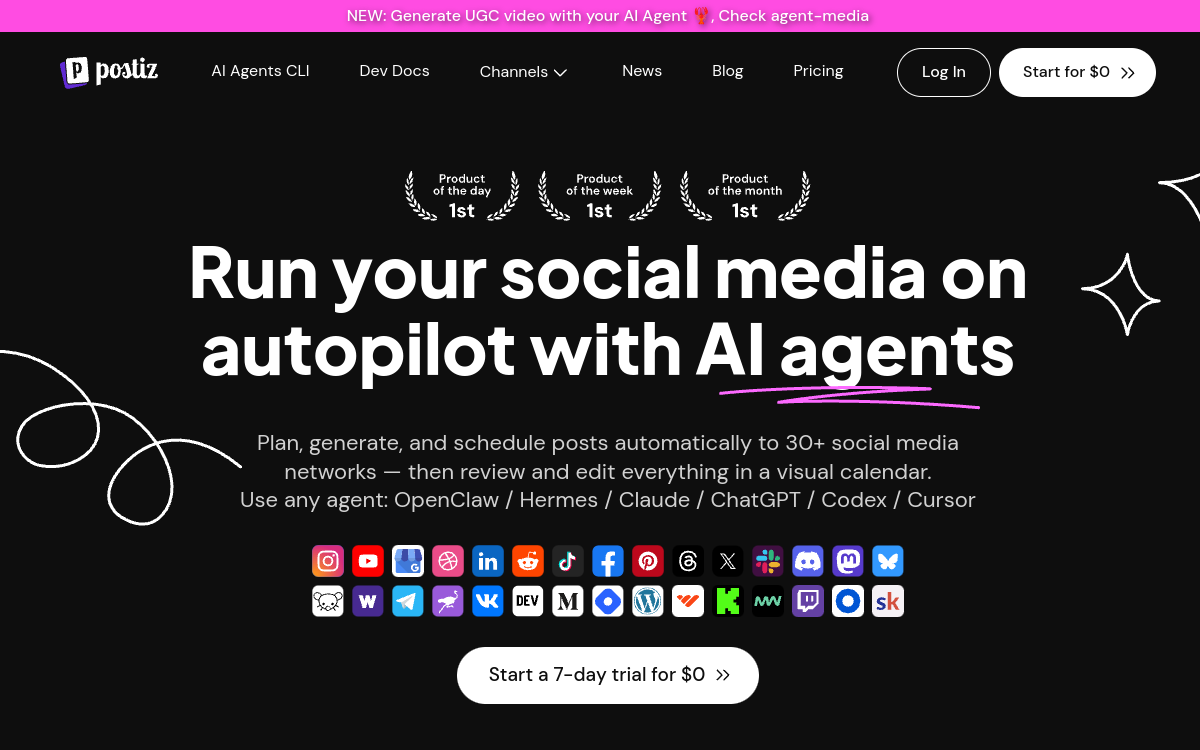
Managing a presence across several social networks takes time, consistency and the right tools. Between writing posts, scheduling them at the right moment and tracking performance, creators and marketing teams often juggle multiple apps. Postiz proposes to centralize all this work in a single interface, with one feature that sets it apart from most competitors: it is fully open source. That means its code is public and anyone can self-host it for free on their own server. Beyond this technical freedom, Postiz combines a visual calendar, simultaneous publishing to more than 30 platforms and AI features to generate text, images and short videos. Designed for freelancers as well as agencies managing several brands, the tool also bets on automation through an open API and connectors to n8n, Make or Zapier. In this overview, we cover what it does, its features, use cases, advantages, pricing and our conclusion to help you decide whether it fits your needs.
What is Postiz?
The essentials
Postiz is a social media management and scheduling tool. Concretely, it lets you create posts, schedule them in advance and publish them automatically to many social platforms from a single dashboard. Its open-source nature, with a repository available on GitHub, sets it apart from classic proprietary solutions: you can use it as a paid hosted version or install it freely on your own infrastructure. The tool is built around a visual calendar that acts as the control center, where you plan, review and adjust each piece of content before publishing. Postiz also integrates artificial intelligence to assist content creation, plus technical connectors for developers and automation teams. It therefore addresses a broad audience, from individual creators to multi-brand agencies.
Key features
Postiz is built around a visual calendar that centralizes the scheduling and review of all posts. Cross-posting lets you publish the same content simultaneously to more than 30 networks: Facebook, Instagram, Threads, LinkedIn, X, TikTok, YouTube, Bluesky, Mastodon, Reddit, Discord, Telegram, Pinterest, but also blogging platforms like WordPress, Medium, Dev.to or Hashnode. The built-in AI generates text, images from prompts and short videos, with integration to agents such as Claude and ChatGPT. On the tracking side, Postiz provides analytics per post and per channel to measure performance. Team features include unlimited members on higher paid plans and the management of several workspaces for different brands or clients. Finally, the tool stands out for its technical openness: a public REST API, webhook support, OAuth2 authentication, an MCP server, as well as automatic posting via RSS feeds round out the set to maintain a steady presence.
Use cases
Postiz covers a variety of situations. A content creator can schedule a whole week of posts to Instagram, TikTok, YouTube and LinkedIn in a single session, then let the tool publish at the right moment. An agency managing several clients uses separate workspaces to keep brands apart and collaborate with a team on each calendar. A developer or technical team connects Postiz to its own apps via the REST API and webhooks, or triggers posts from an n8n or Make.com workflow on specific events. Bloggers benefit from cross-posting to WordPress, Medium or Dev.to. Finally, organizations sensitive to privacy or data control choose self-hosting to keep a grip on the infrastructure and the publishing data.
Advantages
Postiz’s first benefit is centralization: managing more than 30 networks from a single interface saves considerable time and reduces missed posts. The visual calendar offers a clear overview that eases editorial planning and the consistency of the communication line. The AI speeds up content production, helping maintain a steady pace without starting from scratch for each post. The open-source aspect brings rare transparency and freedom: free self-hosting removes subscription costs for technical profiles and guarantees data control. Finally, the openness via API, webhooks and MCP server lets you embed social publishing into broader automation chains, where many closed suites remain siloed.
Pricing
Postiz offers a 7-day free trial, then four monthly hosted plans. The Standard plan is $29 per month (5 channels, 400 posts per month, AI copilot, 3 AI videos). The Team plan at $39 adds 10 channels, unlimited posts and members, 100 AI images and 10 AI videos. The Pro plan at $49 goes up to 30 channels, 300 images and 30 AI videos. The Ultimate plan at $99 offers 100 channels, 500 images and 60 AI videos. A 20% discount applies with annual billing. Above all, the open-source version can be deployed for free on your own cloud, which is an economical option for technical users.
Conclusion
Postiz is a complete, flexible solution to steer your social media presence. Its major strength lies in its dual nature: a turnkey SaaS for those who want to start fast, and a self-hostable open-source project for those who prioritize control and zero cost. Coverage of more than 30 platforms, built-in AI and technical openness via API and automations make it a relevant choice for creators, agencies and developers. Provided you accept a subscription from $29 per month or manage the installation yourself, Postiz clearly deserves a try during its 7-day trial.