


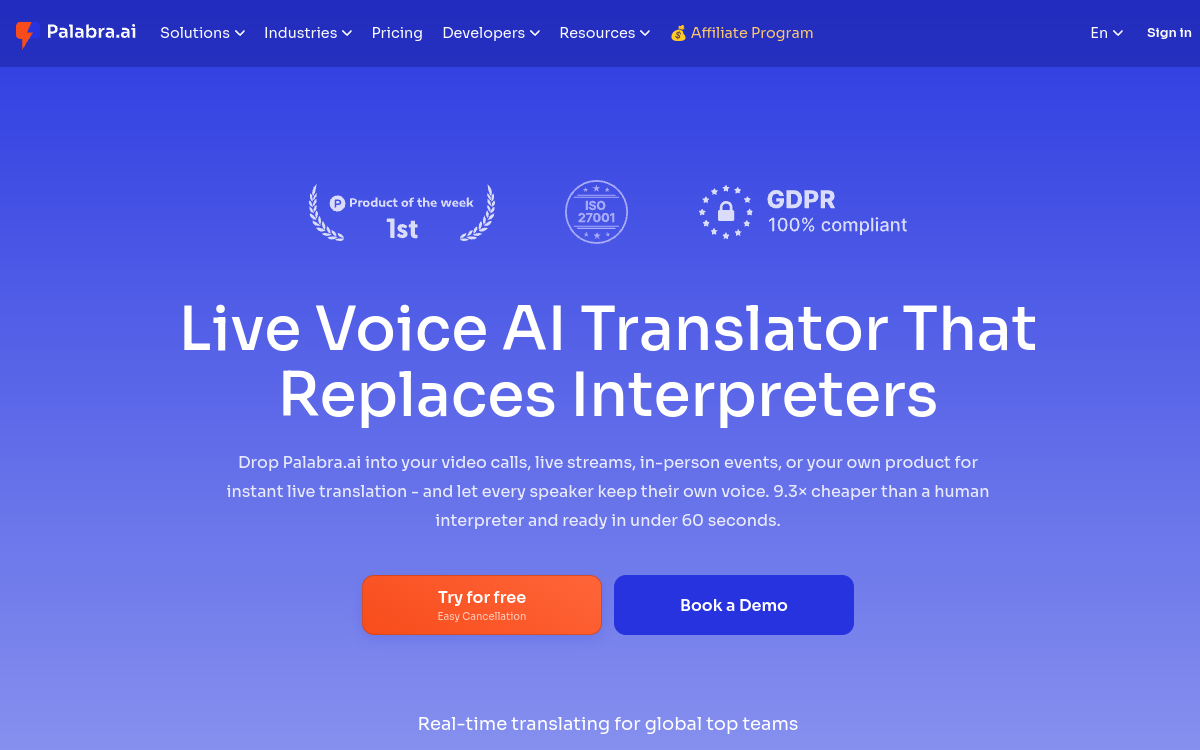
Palabra AI is a real-time voice translation platform for calls, webinars, events, and streaming. Its proprietary technology combines speech recognition, translation, and voice cloning to deliver natural audio in more than sixty languages. Available via a speech-to-speech API or ready-to-use tools, Palabra AI can be deployed on private servers for ultra-low latency.
What is Palabra AI?
The essentials
Palabra AI is a real-time voice translation platform built on proprietary AI models specifically trained for voice. Its architecture combines a speech recognition module, a multilingual translation engine, and a voice synthesis system capable of cloning the speaker’s voice. Available as an API or ready-to-use tools, Palabra AI integrates into webinar, call, and live event workflows. The platform also offers deployment on private servers to meet compliance and latency requirements of large enterprises.
Key features
Palabra AI is built around three main capabilities. The first is live voice translation, covering more than sixty languages, including the most common European languages as well as key Asian and Middle Eastern languages. The second is voice cloning: the solution replicates the speaker’s timbre, tone, and style in the target language, making the experience much more natural than conventional synthesized voice. The third is technical integration, with a speech-to-speech API, translated captions API, and compatibility with main video conferencing and streaming tools. Palabra AI also offers speaker diarization to distinguish voices in a conversation, customizable industry glossaries, and emotion transfer currently in development. Users can choose a voice from the library or clone their own, without losing intonation nuance. Finally, deployment on private regional servers offers ultra-low latency, essential for real-time usage.
Use cases
Palabra AI targets several high-value scenarios. Companies organizing international webinars can stream their sessions in multiple languages simultaneously without hiring interpreters. Multilingual customer support teams can manage their calls while keeping the original voice, which humanizes customer relationships. Hybrid event producers can enrich their broadcasts with translated captions and audio tracks adapted to each regional audience. Creators and streamers broadcasting internationally can expand their reach while preserving their vocal identity. Finally, software editors can integrate live translation into their product via the API and differentiate their offering in demanding multilingual markets.
Advantages
Adopting Palabra AI brings several strategic benefits. The first is reducing operational costs related to human interpreters without sacrificing perceived communication quality. The second is expanding accessible audience, which opens new markets and improves international prospect conversion. The third is preserving brand identity, thanks to voice cloning that maintains consistent experience across languages. The fourth is compliance, made possible by deployment on private servers. All of this translates to quick return on investment for organizations dependent on multilingual communication.
Pricing
Palabra AI offers three annual subscription levels. The Pro plan starts at $150 per month for 150 monthly credits, ideal for creators and small teams discovering live translation. The Scale plan at $900 per month targets growing businesses with larger volumes. A custom Business plan is available for large accounts requiring private deployment, dedicated SLAs, and premium support. A free trial allows evaluating the solution before any commitment.
Conclusion
Palabra AI meets the demanding needs of multilingual businesses wanting to abolish language barriers in real time. Its proprietary LLM, voice cloning, and private deployment make it a serious player for B2B organizations ready to invest in quality global communication.