


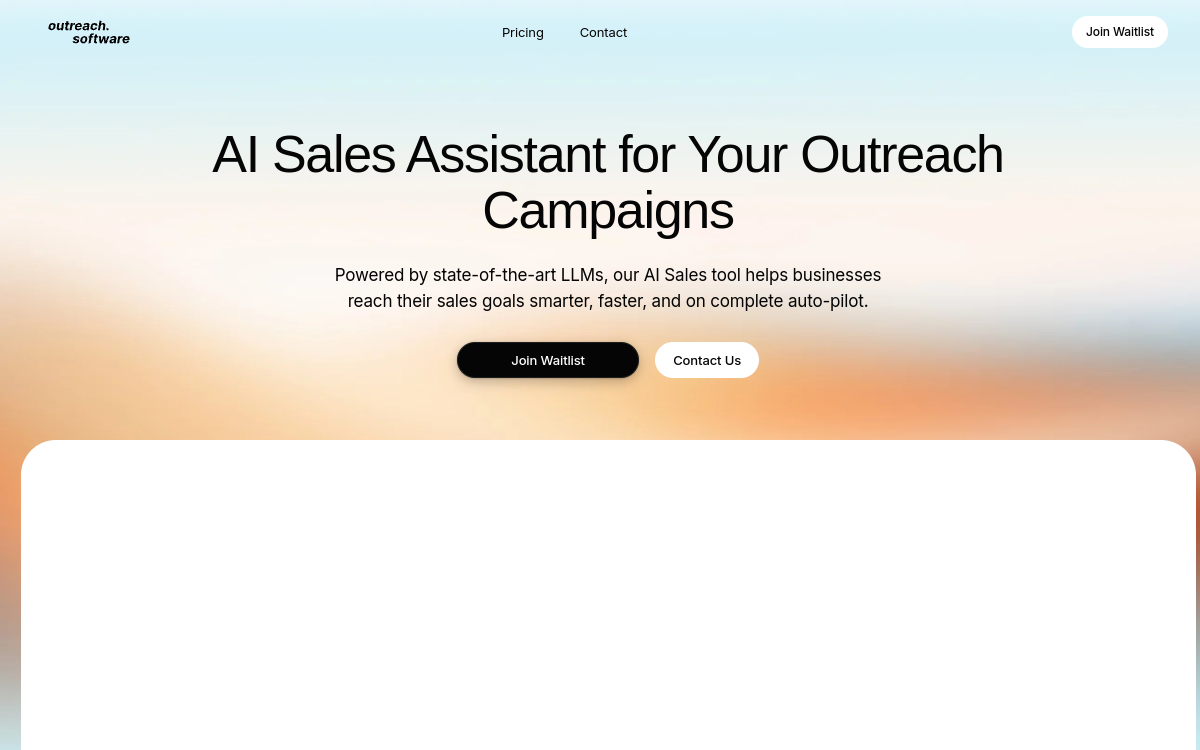
Recruiting and training a team of sales reps dedicated to outbound prospecting is expensive and time-consuming. That’s exactly the problem Outreach.software sets out to solve by offering an AI agent able to take on the work of an SDR (Sales Development Representative). Rather than asking a human to find prospects, write dozens of emails and follow up one by one, the tool hands this entire workflow to an artificial intelligence powered by large language models. The stated goal is to reach your sales targets faster, more intelligently and on near-autopilot. In this article, we concretely describe what Outreach.software does, its main features, its use cases, its advantages, its pricing grid and which company profile it really makes sense for. The idea is to help you know whether delegating your prospecting to an AI agent fits your organization, or whether a more manual approach remains preferable depending on your budget and acquisition channels.
What is Outreach.software?
The essentials
Outreach.software is an AI sales prospecting agent, often referred to as an AI SDR. In concrete terms, it automates the pipeline generation cycle: it identifies relevant prospects, enriches their information with company and contact data, writes personalized messages and handles follow-ups through to booking a meeting. Where a classic email sequencer simply sends scheduled messages, Outreach.software aims to reproduce the reasoning of a junior salesperson by relying on large language models. It connects to market CRMs such as HubSpot, Salesforce and Zoho to centralize leads and activity. The product is aimed first and foremost at service companies and SaaS vendors that need volume without expanding their headcount.
Key features
The core of Outreach.software’s offering rests on end-to-end automation of prospecting work. The first building block is lead identification and enrichment: the tool searches for prospects matching your target and completes their profiles with information on the company and key people. Next comes writing personalized emails, aligned with the brand voice you define, so that messages don’t look like generic blasts. The agent then automatically handles follow-ups based on recipient behavior and schedules meetings when interest is confirmed. A lead scoring system helps prioritize the most promising contacts. Finally, the tool produces daily or weekly performance reports depending on the tier chosen, to track the volume of emails sent, replies and opportunities generated. The whole thing works without constant manual intervention, which is the central promise of the autopilot. The CRM integrations with HubSpot, Salesforce and Zoho ensure that the collected data and prospecting activity flow directly into your CRM, avoiding double entry and making it easier for sales teams to track.
Use cases
Outreach.software finds its place in several concrete scenarios. A young SaaS company that wants to generate a steady flow of qualified meetings can hand its prospecting to the agent without hiring a full-time SDR. A B2B services agency can use it to continuously feed its pipeline while focusing its teams on selling and customer relationships. Consulting firms or providers targeting specific accounts can rely on enrichment and scoring to reach the right contacts. The tool also suits sales teams already equipped with a CRM like Salesforce or HubSpot who want to add a layer of automation to their existing outbound. In all these cases, the common thread is the desire to increase volume while letting AI carry out the repetitive tasks of research, writing and follow-up.
Advantages
Outreach.software’s main benefit is time savings: delegating lead research, writing and follow-ups frees salespeople for high-value conversations. The second advantage is consistency, because the agent works continuously and maintains a prospecting pace that few human teams sustain over time. Brand-voice-aligned personalization keeps messages consistent with your image, and automatic enrichment improves targeting relevance. The CRM integrations provide full visibility into the activity generated, which makes sales management easier. Finally, for a growing company, the tool can be a more predictable alternative than hiring a prospecting team, provided you accept its monthly cost.
Pricing
Outreach.software’s pricing grid is positioned high-end. The entry-level AI SDR plan starts at $399 per month and includes around 300 leads per month with hyper-personalization and weekly reports. The Micro plan rises to $649 per month with one profile, 300 leads and 1,800 emails plus daily reports. The Basic plan, presented as the most popular, reaches $979 per month with two profiles, 500 leads and 3,400 emails. A minimum three-month commitment is required on these plans. No free plan is highlighted, which places the tool on a deliberate prospecting budget rather than a one-off trial.
Conclusion
Outreach.software is aimed at companies that want to industrialize their outbound prospecting by entrusting execution to an AI agent rather than a human team. Its strengths are real: end-to-end automation, enrichment, personalization and solid CRM integrations. The main obstacle remains cost, with an entry point at $399 per month and a three-month commitment. For a SaaS or B2B agency with a structured prospecting budget, the investment can be justified by the volume and consistency obtained. For a freelancer or an organization looking to test the approach without commitment, lighter solutions will be a better fit.