


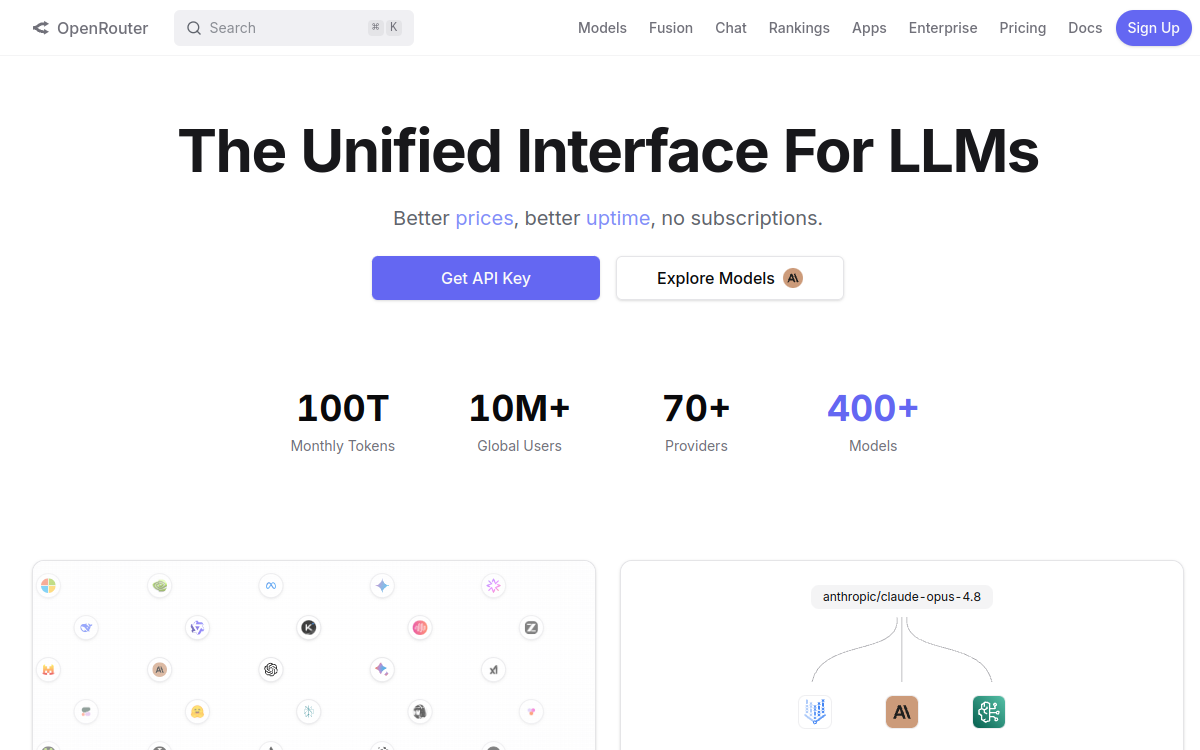
In a unified LLM API market crowded with tools, OpenRouter stands out with its pragmatic approach to a unified API to access hundreds of LLMs. This article breaks down in detail what the tool does, who it’s for, how it positions itself against the competition and which of its use cases are most relevant. The goal: to give you everything you need to decide whether OpenRouter deserves a place in your current stack. We’ll cover the flagship features, the target user profiles, the concrete expected benefits and, of course, the pricing model. By the end of this article, you’ll have a clear and nuanced view of what OpenRouter really brings to a professional or personal workflow. Whether you count yourself among AI developers or SaaS startups, this guide will help you decide.
What is OpenRouter?
The essentials
OpenRouter is an AI platform dedicated to a unified API to access hundreds of LLMs. It targets the code & development space with a clear promise: simplifying users’ work by automating recurring tasks. In concrete terms, OpenRouter positions itself in the unified LLM API space with a strong promise: making a unified API to access hundreds of LLMs accessible to an audience that doesn’t have the time or the technical skills to assemble a more complex set of tools. The tool focuses on a smooth experience, a quick learning curve and a competitive pricing model. On the technical side, it relies on recent AI models and an ecosystem designed for productivity. The end goal is clear: to save time on repetitive or technical tasks without sacrificing the quality of the deliverable.
Key features
The core of OpenRouter’s offering rests on several complementary functional building blocks. Among the most notable: a clear interface for code & development, useful integrations with everyday tools, an affordable entry plan for small budgets, responsive support and educational documentation, and concrete use cases for AI developers. Each feature has been designed to fit into a coherent unified LLM API workflow. The tool doesn’t try to pile up options: it favors a clear, results-oriented experience. This approach is reflected in the interface, designed to stay readable even for non-technical users. Advanced users will nonetheless find enough settings to fine-tune their outputs. The vendor’s roadmap points to regular improvements to the model and integrations, which keeps OpenRouter relevant over time and not just in the moment.
Use cases
In practice, OpenRouter finds its audience among a variety of profiles: AI developers, SaaS startups, product teams, and indie builders. For these users, the tool mainly serves to speed up a unified API to access hundreds of LLMs tasks that, without AI, would take considerable time or require outside expertise. The most common use cases revolve around rapid asset production, creative iteration or automating part of a broader workflow. According to user feedback, the time savings observed add up to hours per week for regular users. In a team setup, OpenRouter can slot in alongside existing tools without requiring a deep overhaul of the current stack.
Advantages
Choosing OpenRouter means betting on three major benefits. First, measurable time savings on recurring tasks tied to a unified API to access hundreds of LLMs. Next, real accessibility for non-technical profiles, which democratizes AI within the team. Finally, greater consistency in deliverables thanks to reproducible settings. Beyond these points, the tool helps reduce users’ cognitive load by automating what can be automated, without imposing a radical change of habits. For organizations looking to industrialize their use of AI, OpenRouter represents a pragmatic and reasonable entry point.
Pricing
On the pricing side, OpenRouter adopts a model aligned with market standards: Free / Paid. The entry point remains accessible for freelancers and small teams, and higher plans unlock advanced features, larger quotas or extended commercial use. The vendor generally offers a trial to test the tool with no commitment, which makes the buying decision easier. The value for money obviously depends on how intensively you use it: the more you use it, the more obvious the return on investment becomes.
Conclusion
Ultimately, OpenRouter earns its place in the landscape of unified LLM API tools in 2026. It doesn’t try to do everything, but to do very well what it sets out to do: accessible, fast and useful a unified API to access hundreds of LLMs. If you match the target profiles and your use cases align with its strengths, trying it is almost always worth it. Our recommendation: test it on a real, everyday scenario.