


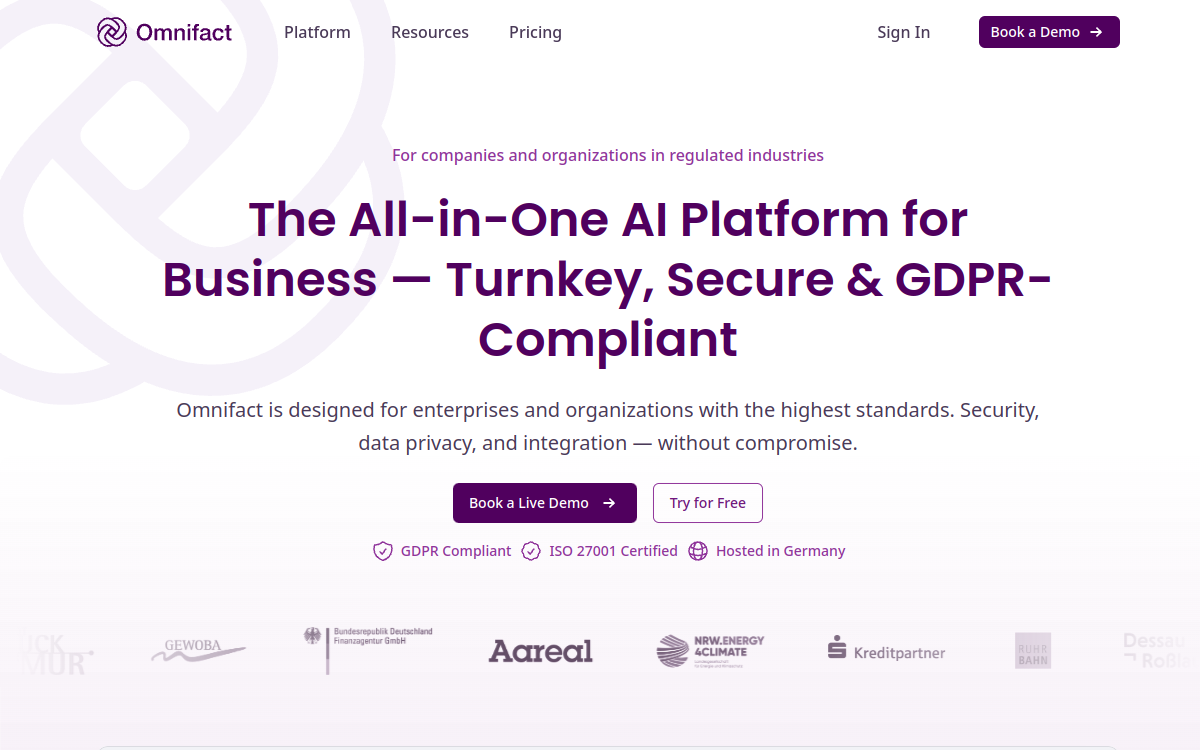
The adoption of generative AI often runs into a simple but crucial question in business: what becomes of the data sent to the models? For a bank, a hospital or a government agency, sending client or patient records to a third-party service is simply unthinkable without solid guarantees. This is exactly the ground Omnifact positions itself on, an enterprise AI platform developed in Frankfurt and hosted in Germany. Its promise comes down to a few words: provide full access to generative AI while guaranteeing confidentiality and regulatory compliance. In concrete terms, Omnifact brings together a chat connected to several major models, custom assistants built on internal data, and a mechanism for automatically masking sensitive information. This article details what the platform actually offers, who it’s for, how it works and how much it costs, to help IT and compliance leaders assess whether it fits their constraints.
What is Omnifact?
The essentials
Omnifact is an all-in-one AI platform aimed at organizations, particularly those operating in regulated sectors. It consists of two main building blocks: a chat that provides access to several language models (OpenAI, Anthropic, Mistral, Google) from a single interface, and Spaces, custom AI assistants plugged into a team’s internal documents and information. Its distinctive element is the Privacy Filter, a proprietary technology that automatically masks sensitive data, such as client identifiers or patient records, before it’s sent to an external model. The platform is ISO 27001 certified, designed to comply with the GDPR and hosted in Germany, which meets European data sovereignty requirements.
Key features
The chat is the entry point: it lets you switch between several model providers as needed. Spaces go further by creating team-specific assistants able to provide contextual answers from internal documents, turning the organization’s knowledge base into a source of reliable answers. The Privacy Filter acts upstream by masking confidential data before any external sending. On the administration side, Omnifact offers role-based access control, integration with enterprise SSO, full logging of user interactions, document classification and multi-tenancy support. The platform also connects to CRM systems, document management systems (DMS) and databases via standardized APIs. Finally, deployment remains flexible: European cloud via hosts such as IONOS or Open Telekom Cloud, private cloud, on-premise, or even an air-gapped environment for the strictest security requirements.
Use cases
Omnifact covers a wide range of business functions in sensitive contexts. In finance, Omnifact is used to automate the processing of financial data and assist compliance teams. Healthcare institutions use it to handle patient data in a secure setting. Public administrations find in it a way to automate administrative tasks while meeting sovereignty requirements. More broadly, the platform helps teams classify documents, analyze internal policies, manage client requests and quickly get answers from their document base. Each Space becomes an assistant dedicated to a given department, whether legal, human resources or customer relations, which makes it possible to tailor AI to each department’s specific processes.
Advantages
Omnifact’s main benefit is removing the confidentiality barrier that often blocks AI adoption in business. Thanks to its certified setup, organizations can leverage generative AI without exposing their most sensitive data to third parties. Unified access to several models avoids juggling different subscriptions and lets you choose the model best suited to each task. Spaces make the most of existing document assets by making them queryable in natural language. For IT and compliance teams, the SSO, role management and logging features provide the traceability and control needed in a regulated environment. Finally, deployment flexibility makes it possible to align the solution with each organization’s own security policies.
Pricing
Omnifact offers two plans. The Pro plan is billed at €25 per user per month with annual billing, with a 10-day free trial and no credit card. It gives access to the entire platform, including chat and Spaces, includes €5 in monthly credits per user for premium models, up to 5,000 pages for Spaces, email support within 24 hours and the Privacy Filter. It’s aimed at teams of up to 50 users. The Enterprise plan, on quote, adds custom credits, usage analytics, API access to Spaces, enterprise SSO, custom SLAs, the on-premise deployment option and a dedicated account manager, with no user limit.
Conclusion
Omnifact occupies a clear and relevant niche: enabling regulated organizations to adopt generative AI without giving up confidentiality or compliance. Its Privacy Filter, certified German hosting and deployment flexibility make it a serious candidate for banks, healthcare players and public administrations. The absence of a durable free plan and the pronounced European orientation may put off some profiles, but for companies concerned with data sovereignty, the offering is coherent and well built. Worth evaluating first if compliance is a non-negotiable criterion.