


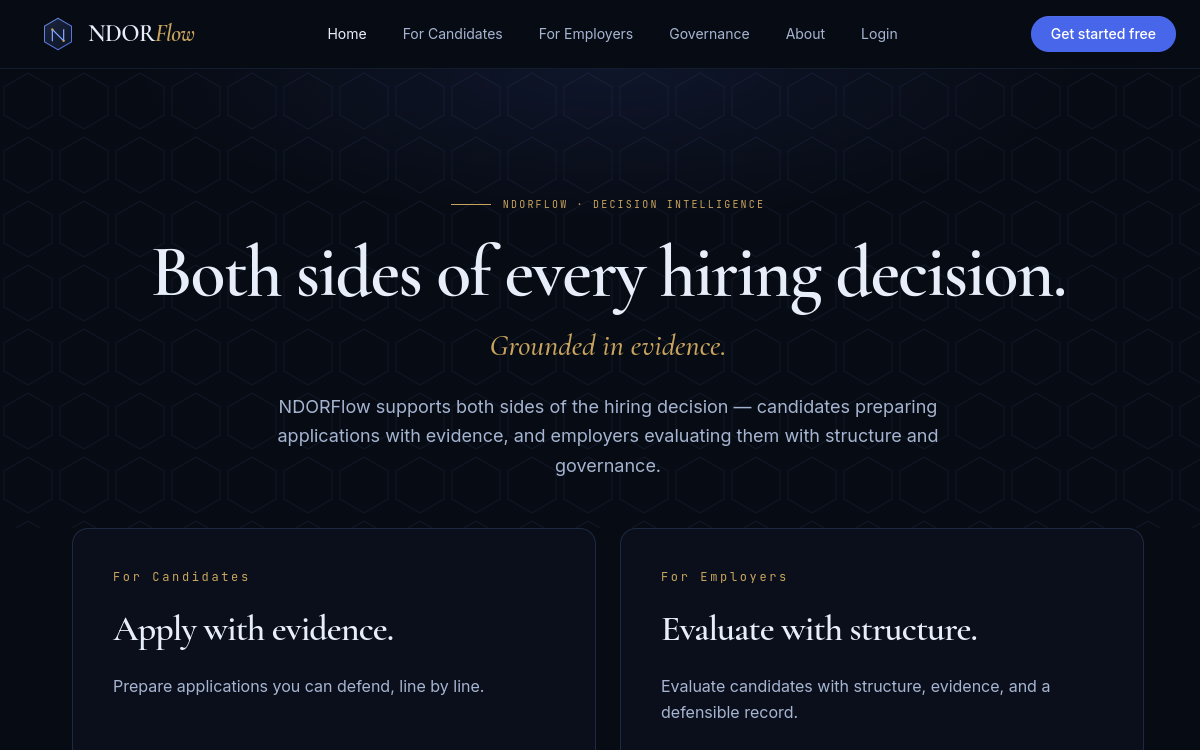
Recruitment remains an area where decisions must be explainable and justifiable, both for candidates and employers. NDORFlow addresses this exact issue by offering a decision intelligence platform designed to make every application and evaluation traceable and defensible. Developed by IAA Energy Resources Limited, a London-based company, the solution takes a clear stance: it automates nothing without your explicit consent and does not substitute for your judgment. Where many tools promise to send hundreds of applications in bulk or filter profiles in one click, NDORFlow focuses on rigor, evidence, and auditability. For a candidate, this means being able to defend every line of their application to a recruiter. For an employer, it means having a structured and exportable decision history. This dual approach makes it a niche tool, but well-targeted for those who value compliance and transparency in their hiring processes.
What is NDORFlow?
The essentials
NDORFlow is a decision intelligence platform applied to recruitment, accessible online and organized around two distinct audiences. The first is the candidate, for whom the tool offers the ability to build evidence-backed applications by mapping their experiences point by point against job requirements. The second is the employer, to whom the platform offers a structured evaluation framework, calibrated by role, and generating immutable decision dossiers. The tool deliberately positions itself downstream of existing systems: it does not replace a sourcing ATS, but integrates into the chain to make analysis and decision-making more reliable. The core promise lies in three words displayed by the publisher: audit-ready, evidence-led, and private by design. Payments are processed through Stripe and analytics, which is optional, through PostHog.
Key features
On the candidate side, NDORFlow deploys a multi-step journey. The user imports a source CV, then runs a relevance analysis called Analyse Fit, which measures job fit with a line-by-line mapping. This is followed by CV tailoring, cover letter generation, and the creation of Interview Intelligence Packs to prepare for interviews. The process concludes with the assembly of an immutable application pack, where each element is linked to a piece of evidence. On the employer side, the platform offers a Candidate Dossier intake that normalizes candidates from different channels into structured profiles. The evaluation relies on role-calibrated rubrics that preserve reasoning, strengths, gaps, and the weight of evidence. The evaluator alignment module displays differences in assessment instead of smoothing them out, preserving nuance. Finally, Governance Packs export signed (SHA), immutable decision dossiers in PDF and DOCX formats. A cross-cutting principle governs the whole system: every paid action requires explicit intent, with no automatic applications, tailoring, or decisions.
Use cases
Several concrete scenarios emerge. An active job seeker can use Analyse Fit to objectively understand their gaps against a job offer, then tailor their CV and prepare for interviews with solid arguments. An applicant applying for highly competitive roles gains the ability to defend every point of their file. On the employer side, an SME structuring its hiring process for the first time can rely on calibrated rubrics to standardize evaluations across recruiters. An HR team subject to compliance requirements finds in Governance Packs a way to document their decisions and respond to an audit. Finally, organizations wanting to reduce bias and track disagreements between evaluators have a suitable framework, whereas other tools tend to mask these discrepancies.
Advantages
The main benefit of NDORFlow lies in traceability. For the candidate, every application becomes a document that can be justified point by point, which strengthens credibility with the recruiter. For the employer, the value lies in the defensibility of decisions: in the event of a dispute or audit, the Governance Pack provides a clear and inviolable history. The anti-automation stance, which may seem counter-intuitive, protects the user from opaque decisions and preserves their control. The emphasis on privacy, data encryption, and GDPR compliance reassures organizations sensitive to data protection. Finally, the existence of free tiers on both sides allows users to test the real value of the tool before any financial commitment.
Pricing
NDORFlow offers two pricing structures. For candidates, the Base tier is free, no card required, with 2 Analyse Fit analyses per day. The Focus plan costs £39/month (or £324/year) and the Flow plan £69/month (or £660/year), with a Founding Member rate locked in for life. Credit packs are available: 20 credits for £10, 50 for £24, 120 for £54, with no expiration. For employers, the Starter tier is free, Professional is £149/month (£1,490/year), and Business is £399/month (£3,990/year), with an Enterprise offer on quote. The publisher applies strict caps with no overage charges.
Conclusion
NDORFlow is a serious response to a specific need: making recruitment more transparent and defensible, on both sides of the table. Its strength lies in its focus on evidence and auditability, rather than the promise of total automation. This is also its limitation: the tool remains niche, and its pricing on the employer side clearly targets structured organizations. For a demanding candidate or an HR team concerned with compliance, the free trial is well worth a look.