


Switching from ChatGPT to Claude, then to Gemini, has become common: each assistant has its strengths. But with every switch, context is lost. You rephrase the same instructions, copy and paste snippets of past conversations, and explain your project all over again. This daily friction wastes valuable time for advanced AI tool users. MemoryBase tackles this problem head-on by offering a unified memory shared across your different assistants. Concretely, the tool captures your exchanges on the main AI platforms, automatically groups them by project, and allows you to inject this context wherever you need it. Rather than a simple notepad or a bookmark manager, MemoryBase positions itself as a centralized memory hub designed for multi-AI workflows. In this presentation, we detail how it works, its named features, its real-world use cases, its pricing, and the profiles it is best suited for, to help you understand if this tool deserves a place in your daily stack.
What is MemoryBase?
The essentials
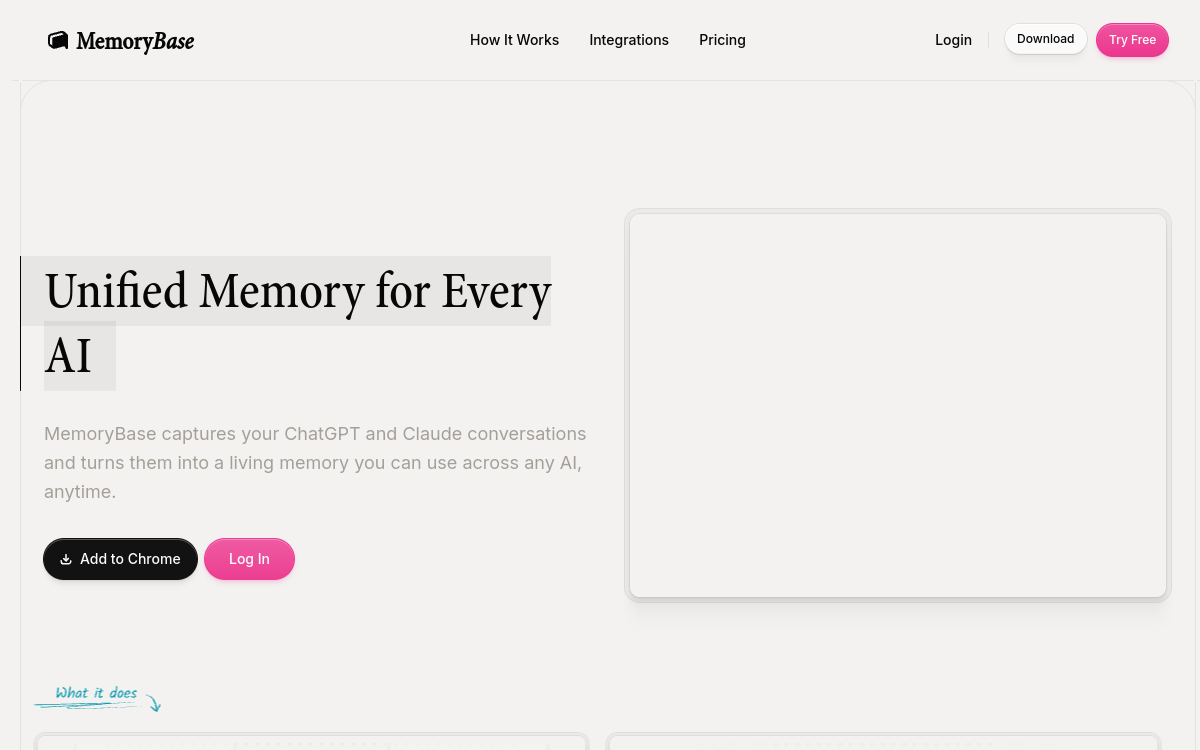
MemoryBase is a unified memory system for AI tools. Its role is to capture conversations from multiple assistants—currently ChatGPT, Claude, and Gemini—and make them usable in any other tool. The core idea is to create a living, persistent memory that is independent of the platform used. The product automatically organizes exchanges, offers timeline and project views, and introduces the concept of context packs to share a selection of information without transmitting everything. MemoryBase is not limited to consumer chatbots: it also serves as a memory hub for coding environments and autonomous agents. It is primarily aimed at users who juggle multiple AIs daily and want to maintain context continuity.
Key features
MemoryBase relies on several complementary features. Cross-LLM memory unifies conversations from ChatGPT, Claude, and Gemini into a common space, with Perplexity and Grok announced on the roadmap. Synchronization happens automatically in the background, without manual intervention. Exchanges are automatically grouped and organized, then viewable via a chronological timeline view or a project view. Context packs allow you to build targeted sets of information to share selectively with another tool, avoiding the need to transmit the entire history. On the development side, MemoryBase integrates with Claude Code and Codex to push context directly into the coding environment. For agents, the product connects to OpenClaw, Hermes, as well as via CLI and MCP, acting as a memory hub for agents. Finally, security is based on end-to-end encryption and local data cleaning, two important guarantees when centralizing potentially sensitive conversations. The whole setup forms a transversal memory layer rather than an isolated tool.
Use cases
The use cases for MemoryBase are highly practical. A developer starting a session on Claude Code can reinject the context of an architectural discussion held earlier on ChatGPT, without having to explain everything again. A consultant running a client project over several weeks can find the history grouped by project, regardless of the assistant used. A user wanting to test a new autonomous agent can provide it with a specific context pack rather than a mass of information. Professionals comparing answers from multiple models on the same topic maintain a shared, consistent memory. Finally, anyone regularly switching between Gemini and Claude to leverage their respective strengths gains continuity. In all cases, the common thread is the same: preserving context and avoiding repetition.
Advantages
The main benefit of MemoryBase is the time saved by preserving context between tools. Instead of re-explaining a project with every assistant change, the user reuses an already established memory. Automatic organization into projects and the timeline view reduce the cognitive load of management. Context packs provide fine-grained control over what is shared, which is useful for privacy and response relevance. Code and agent integrations turn this memory into a real lever for technical productivity. End-to-end encryption offers a reassuring framework for centralizing data. Overall, MemoryBase streamlines multi-AI workflows and limits information loss.
Pricing
MemoryBase offers simple and clear pricing. The free plan, at 0 dollars forever, allows you to connect ChatGPT and Claude, access six months of history, timeline and project views, and automatic synchronization. The Pro plan, at 9 dollars per month billed annually (or 108 dollars per year), adds unlimited history, unlimited context packs, integrations with AI agents like OpenClaw, and priority support. New accounts benefit from a 7-day Pro trial with no credit card required. Note that if you downgrade to the free plan, your memory is kept, but Pro features become inaccessible until you upgrade again.
Conclusion
MemoryBase addresses a very real pain point for AI users: the fragmentation of memory between assistants. Its value proposition is clear and its execution is consistent, featuring cross-LLM memory, reusable context packs, and integrations with coding tools and agents. Its relative youth brings a few caveats, such as the current absence of Perplexity and Grok, and an integration catalog that still needs expanding. The free plan is enough to evaluate the tool, and the Pro plan at 9 dollars per month remains affordable for those who use it daily. For a multi-AI power user or a developer, MemoryBase is definitely worth a try.