


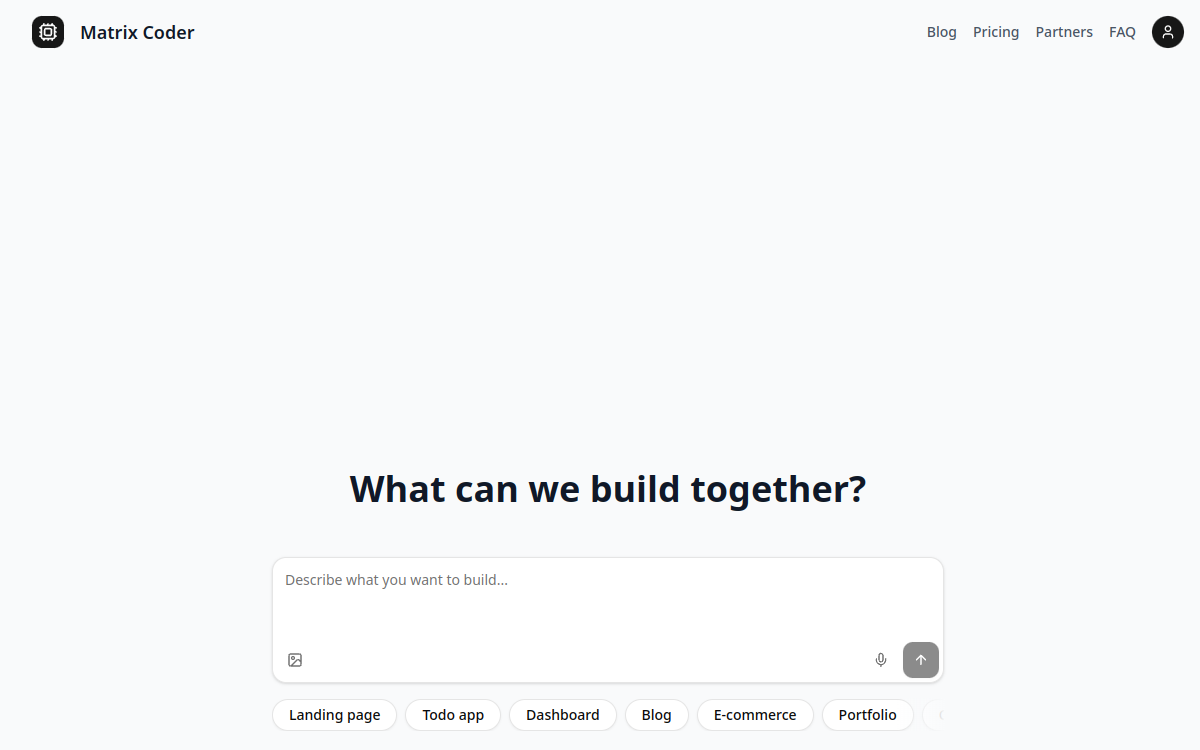
Vibe coding, the approach of describing what you want to build in natural language and letting AI generate the code, is gaining ground among developers and creators without a technical background alike. Matrix Coder fits perfectly into this movement. The platform offers to generate web applications from simple text prompts, leveraging v0 SDK technology. The idea is appealing: rather than configuring an environment, installing dependencies, and writing each component by hand, you chat with the AI and refine the result through your exchanges. Whether you want to quickly set up a landing page, a dashboard, or a product prototype, Matrix Coder aims to shorten the path from idea to functional application. In this overview, we detail what the tool actually does, its features, its concrete use cases, its advantages, its unique pricing model, and our conclusion on its positioning.
What is Matrix Coder?
The essentials
Matrix Coder is an artificial intelligence web application generator. Concretely, you enter a text description of what you want to build, and the platform produces the corresponding code, mainly in the form of React components and user interfaces. The engine is powered by the v0 SDK, a recognized technology for UI generation. Interaction takes place via a chat system: you formulate a request, observe the result, and then ask for adjustments until you get what suits you. The platform is published by Santa Fe Capital Management LLC, based in California. It positions itself as a vibe coding solution accessible both to developers looking to save time and to non-technical profiles wishing to bring a web idea to life.
Key features
The core feature of Matrix Coder is text-to-code conversion. From a prompt, the tool generates React components and the associated interface. The workflow is based on a conversational chat: each exchange allows you to refine, correct, or enrich the result, which aligns well with the reality of AI-assisted development where multiple iterations are the norm. The tokens used to pay for generation can be used across multiple conversations, providing flexibility to run several projects in parallel. Generated content remains private unless you choose to share it. The publisher also specifies that the code can be deployed to production, and even suggests asking the AI for a step-by-step deployment guide. Finally, a free token mechanism linked to the affiliate program allows you to earn additional credits through purchases made by partners. The tool remains honest about its limitations: the AI can make mistakes and require repeated adjustments.
Use cases
Matrix Coder highlights a clear list of use cases. These include creating landing pages to present a product or service, dashboards to visualize data, blogs, task management applications, e-commerce sites, portfolios, chat applications, and even calculators. For an indie hacker, it is a quick way to test a product idea without investing days of development. For a freelancer, it allows delivering a functional mockup to a client in a short time. Non-technical profiles see it as an entry point to bring a web project to life without mastering React. In all cases, the conversational approach is particularly suited to the prototyping and exploration phases, where the goal is to iterate quickly.
Advantages
The first benefit is speed: going from a description to a functional interface in a few exchanges saves a considerable amount of time during the scoping and prototyping phases. The second advantage is the business model. Where many competitors impose a monthly subscription, Matrix Coder sells one-time payment token packs that never expire. You pay once, you consume at your own pace, without recurring commitment or waste if you don’t use the tool every month. Since the generated code can be used commercially after review, the tool can be integrated into a real production pipeline. Finally, relying on the v0 SDK provides a solid technical foundation for interface generation, which is reassuring regarding the quality of the starting point.
Pricing
Matrix Coder does not offer a free plan or subscription, but rather three one-time payment token packs. The Starter Pack at $10 offers 1 million tokens, designed for quick prototypes and short sessions. The Growth Pack at $25, presented as the most popular, provides 5 million tokens for more intensive iterations. The Scale Pack at $65 offers 10 million tokens for sustained generation workflows. In all cases, access is immediate, tokens can be used across multiple chats, and they never expire. Note: no refunds are granted, as the publisher cites the consumption of GPU resources.
Conclusion
Matrix Coder meets a specific need: quickly generating React web applications without a monthly commitment. Its chat-based approach and its engine based on the v0 SDK are well-suited for prototyping phases and profiles that want to materialize an idea without coding everything by hand. The one-time payment, non-expiring token model is a strong argument against competing subscriptions. The assumed limitations remain: no free plan, no refunds, and an AI that requires iterations. For a pragmatic developer or indie hacker, it is worth a try, provided you always review the code before production.