


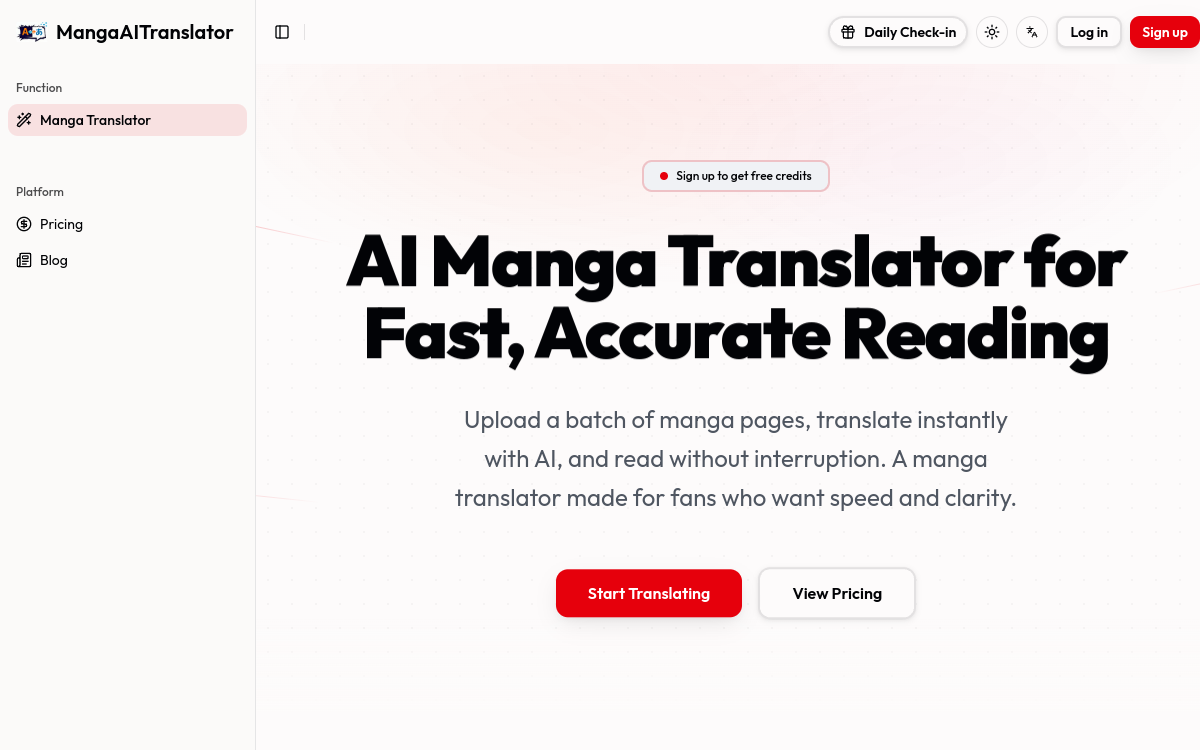
MangaAITranslator automates manga translation & localization from images. The tool detects text in speech bubbles (OCR), translates it and reinserts a readable version while respecting layout as much as possible. Useful for quickly understanding a chapter, preparing a scanlation draft or accelerating localization, without mastering Japanese. A significant time-saver for a no-code image-oriented workflow.
What is MangaAITranslator?
The essentials
MangaAITranslator is an image-oriented manga translation tool. It combines several components: text recognition (OCR) to extract content from speech bubbles, automatic translation to convert text into the target language, and reinsertion to make the page readable after processing.The tool is designed for manga constraints: vertical text, multiple bubbles, varied fonts and graphic elements close to characters. The goal is to reduce manual manipulation, which is often lengthy when using separate tools.MangaAITranslator targets curious readers, localization teams and creators who want to save time. It’s particularly suitable as a draft, before proofreading and stylistic adaptation to produce a coherent final version.
Key features
The central feature is importing manga page images. Once the page is loaded, OCR analyzes the surface, identifies text zones and extracts content, including when text is arranged in bubbles or vertical columns.Next, the tool automatically translates the text. Depending on configuration, it can offer multiple output languages and handle short segments typical of dialogue. Reinsertion is a key point: MangaAITranslator attempts to replace translation in bubbles while maintaining good readability, limiting overflow and respecting layout balance.To save time, batch processing may be available, useful for entire chapters. Finally, export allows you to retrieve translated pages or text content for proofreading, correction or typographic adaptation in an external tool.
Use cases
For a reader, the most direct use is quick understanding of an untranslated manga. In just minutes, you can get a readable version that conveys the overall sense of dialogue.For scanlation or fansub teams, the tool serves as a working base: it generates a draft that accelerates initial translation, then human proofreading focuses on nuances, tone and cultural references. Localization studios can also use it to process volume, especially in the pre-translation phase.Finally, creators can use it to adapt graphic content into multiple languages, prepare localized storyboards or quickly verify text variations before final layout. In all cases, the tool is most efficient when images are clear and well-contrasted.
Advantages
The main benefit is saving time. Instead of chaining multiple tools, MangaAITranslator offers an integrated workflow: extraction, translation and reinsertion. This reduces friction and allows processing more pages.The second benefit is accessibility. Even without technical skills, you can get an exploitable result, democratizing understanding and pre-localization of visual content.Finally, the tool improves brief and proofreading quality. By providing a structured base, it becomes easier to identify ambiguous passages, correct onomatopoeia and adjust tone. Used as a draft, it lets humans focus on editing rather than manual extraction.
Pricing
MangaAITranslator typically works on a subscription model, with an entry point around $10 per month. A trial period may be offered to test OCR quality and translation relevance on a few pages.Cost often depends on processed volume, number of pages or translation credits, and sometimes advanced features like batch processing. For occasional use, the trial is enough to validate if the tool meets your needs. For heavy use, the subscription becomes worthwhile once it replaces several hours of manual manipulation.Before subscribing, it’s recommended to test with scans of varying quality to assess robustness on typical manga fonts and effects.
Conclusion
MangaAITranslator is an excellent niche tool for translating manga pages from images. By combining OCR, translation and reinsertion, it simplifies a usually complex workflow and provides significant time savings.Its best use is producing a first readable draft, then letting human proofreading refine style, onomatopoeia and references. For readers, creators and localization teams, it’s a practical solution to accelerate understanding and production, while maintaining editorial control over the final version.