


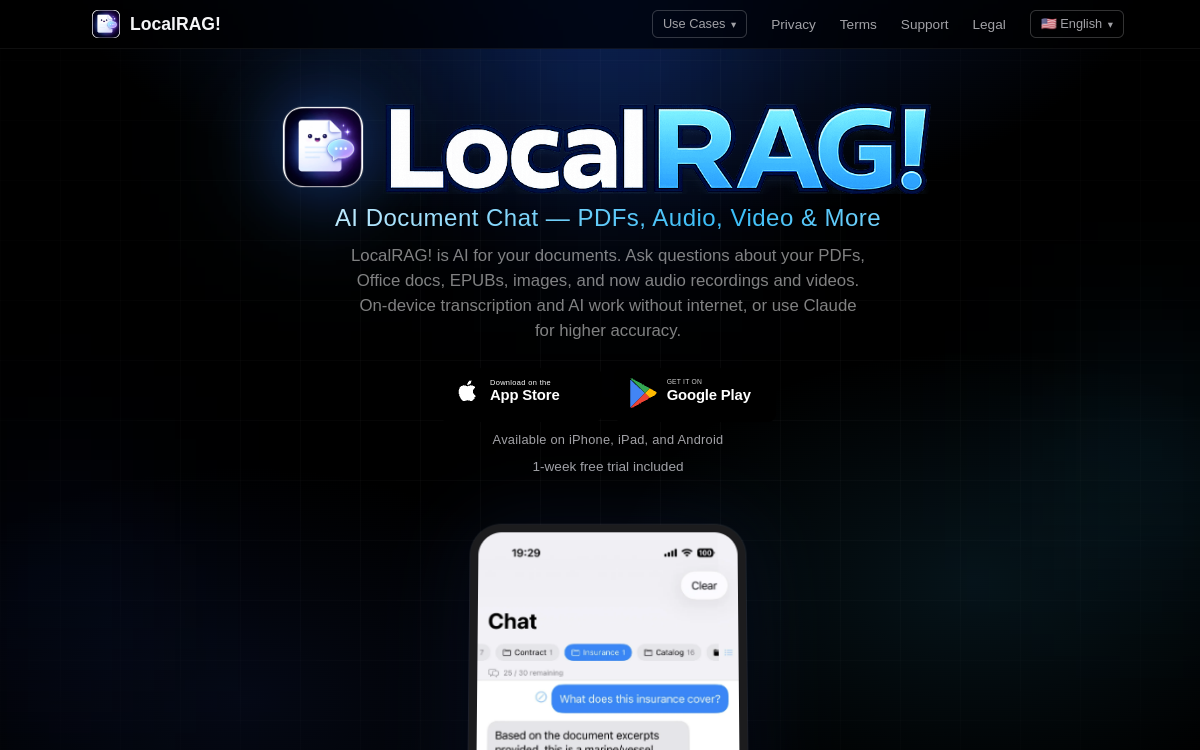
LocalRAG is a mobile application (iPhone, iPad, Android) that allows you to ask questions about your documents (PDF, Word, Excel, EPUB, images, 15 formats) using a local LLM (Qwen3 4B) fully embedded on the device. The user maintains total confidentiality: no data is sent to the cloud. For better quality, the app can switch to Claude API. Citations, PDF highlighting, and multilingual search are integrated.
What is LocalRAG?
The essentials
LocalRAG is a mobile application (iOS, iPadOS, and Android in beta) dedicated to document chat with local language model execution. The application supports 15 document formats, including PDF, EPUB, Word, Excel, PowerPoint, and images via OCR. The user adds their files to a collection and can ask questions in natural language. LocalRAG returns an answer with sourced citations and corresponding PDF highlighting. The product’s strength lies in its local Qwen3 4B LLM, which runs entirely on the device after an initial download. For better quality, a switch to Claude API is available.
Key features
LocalRAG integrates a complete document processing pipeline. Extraction and indexing happen 100% locally: BM25 for lexical search, E5 multilingual embedding model for semantic search. Questions are processed by Qwen3 4B locally or Claude (Opus, Sonnet, Haiku) in the cloud based on user choice. Answers include citations [1][2] that point to the exact page with highlighting. The application manages collection sorting and custom order, OCR for photos and scans, PDF table extraction respecting structure, and transparency on the search pipeline. Recent release notes mention inline citations, PDF highlight, and cross-language search.
Use cases
The primary use cases concern legal professionals who must quickly identify clauses, risks, and obligations in contracts. Researchers find valuable help summarizing academic papers and cross-referencing results. Students can dialogue with their textbooks and prepare exams efficiently. Consultants use LocalRAG to prepare client files without sending data to the cloud. Doctors can consult confidential protocols or publications. Finally, general users leverage OCR to transform photos of whiteboards or handwritten notes into indexable documents.
Advantages
The main benefit is total confidentiality when using local mode: no data leaves the device. The second benefit is offline availability: the application works without internet, which is valuable on the go or in constrained environments. The third benefit is search quality: BM25 plus E5 plus Qwen3 4B deliver relevant results with verifiable citations. The fourth benefit is flexibility: ability to switch to Claude for the most complex queries. Finally, OCR and support for 15 formats allow you to centralize your entire corpus in a single application.
Pricing
LocalRAG offers a free one-week trial, then a paid subscription to unlock permanent use. The application is available on the iOS App Store and Android Play Store (beta). The Qwen3 4B local LLM is included in the application, provided you download the required ~3 GB. Switching to Claude requires using your own OpenAI/Anthropic API key and paying the associated consumption. No hidden fees are applied once the subscription is purchased.
Conclusion
LocalRAG addresses a precise and growing need: enjoying an AI document assistant without compromising data confidentiality. Local execution, functional richness, and citation quality make it a reference for mobile professionals and those concerned with their digital sovereignty.