



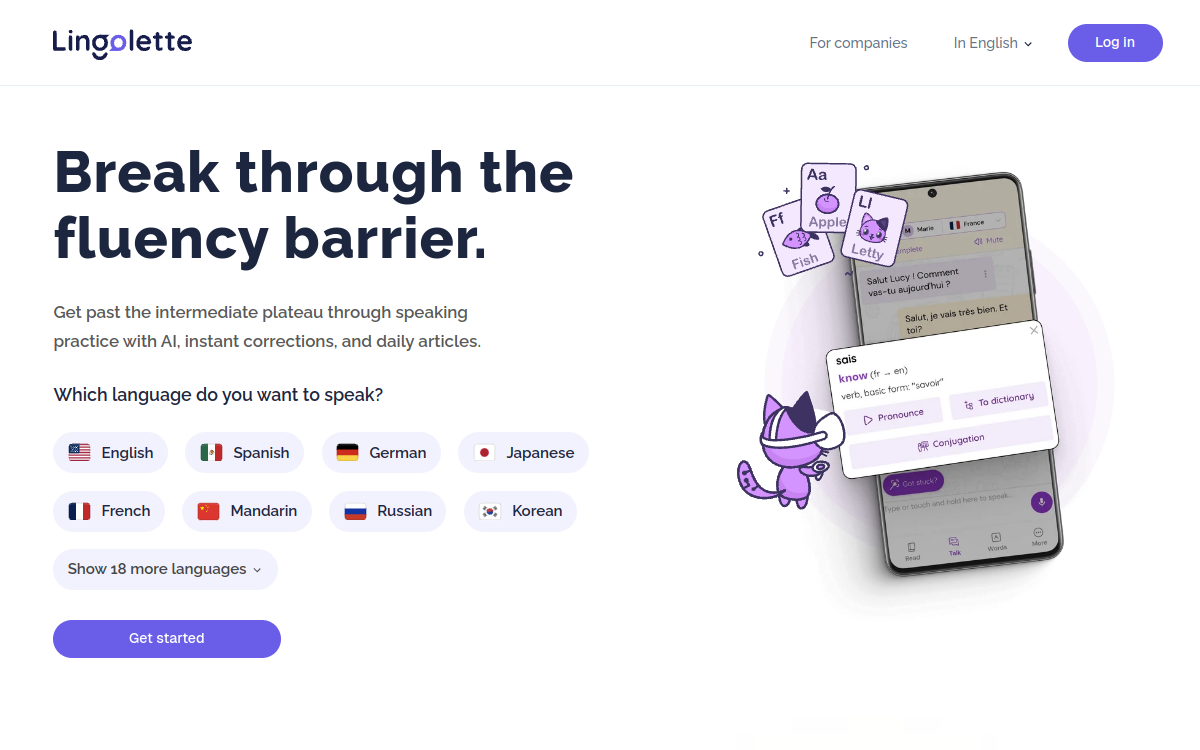
Learning a language is often easier at the beginning than in the middle. Once the basics are acquired, many learners find themselves stuck: they understand what they read or hear, but hesitate as soon as they need to speak. It is precisely this famous intermediate plateau that Lingolette seeks to help you overcome. The application relies on an AI-assisted conversational approach, where oral practice takes center stage. Instead of chaining together fill-in-the-blank exercises, it offers an AI tutor to talk to out loud, daily articles to read and comment on, and a vocabulary learning system directly in context. Available on mobile and browser, in over 26 languages, Lingolette is aimed at those who want to gain fluency without paying for a private tutor or adhering to a rigid schedule. In this overview, we detail how it works, its features, its use cases, and its limitations to help you judge if it matches your way of learning.
What is Lingolette?
The essentials
Lingolette presents itself as an AI-powered language teaching machine. Its stated goal is clear: to help learners move past the intermediate level through active practice. The tool relies on two complementary pillars. On one hand, an immersive voice chat allows you to converse orally with a virtual tutor on various topics, with the option to choose a dialect. On the other hand, daily articles offer tailored reading, followed by comprehension questions and exchanges with the AI about the content. Vocabulary learning happens as you read: clicking on a word reveals its definition and pronunciation. The difficulty adjusts to each individual’s level, making it a personalized training companion accessible from a phone or browser.
Key features
The heart of Lingolette is its immersive voice chat. The learner actually speaks with an AI tutor, chooses the dialect of interest, and addresses various conversation topics, recreating a situation close to a real exchange. During this practice, step-by-step corrections intervene to point out mistakes without abruptly interrupting the flow, allowing you to progress with confidence. The second major feature is the reading of daily articles: texts adapted to the user’s level, accompanied by comprehension questions, which can then be discussed with the AI to go deeper. Vocabulary learning in context completes the package: simply click on an unfamiliar word encountered in an article or conversation to get its meaning, pronunciation, and a dictionary entry. Finally, the experience is personalized: the difficulty, interests, and pace adapt to the user. The application covers over 26 languages, including English, Spanish, German, Japanese, French, Mandarin, Russian, and Korean, and is available on iOS, Android, and web browser.
Use cases
Lingolette naturally fits into the routine of an independent learner. The main use case is speaking practice: practicing conversation when you have no one to speak the target language with. The voice chat then serves as an exchange partner available at any time. A second use is vocabulary enrichment and consolidation through reading: daily articles offer a regular supply of real content, ideal for maintaining and expanding your lexicon. The tool is also suitable for micro-learning: its short sessions, of about fifteen minutes, can be slipped into a break or a commute. Finally, it helps learners who do not have the budget for private lessons or a language school to maintain regular, AI-structured practice. It is therefore a daily support tool rather than a complete academic program.
Advantages
The primary benefit of Lingolette lies in the emphasis placed on speaking, which is often neglected by traditional applications in favor of written exercises. By getting the learner to speak from the start, the tool directly targets the source of the intermediate block. Step-by-step corrections provide immediate feedback without being discouraging, helping to build confidence. Vocabulary learning in context is more durable than memorizing isolated lists, as words are encountered in real reading or conversation situations. The personalization of difficulty prevents both boredom and frustration. Finally, multiplatform availability and coverage of over 26 languages make practice flexible and continuous, without time or location constraints.
Pricing
Lingolette offers a free start to discover the application. Beyond that, the tool operates on a paid subscription model. However, the precise pricing tiers are not publicly displayed on the website: they appear after creating an account and logging in. Several user testimonials describe the service as affordable, especially compared to the cost of a language school or private lessons, but it is advisable to check the exact amounts directly in the app before committing. It is therefore recommended to use the trial version to evaluate the tool’s value before making any payment.
Conclusion
Lingolette meets a concrete and common need: breaking through the intermediate plateau by practicing speaking. Its combination of immersive voice chat, guided corrections, daily articles, and vocabulary in context forms a coherent package for gaining fluency. The main reservations concern the non-public pricing, the lack of a human tutor, and the targeting of intermediate rather than beginner levels. For an already independent learner who wants to practice regularly and unlock their speaking skills, it is an option worth testing via the free version.