



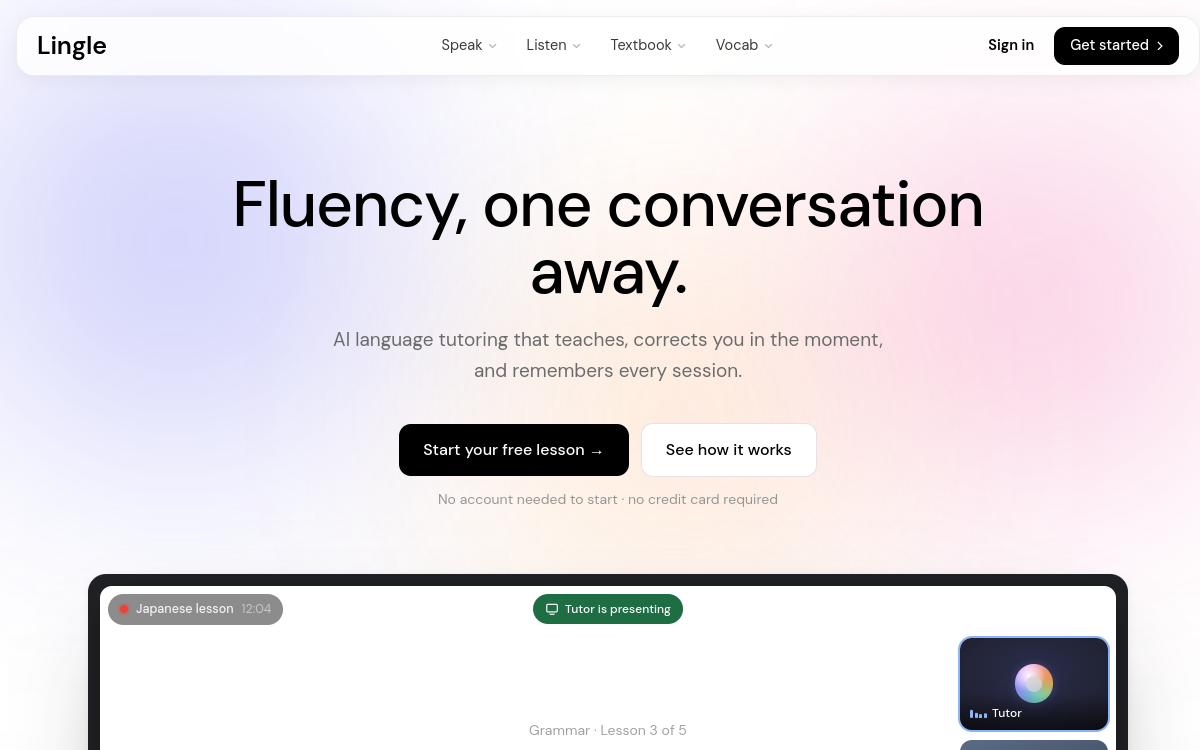
Learning a language requires consistency, speaking time, and immediate feedback on errors—three things that are hard to combine with traditional methods. Group classes leave little room for individual expression, study apps neglect speaking, and human tutors often impose restrictive schedules and discouraging rates. Lingle offers an alternative: an AI-powered language tutor, accessible on demand, that dialogues with you orally during structured sessions. The tool covers eight languages, from French to Japanese, and promises something simple: effective learning that listens, remembers, and adapts. Concretely, the AI leads the conversation, corrects your mistakes as you speak, and remembers your progress from one lesson to the next. This continuity, rare in automated learning tools, aims to reproduce the ongoing relationship you have with a real teacher. In this article, we detail what Lingle is, its features, use cases, strengths, and pricing model, to help you determine if this tool fits your learning style.
What is Lingle?
The essentials
Lingle is an online language tutoring service based on artificial intelligence. Rather than offering written exercises or flashcards, it relies on voice sessions of about thirty minutes during which the learner converses with an AI tutor. The product supports eight languages: Japanese, Korean, Chinese, Spanish, French, German, Italian, and Portuguese. Its unique feature is a persistent memory: the AI retains the user’s level, goals, and identified weaknesses from one lesson to the next, allowing it to adjust the content and difficulty. Developed by two self-funded founders, Lingle positions itself as an accessible solution, free of scheduling constraints, for practicing a language orally on a regular basis.
Key features
The heart of Lingle is the thirty-minute voice session, a structured format that encourages the learner to speak. During the exchange, the AI corrects grammar in real time and guides pronunciation and phrasing. Persistent memory is the second key feature: the tool remembers previous lessons to ensure pedagogical continuity and avoid starting from scratch each time. Progress tracking automatically identifies weak points and guides vocabulary reviews and grammar exercises accordingly. Each session concludes with notes and key takeaways, allowing you to review the material afterward. The lesson plan is customized according to the declared level and goals of the user. Finally, Lingle offers a free demo lesson, with no credit card required, to test the experience before making any commitment, as well as a direct feedback channel to the founders.
Use cases
Lingle is primarily aimed at people who want to improve their speaking fluency, the hardest aspect to work on alone. A busy professional can fit in a thirty-minute session whenever they want, without booking a slot with a tutor. A beginner starting an Asian language like Japanese or Korean benefits from personalized support and a reassuring environment to express themselves without fear of judgment. Intermediate learners use it to maintain and consolidate their skills through weakness tracking and targeted reviews. Travelers preparing for a trip can practice concrete conversational situations. Generally speaking, the tool is suitable for anyone looking for regular practice and immediate feedback, rather than a theoretical course or a simple memorization app.
Advantages
The primary benefit of Lingle is consistency: a short, on-demand format makes it easy to build a learning habit, a key factor in language success. Persistent memory brings a rare coherence to automated tools, avoiding the need to re-explain your level or goals at each session. Real-time corrections accelerate progress, as the learner rectifies mistakes the moment they make them. The lack of scheduling constraints and a price lower than that of a human tutor make learning more accessible. Finally, weakness tracking and session notes offer concrete visibility into progress, which maintains motivation over time.
Pricing
Lingle offers several entry points. A demo lesson is offered for free, with no credit card required, to discover the service. This is followed by a three-day free trial, then a subscription at $20 per month giving unlimited access. Users who start directly without a trial period benefit from a reduced rate of $16 per month. The subscription can be canceled at any time. Early beta adopters can also lock in a lifetime rate. This pricing structure remains simple and significantly more affordable than traditional human tutoring.
Conclusion
Lingle offers a pragmatic approach to language learning: short voice sessions, an AI tutor that remembers you, and immediate corrections to improve speaking skills. Its catalog of eight languages and its schedule-free model make it a good companion for regular practice. The product is still young and focused on conversation, but its free demo and accessible pricing allow you to evaluate it risk-free. For anyone looking primarily to gain speaking fluency, it is an option worth trying.