


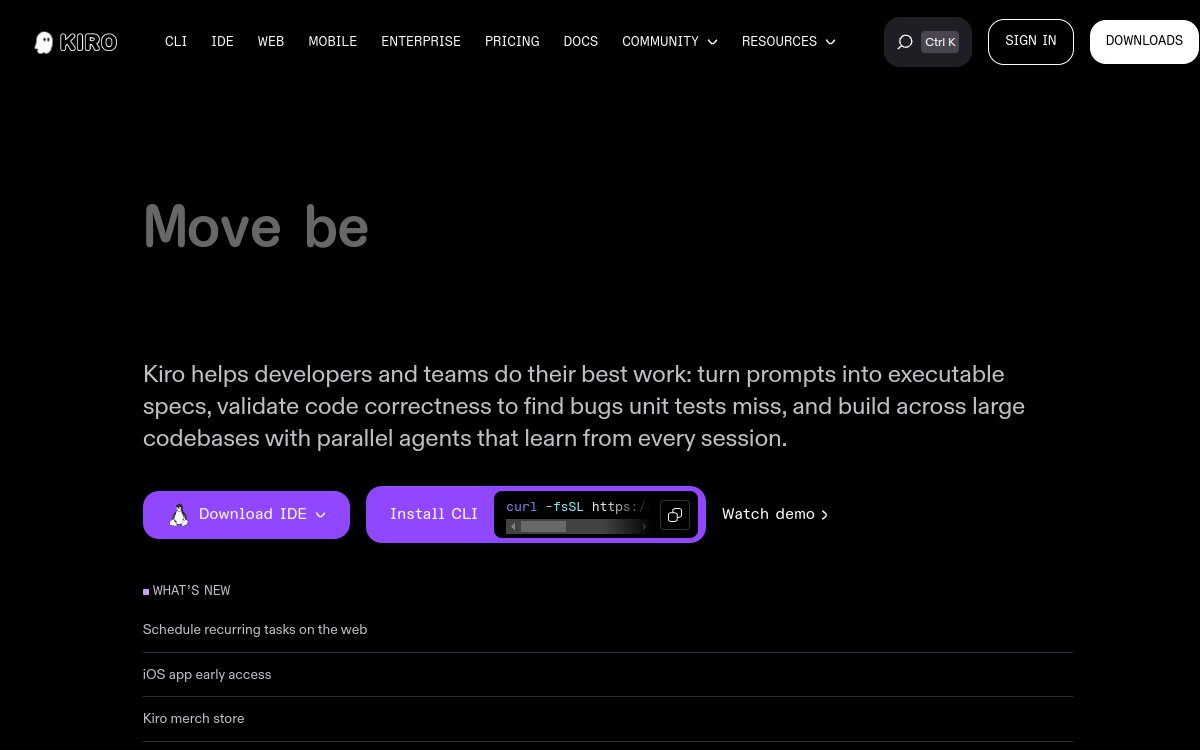
Kiro is an agentic IDE developed by Amazon Web Services, designed to guide developers from prototype to production through specification-driven development. Unlike traditional code assistants, Kiro structures each project around three markdown files (requirements.md, design.md, tasks.md). It integrates agentic hooks triggered by file events, MCP support to connect specialized tools, and advanced agentic chat. Compatible with Python, TypeScript, Go, Rust, Java, and more, Kiro targets developers who want a rigorous AI tool, beyond simple vibe coding.
What is Kiro?
The essentials
Kiro is an agentic integrated development environment (IDE) developed by AWS. Its central principle is based on specification-driven development: each project is structured around three essential markdown files — requirements.md for functional requirements, design.md for technical architecture, and tasks.md for tasks to be completed. This approach ensures consistency between the initial vision and the code produced, giving the AI agent a clear framework to act within. Kiro can run in standalone mode, like a traditional IDE, or in CLI mode to integrate into CI/CD pipelines.
Key features
Kiro has several distinctive features. Agentic hooks allow you to automatically trigger actions when file events occur: saving can trigger unit test generation, creating a file can trigger security analysis or documentation updates. Support for the MCP protocol (Model Context Protocol) allows you to connect Kiro to external specialized tools like databases or REST APIs. An advanced agentic chat accepts files, URLs, and documentation as context. Kiro also includes steering rules to customize AI behavior across the entire project. The whole system works with more than 20 languages including Python, TypeScript, Go, Rust, Java, Kotlin, PHP, Ruby, C#, SQL, and YAML.
Use cases
Kiro is particularly suited for complex full-stack development projects where traceability of design decisions is important. Distributed teams benefit from automatically generated documentation from specs, which serves as a shared repository. Freelance developers working on client projects appreciate the rigor imposed by the specification model, which facilitates stakeholder engagement. Kiro is also suitable for projects that evolve rapidly and require reliable automated tests generated on the fly by hooks.
Advantages
The main benefit of Kiro is eliminating the drift that affects vibe coding projects: the AI agent always acts within the framework defined by specifications, ensuring consistency and alignment with objectives. Productivity is increased by hooks that automate repetitive tasks with each code change. Code quality is enhanced by automatically triggered reviews and analyses. Finally, the lack of dependence on an AWS account makes Kiro accessible to all developers, regardless of their infrastructure.
Pricing
Kiro offers a free tier with 50 agentic requests per month, no credit card or AWS account required. The Pro plan is billed at $20/month and includes 225 vibe requests and 125 spec requests. Pro+ and Power plans ($200/month) are available for intensive usage. On first login, each user receives 500 bonus credits usable within 30 days. Additional requests are billed at $0.04 for vibe requests and $0.20 for spec requests, which are more complex.
Conclusion
Kiro represents a new generation of AI IDE that relies on rigor and structure rather than the fluidity of vibe coding. For developers looking to industrialize their use of AI in ambitious, well-documented projects, it’s one of the most mature tools available on the market today.