


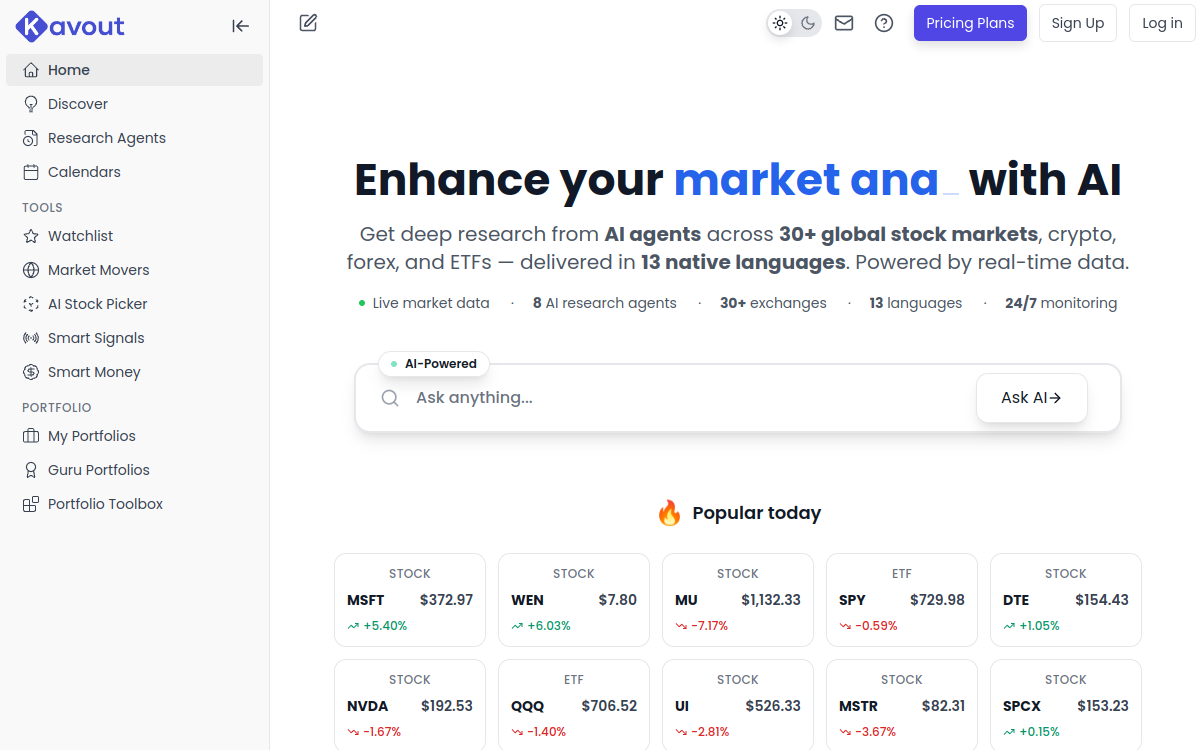
Choosing a stock or tracking a diversified portfolio requires digesting a mass of data that quickly exceeds the capacity of an individual investor. This is precisely the space where Kavout operates, a platform that applies artificial intelligence to financial research. Rather than offering a simple price table, the tool provides a series of specialized AI agents, each designed for a specific step in the decision-making process: discovering stocks, identifying signals, monitoring market movements, or structuring a portfolio. The stated ambition is to make analysis once reserved for professionals accessible to a wider audience, across more than 30 global markets and in 13 languages. In the sections that follow, we detail what Kavout actually is, what features it offers, its relevant use cases, its benefits and limitations, as well as its pricing. The goal is to give you a clear, factual overview to help you judge whether this platform aligns with your investment style and market monitoring needs.
What is Kavout?
The essentials
Kavout is an online platform of AI agents dedicated to investment research and analysis. It is aimed at investors who want to enhance their decision-making with automated tools capable of processing continuous market data. The service covers several asset classes: stocks, ETFs, cryptocurrencies, and major currency pairs, with real-time quotes on US equities and a slight delay on certain indices and futures contracts. Operation is based on a research credit system: each query to the agents consumes credits, allocated according to the chosen plan. Available in thirteen native languages and covering over thirty global markets, Kavout presents itself as an analysis assistant, and not as a broker or a regulated financial advisor.
Key features
The core of Kavout lies in its named agents and tools. InvestGPT acts as a conversational interface to query market data. The AI Stock Picker helps identify securities based on analysis criteria, while Smart Signals highlights indicators and signals likely to guide a decision. Smart Money focuses on the movements of major players, and Market Movers tracks the largest market variations in real time. For organization, the Watchlist allows users to monitor a selected set of securities, and the Stocklist lets them explore universes of stocks. Finally, the Portfolio Toolbox groups portfolio management functions, with a Factor Portfolio Builder, optimization tools, and Guru Portfolios available on higher plans. The entire system relies on financial metrics that are more or less advanced depending on the plan, and a signal database API is mentioned for more technical uses. This range thus covers the complete chain, from discovering an investment idea to tracking a structured portfolio.
Use cases
Kavout’s use cases are organized around a few concrete scenarios. An investor in the research phase can rely on the AI Stock Picker and InvestGPT to explore a universe of stocks and ask natural language questions about a company or sector. Those already tracking positions will use the Watchlist and Market Movers to stay informed of significant variations and receive real-time alerts. Fans of more advanced analysis will explore Smart Signals and Smart Money to detect trends or the behavior of major players. Finally, an investor looking to structure their allocation will turn to the Portfolio Toolbox to build, optimize, and compare portfolios. The entire system works across more than 30 markets, allowing coverage of US equities as well as European or Asian markets, in a diversification logic.
Advantages
The main benefit of Kavout is condensing market research that would otherwise require multiple sources and a lot of time into a single interface. Multi-asset and multi-market coverage avoids juggling separate tools for stocks, crypto, or forex. Real-time data on US equities provides useful responsiveness for tracking positions. Availability in thirteen languages expands access to non-English speaking investors, which remains rare on this type of platform. The free plan is another advantage: it allows users to test the agents’ logic without commitment before deciding on a subscription. For an individual, the value lies in adding an AI layer to their monitoring, which helps formulate hypotheses and filter information, while keeping ultimate control over the final decision.
Pricing
Kavout offers three subscription levels. The free plan, at $0/month, gives access to 10 monthly research credits, one AI agent, and limited access to markets and metrics. The Pro plan, at $16/month (billed $192 annually), increases the quota to 1,000 credits, unlocks seven AI agents, unlimited access to over 30 markets, and features like AI Stock Pickers, Smart Signals, and live Market Movers. The Premium plan, at $39/month (billed $468 annually), goes up to 3,000 credits and adds the Factor Portfolio Builder, portfolio optimization, and Guru Portfolios. Credits remain valid for 90 days, with no hidden fees, and the subscription can be canceled at any time.
Conclusion
Kavout is aimed at individual investors who want to gain efficiency in their market research using AI agents. Its broad coverage, real-time data, and free plan make it an accessible starting point to test the contribution of AI to a personal strategy. However, the credit system and sometimes brief documentation suggest managing expectations: this is an analysis and discovery tool, not a broker or a regulated advisor. For anyone looking to structure their monitoring and explore investment ideas across multiple markets, the free trial allows them to form an opinion risk-free before choosing a plan.