


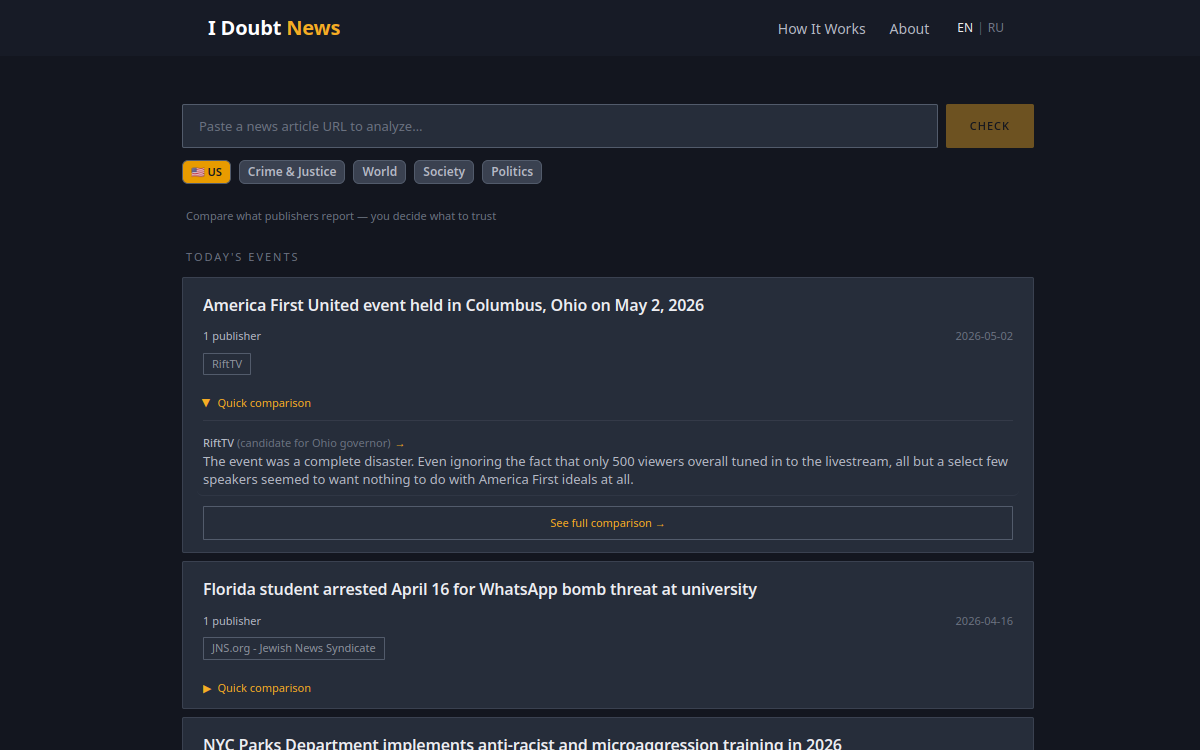
Faced with the proliferation of online content, distinguishing reliable information from a biased article has become a real daily challenge. iDoubt News positions itself as a response to this need: an artificial intelligence platform dedicated to press analysis. Its objective is simple to state but ambitious to achieve: to help everyone read the news with a more critical eye. Rather than settling for a true or false verdict, the tool dissects how an article is written, highlights the rhetorical devices used, and assigns a reliability score. This approach is part of a media literacy initiative, where the reader remains the main actor of their own judgment. iDoubt News does not claim to think for you: it provides concrete clues to feed your reflection. In this overview, we detail its operation, features, use cases, and limitations to help you understand what it can really bring to your news consumption.
What is iDoubt News?
The essentials
iDoubt News is a press analysis platform powered by artificial intelligence. Its role is to examine news articles to identify bias, manipulation techniques, and signals of misinformation. The tool covers several major themes, including politics, economics, regional, and international affairs. Concretely, its algorithms analyze the text of an article and identify specific processes that can influence the reader without them realizing it. Following this analysis, the article receives a reliability score designed to indicate its degree of neutrality or, conversely, bias. The tool does not replace human judgment: it accompanies it by making often discrete mechanisms visible. It is a monitoring and media education tool rather than a tribunal of truth.
Key features
The main feature of iDoubt News is the detection of manipulation techniques and bias. The tool identifies selective reporting, cherry-picked data, out-of-context quotes, biased framing, conspiracy theories, false equivalences, appeal to fear, emotional language, biased vocabulary, and appeals to authority. This analysis grid makes it possible to understand not only if an article is biased, but also how it is. Next comes the scoring system: each article receives a score on a scale from -1 to 1. A value of 0 corresponds to content deemed neutral and balanced, while the extremes signal a highly biased or manipulative text. Finally, the platform provides links to the original sources of the articles, inviting the reader to consult them directly and form their own opinion. This combination of detection, scoring, and referral to sources constitutes the core of the tool’s value proposition.
Use cases
iDoubt News naturally finds its place in several contexts. The first is the quick evaluation of an article before sharing it on social networks or citing it in a work: checking its reliability score avoids sharing misleading content. The second concerns learning: students and teachers can rely on the tool to concretely illustrate media manipulation techniques and develop critical thinking. The third use case involves information monitoring: a curious reader or a professional following the news can use it to spot biased angles in the coverage of the same subject by different media outlets. Finally, the tool is a useful starting point for anyone wishing to trace back to the primary sources of information rather than relying on a paraphrase. In all these cases, iDoubt News acts as a critical reading assistant.
Advantages
The main benefit of iDoubt News is making visible what is usually implicit. By precisely naming the techniques used, the tool transforms a vague intuition into a concrete observation, which strengthens the reader’s confidence in their own judgment. The reliability score also provides an immediate reference point, practical when short on time for an in-depth analysis. The systematic linking to original sources encourages a healthy habit: verifying before believing. On a pedagogical level, the tool is an excellent support for teaching media literacy in a lively and applied way. Finally, its free access makes it available to as many people as possible, without financial barriers, which fits well with its mission to combat misinformation. These assets make it a relevant reading companion for anyone who wants to consume the news more consciously.
Pricing
iDoubt News operates on a freemium model that allows free access to article analysis. This free access is consistent with its mission of public service and media education. To date, the details of any paid offers are not clearly published: neither the tiers, the amounts, nor the currency are transparently communicated on public pages. Users interested in advanced features or professional use are therefore advised to contact the publisher directly to find out the exact conditions. For individual and occasional use, the free version is more than enough to discover the value of the tool and integrate the verification reflex into your reading routine.
Conclusion
iDoubt News addresses a major challenge of our time: the difficulty of distinguishing reliable information from manipulated content. By detecting specific techniques and assigning a reliability score, the tool offers real support for critical reading, without ever replacing the user’s judgment. Its limitations are real—unsubtle rating scale, lack of pricing transparency, absence of documented API—but they do not detract from its usefulness for personal or educational use. To develop critical thinking and get into the habit of tracing back to sources, iDoubt News is an accessible and free starting point. Professionals requiring exhaustive fact-checking, however, will need to supplement it with other, more comprehensive solutions.