



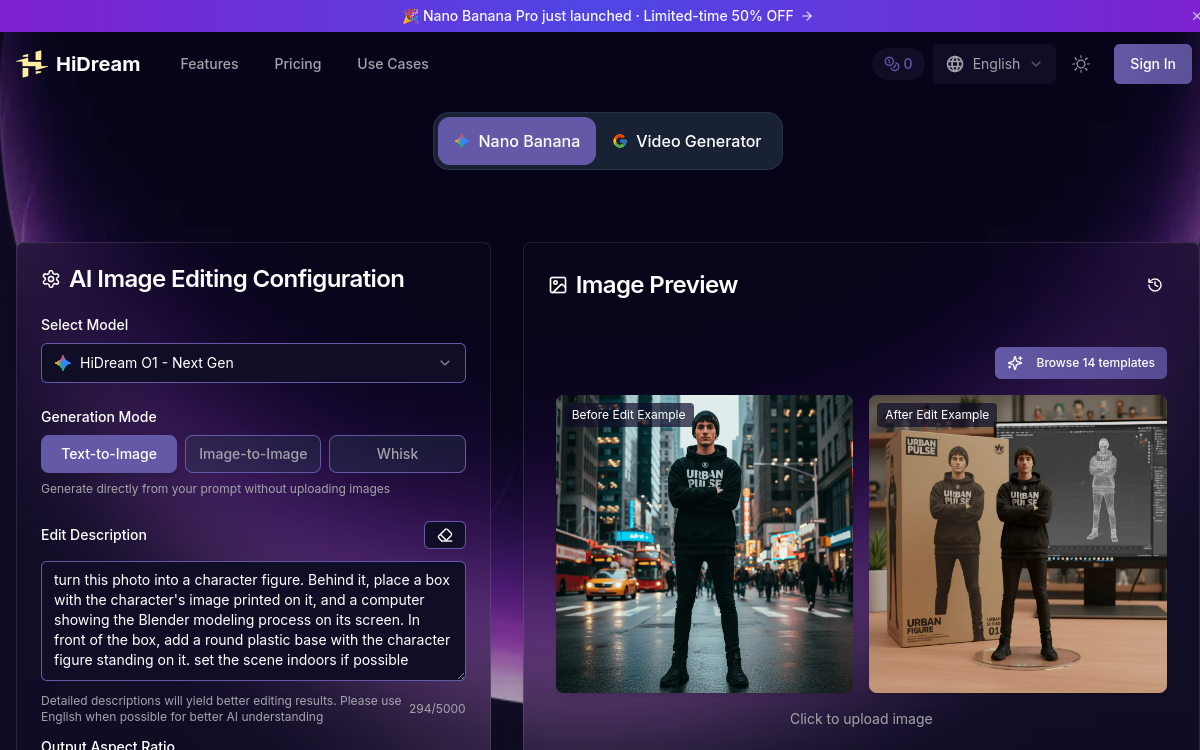
Image generation by artificial intelligence has become an area of intense innovation, and HiDream stands out with an uncommon choice: exposing a genuine open-source foundation model rather than a proprietary black box. Accessible via hidream.io, the platform allows you to produce visuals from simple text descriptions, in a wide variety of styles and resolutions. Behind the interface lies HiDream-I1, a model with 17 billion parameters published under the MIT license, making it one of the rare commercial generators built on freely accessible technology. This page concretely presents what HiDream offers, how it works, its use cases, its advantages and pricing, to help creators, designers and developers judge whether the tool fits their needs. Whether you’re looking for photorealistic rendering for a professional project or stylized illustrations for creative content, understanding the platform’s strengths and limitations allows you to use it effectively and avoid unpleasant surprises related to the credit system.
What is HiDream?
The essentials
HiDream is an online image generation platform powered by the HiDream-I1 model. The latter is an open-source text-to-image foundation model with 17 billion parameters, based on an architecture called Sparse Diffusion Transformer and distributed under the MIT license. In practice, the user enters a description in natural language and the model produces a corresponding image in seconds. HiDream-I1 comes in three variants: Fast, Dev and Full, which differ in the number of inference steps and thus in the trade-off between speed and final quality. A companion model, HiDream-E1, adds image editing capabilities via instruction. The hosted platform also offers quality tiers ranging from Basic to Ultra, the latter reaching a resolution of 4 megapixels.
Key features
HiDream emphasizes diversity and rendering quality. The platform handles multiple visual styles, including photorealistic, anime, cartoon and painting, covering both professional and creative uses. Available formats include landscape, portrait, square, widescreen and mobile, making it easy to adapt to different platforms like social media or print. The three model variants, Fast, Dev and Full, allow you to choose between fast generation and more polished rendering, with 16, 28 and 50 inference steps respectively. Quality tiers Basic, Pro, Max and Ultra adjust image refinement, with the Ultra tier reaching up to 4 megapixels for high detail level. Premium users benefit from watermark-free outputs and enhanced privacy for their creations. The model relies on good prompt understanding, interpreting creative intent even from simple descriptions. Because HiDream-I1 is open-source and compatible with the Hugging Face diffusers library, developers can also integrate or self-host the model, which clearly distinguishes HiDream from completely closed generators.
Use cases
HiDream’s uses are varied. Content creators and community managers use it to quickly produce stylized visuals for social media, blogs or newsletters, playing with portrait, square or mobile formats. Designers and illustrators use it to explore visual concepts, generate moodboards or prototype ideas in styles ranging from photorealistic to painting. Studios and professionals who need high-resolution visuals appreciate the Ultra tier at 4 megapixels for renderings that can be used in print or large format. Finally, developers and researchers find in HiDream-I1 an open model to experiment with, integrate into their own pipelines or compare to other diffusion models, thanks to its MIT license and compatibility with the open-source ecosystem.
Advantages
HiDream’s main strength lies in its open nature: relying on a foundation model published under the MIT license offers transparency, self-hosting capability and increased trust compared to closed solutions. The variety of styles and formats makes the platform versatile, capable of meeting both photorealistic and purely artistic needs. The Fast, Dev and Full variants system provides useful control over the balance between speed and quality, while the Ultra tier guarantees high resolution for demanding projects. Watermark removal and creation privacy on premium offers meet professional usage expectations. Overall, HiDream combines the flexibility of a hosted tool ready to use with the technical freedom of an open-source model, a compromise rarely offered in this segment.
Pricing
HiDream operates on a credit-based subscription model. The Basic plan is billed at $20 per month and includes approximately 2000 credits, allowing you to generate a significant volume of images depending on the tier chosen. The Premium plan goes to $40 per month with approximately 5000 credits and unlocks access to higher quality Max and Ultra tiers. Credit cost varies depending on the model variant used, with the finest renderings consuming more credits per image. Since HiDream-I1 is open-source, technical users can consider running it themselves, which changes the cost equation outside the hosted platform.
Conclusion
HiDream occupies a unique place among AI image generators by combining an accessible hosted platform and a genuinely open-source foundation model. Its style diversity, multiple formats and Ultra tier high resolution make it a versatile tool for creators, designers and studios, while the MIT license of the HiDream-I1 model appeals to developers and researchers. The credit-based operation and lack of unlimited free offer do require anticipating usage volume. For those who value technical transparency and image quality, HiDream clearly deserves a try.