


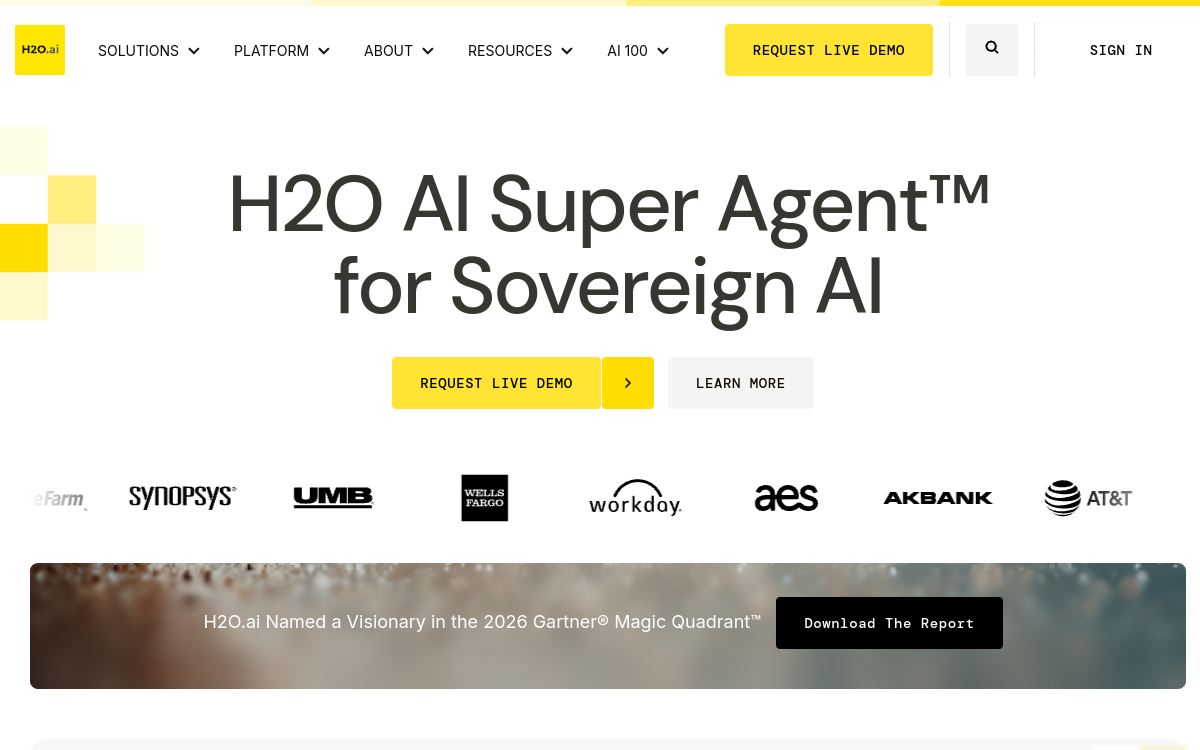
In the enterprise artificial intelligence landscape, few players offer both predictive machine learning and generative AI within a single platform. H2O.ai is an exception. Born from an open-source movement around the democratization of AI, the publisher established itself as a benchmark in AutoML before expanding its offering to GenAI and autonomous agents. Today, more than 20,000 organizations use its technologies, from bank fraud detection to call center automation. Its positioning is clear: to enable large organizations to industrialize AI without ever exposing their data, thanks to cloud, on-premise, or completely isolated network deployments. This article details what H2O.ai is, its flagship products, its concrete use cases, its advantages, its pricing logic, and what you need to know before adopting it.
What is H2O.ai?
The essentials
H2O.ai is an enterprise AI platform that brings together two worlds that were long separated: predictive AI, based on classic machine learning, and generative AI built on large language models. The company has its roots in open source, with H2O-3, a distributed machine learning framework for Python, R, and Spark. Over the years, it has complemented this foundation with commercial enterprise products and its own open models. The guiding idea is to cover the entire lifecycle of an AI project, from data preparation to training, deployment, and agent production, while guaranteeing data sovereignty. The platform explicitly targets regulated sectors where control over infrastructure is non-negotiable.
Key features
The H2O.ai ecosystem is structured around several products with complementary roles. H2O Driverless AI accelerates model development through automatic feature engineering and explainability, a crucial point for regulated uses. h2oGPTe brings enterprise GenAI with multi-model support, cost control, and application integrations with Google Drive, Slack, GitHub, AWS, Snowflake, SharePoint, or Microsoft Teams. H2O LLM Studio enables no-code training and fine-tuning of production-ready LLMs and SLMs. The H2O AI Super Agent steers the platform toward vertical agents, specialized by domain such as banking, telecom, or the public sector, with integrated human supervision. On the model side, H2O Danube3 provides lightweight, offline-usable small language models, while H2OVL Mississippi targets OCR and multimodal Document AI. The platform also supports third-party models like Meta Llama, Qwen, and DeepSeek.
Use cases
H2O.ai’s use cases are anchored in high-stakes sectors. In finance, the platform is used for fraud detection, KYC and client onboarding, loan automation, and regulatory reporting. A large banking institution significantly reduced its losses related to scams thanks to its detection models. In telecom, call center automation allowed an operator to sharply reduce costs. The public and federal sector leverages air-gapped and certified deployment options to process sensitive data. Finally, data science teams use AutoML and explainability to accelerate their modeling cycles while remaining auditable. Transaction reconciliation and fraud investigations are also among the recurring scenarios.
Advantages
The main benefit of H2O.ai lies in its ability to bring together predictive and generative AI without multiplying tools or vendors. This convergence simplifies governance and limits technological fragmentation. The second major asset is sovereignty: on-premise, cloud VPC, and air-gapped options, as well as FedRAMP-type certifications, guarantee that no data or model leaves the organization’s perimeter. The native explainability of Driverless AI meets audit and compliance requirements. Finally, the open-source foundation offers a free and credible entry point: the Danube3 and Mississippi models, along with the H2O-3 framework, allow for commitment-free experimentation before moving to enterprise products.
Pricing
H2O.ai follows a two-tier logic. On one hand, several components are open source and free: the H2O-3 framework, the small Danube3 models, and the multimodal H2OVL Mississippi models can be downloaded and used freely. On the other hand, enterprise products such as Driverless AI, h2oGPTe, and the H2O AI Super Agent are subject to commercial pricing, generally established on a quote basis depending on the scope, infrastructure, and level of support required. This approach allows teams to prototype for free with open source before investing in a managed and supported offer. To get precise pricing, you need to contact the publisher’s sales team.
Conclusion
H2O.ai is a mature and comprehensive platform, tailored for large organizations that want to deploy predictive and generative AI without compromising on data sovereignty. Its combination of explainable AutoML, multi-model GenAI, no-code fine-tuning, and vertical agents makes it a solid foundation for regulated sectors. Individuals and very small teams will find the offering oversized, but an IT department or data team facing compliance constraints will have a reference tool here, backed by a large user base and open-source roots.