



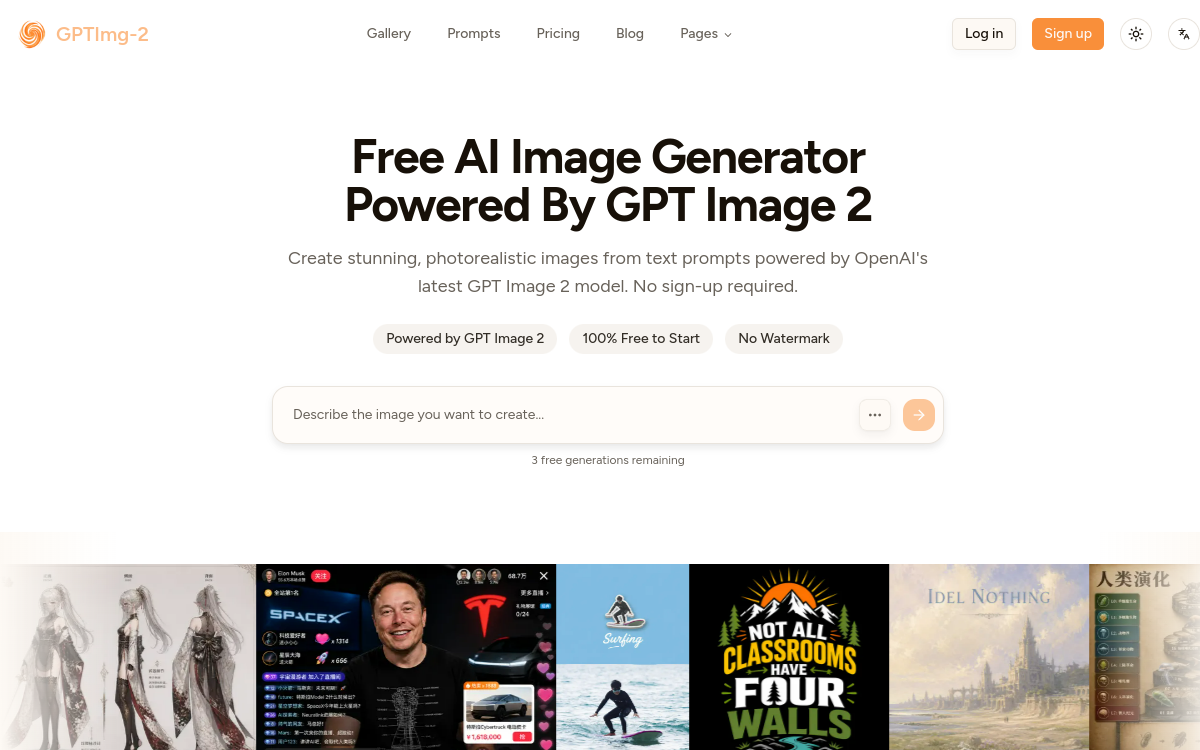
GPTImg-2 offers a dedicated interface to OpenAI’s GPT Image 2 model, one of the best image generators on the market in 2026. The platform produces photorealistic visuals, stylized illustrations, and especially integrated text with remarkable rendering, where most competing models fail. No signup required to get started, no watermark on outputs, full commercial rights, and access to several other complementary models like DALL-E 3 and Flux. It’s a simple, fast, and economical gateway to the capabilities of OpenAI’s latest model.
What is GPTImg-2?
The essentials
GPTImg-2 is a web app that lets you generate images via GPT Image 2, and secondarily via DALL-E 3 and Flux. You enter a prompt, choose the size, quality level, and style, then launch the generation. The result is downloadable as high-definition PNG. The platform offers a guest mode to test without an account and unlocks more features through free registration, like generation history, extra credits, and a higher number of variants per request. The positioning is clear: maximize accessibility of the best OpenAI image model without technical complexity.
Key features
Several features make up the GPTImg-2 experience. Model selection lets you choose GPT Image 2 by default, or switch to DALL-E 3 and Flux depending on your needs. Quality adjustment affects detail finesse and typographic rendering precision, particularly useful for posters or marketing banners. Aspect ratios cover 1:1, 4:3, 16:9, and 9:16, perfect for YouTube thumbnails, Instagram posts, or stories. Batch mode generates multiple variants in parallel to quickly compare several interpretations of a prompt. The monthly credit system is complemented by one-time packs to handle spikes. The platform emphasizes total watermark absence and the ability to use visuals commercially, making it an asset for freelancers and solo founders. No pushy integrated editor is offered: if you need to retouch or crop, export happens in Photoshop, Figma, or elsewhere. It’s a deliberate choice that simplifies the experience for standard generation uses.
Use cases
The first use case is creating thumbnails and social media banners. GPT Image 2’s typographic rendering precision produces readable visuals with integrated slogans. The second case is marketing production for online ads, landing pages, or emails. The third case is product photography for e-commerce, where you can generate stylized and photorealistic setups. The fourth case is editorial illustration for blogs, magazines, or newsletters. The fifth case is personal artistic creation, where model quality lets you rapidly explore visual concepts. For solo founders and creators, GPTImg-2 often serves as a quick multi-tool to deploy for ad-hoc visual production without entering a heavier suite.
Advantages
The primary benefit is quality. GPT Image 2 ranks among the best available models in 2026, and having a simple interface to exploit it is an obvious asset. The second benefit is accessibility. First tests are free without account creation, which reduces friction. The third benefit is transparency. No watermark, commercial rights clearly stated, readable price structure. The fourth benefit is productivity. For marketers producing multiple visuals daily, the tool becomes a daily companion. The fifth benefit is multi-model flexibility, allowing you to vary renderings based on subjects and creative sensibilities.
Pricing
GPTImg-2 offers several tiers: Free Basic with 10 credits per month and limited quality, Starter at 8 dollars per month with 100 credits and standard quality, Professional at 24 dollars per month with 500 credits and all quality levels, and Enterprise at 80 dollars per month for teams. A discount applies to annual subscriptions. Payments go through Stripe and 1% goes to Stripe Climate. Additional credits are available in one-time packs. The pricing grid is competitive and suited to individual and small team uses, with no checkout surprises.
Conclusion
GPTImg-2 is an excellent gateway to the power of GPT Image 2. The interface doesn’t reinvent the wheel but cleanly executes the promise: produce very high-quality images, without watermark, commercially usable, at a reasonable cost. For marketers and creators seeking speed and quality, the tool deserves a place in the daily toolbox, as a complement or alternative to Midjourney.