


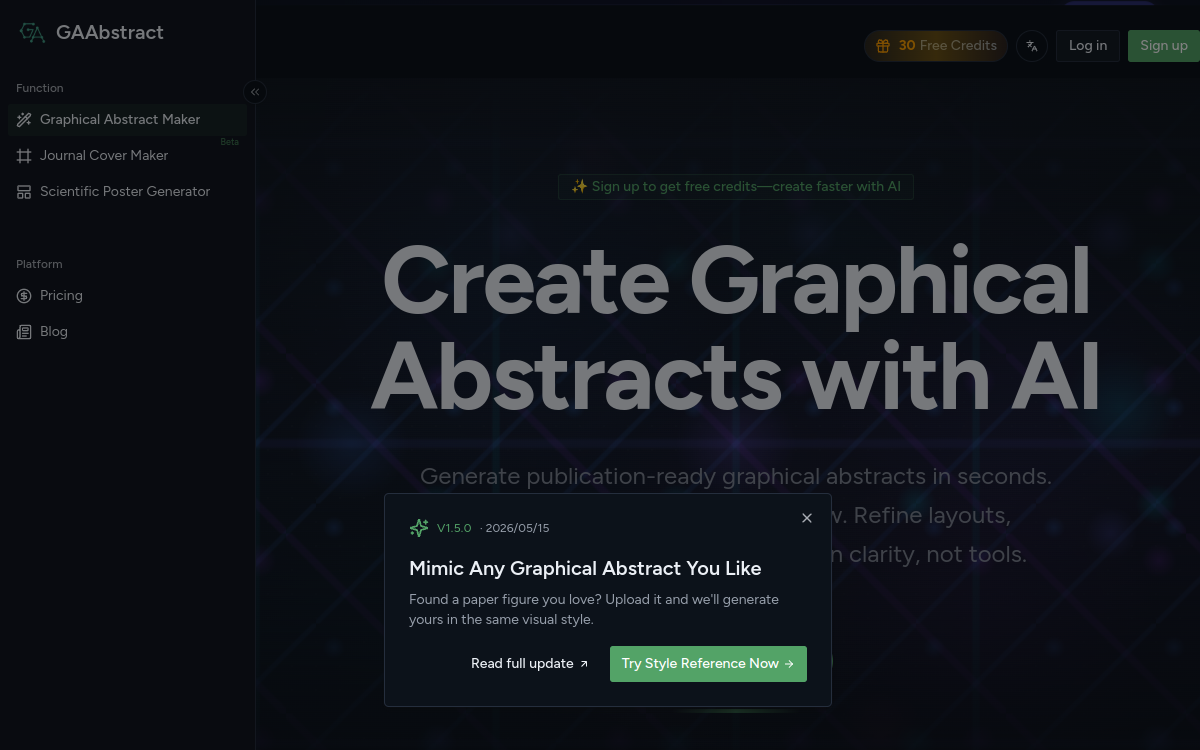
GAAbstract transforms a scientific summary into structured image generation, ready to serve as a graphical abstract. The tool analyzes content, extracts key concepts and proposes clear and coherent visualization. Ideal for researchers, PhD students and academic teams wishing to enhance their publications without advanced design skills or complex software.
What is GAAbstract?
The essentials
GAAbstract is an AI tool specialized in creating graphical abstracts. From a scientific summary or article, it extracts key elements — problem statement, method, results, conclusion — and proposes a synthetic visual representation.Unlike a generalist image generator, GAAbstract is designed for academic constraints. It structures information, prioritizes data and generates a visual suitable for scientific publication standards.The tool primarily targets researchers, PhD students and academic teams who want to save time while improving the visual quality of their submissions. It’s an intermediate solution between manual creation with design software and outsourcing to a graphic designer.
Key features
GAAbstract’s main feature is automatic analysis of scientific text. The AI identifies key concepts and organizes them into visual blocks: diagrams, arrows, icons and logical structures.The tool then generates a coherent graphical abstract, ready for integration into a submission. Users can adjust certain elements, modify labels or refine layout according to journal requirements.GAAbstract also facilitates uniformity within a laboratory or research team. By standardizing format, it strengthens graphic consistency across publications.Finally, ease of use allows researchers without advanced design skills to produce professional output quickly, reducing dependence on complex software or external providers.
Use cases
The first use case is preparing a scientific journal submission requiring a graphical abstract. GAAbstract allows rapid production of a structured version that meets expectations.It’s also useful for conference posters, presentations or educational materials. By transforming a dense summary into a visual diagram, it facilitates understanding at academic events.PhD students can use it to showcase their thesis work, while laboratories can standardize their materials to strengthen visual identity.Finally, the tool can be used as working base before finalization with design software, optimizing time spent on formatting.
Advantages
The main GAAbstract benefit is saving time. By automating visual structuring of a scientific summary, it significantly reduces the graphic design phase.The second advantage is improved clarity. A well-designed graphical abstract facilitates understanding of results and increases publication impact.Finally, the tool promotes consistency within a team. By using standardized format, laboratories can present research homogeneously and professionally.GAAbstract doesn’t completely replace a designer, but it’s an effective accelerator for producing visuals suited to academic requirements.
Pricing
GAAbstract operates on a subscription model, with entry-level offering around $12 per month. A trial period may be offered to test output quality.Price typically depends on number of projects generated or available advanced features. For a researcher or PhD student, cost is often offset by time saved and improved submission quality.Before subscribing, it’s recommended to test the tool on a representative summary to assess structure relevance and suitability to your target journal’s requirements.
Conclusion
GAAbstract is a specialized AI tool that addresses a specific academic need: quickly producing a clear and structured graphical abstract. By automating text analysis and visual generation, it facilitates research work enhancement.While it doesn’t replace a designer for highly customized projects, it’s an excellent starting point to accelerate submissions and improve publication visual impact. For researchers and academic teams, it’s an effective productivity and scientific communication lever.