


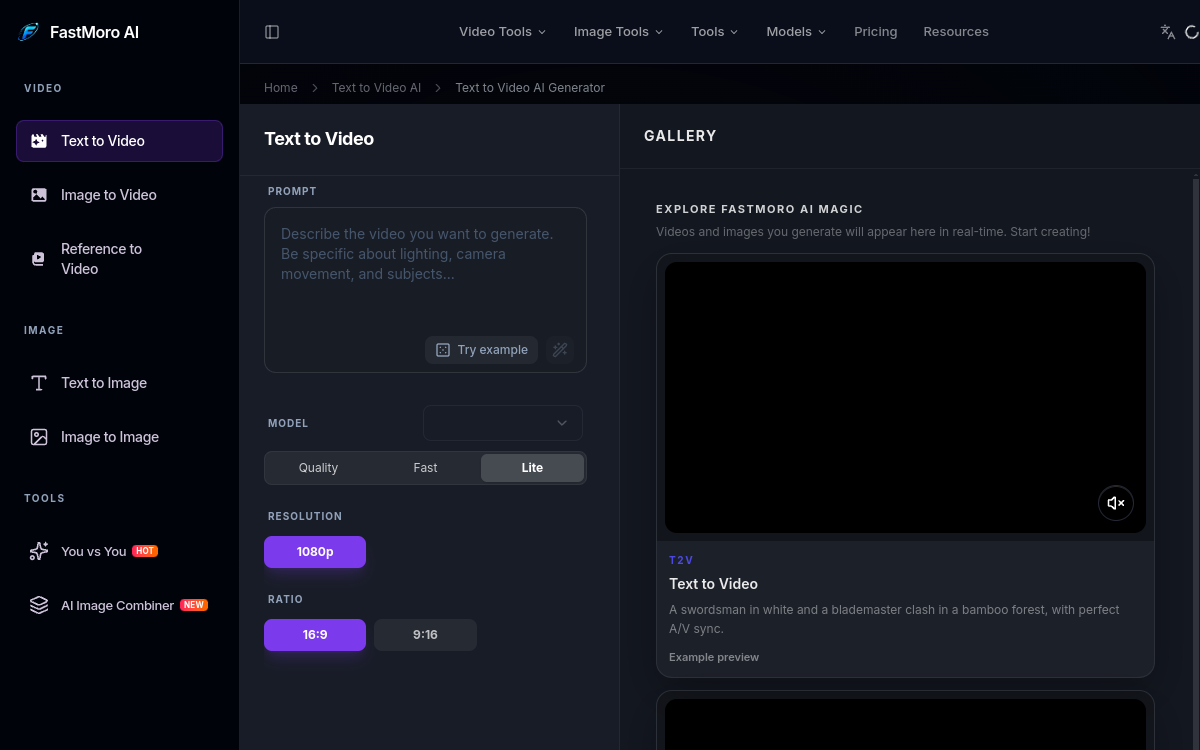
AI-powered video generation has accelerated dramatically, to the point where models change almost every quarter. For a creator, keeping up with this pace and choosing the right engine becomes a headache. Fast Moro AI offers a pragmatic solution: bring together multiple cutting-edge models under a single interface and enable generating a complete video, sound included, from plain text. The user describes their scene in natural language, picks a model, resolution, and format, then lets the servers produce the clip. The central argument is immediate synchronization of audio and image, which saves an editing step. This article reviews what the tool actually does, its options, concrete use cases, and its credit-based pricing model.
What is Fast Moro AI?
The essentials
Fast Moro AI is a text-to-video generator designed to produce professional-quality sequences without technical skill. Its logic rests on aggregation: rather than impose a single algorithm, the platform gives access to several reputable models, including Veo 3.1 and Gemini Omni from Google, Seedance 2.0 from ByteDance, Grok Imagine from xAI, and an in-house model, Happy Horse. The user makes a request in plain language, without advanced prompt engineering, and gets a video complete with synchronized sound. The target audience includes content creators, YouTubers, social media managers, marketers, and film students—anyone who needs to quickly produce convincing animated images.
Key features
The heart of Fast Moro AI is its library of interchangeable models, allowing you to tailor the output to your project: cinematic style for a trailer, anime for a stylized clip, photorealistic for a product demo. Simultaneous audio-visual generation ensures dialogue matches image right out of the box, no manual resyncing needed. On the settings side, the user chooses resolution—720p, 1080p, or 4K—duration from 4 to 10 seconds, and aspect ratio: 16:9 for YouTube, 9:16 for vertical formats, 1:1 for square. Realistic motion simulation aims to make movements believable, and an audio toggle lets you turn sound on or off. Rendering relies on GPU clusters in the cloud for speed. Each generation consumes a set number of credits, so you’ll want to budget your attempts. Overall, it’s a lightweight studio designed to iterate quickly on ideas rather than finalize complex editing.
Use cases
Fast Moro AI’s use cases center on rapid production. A YouTuber can generate an illustration shot or stylized intro without filming. A community manager adapts the same idea across multiple formats to tailor a post for Instagram, TikTok, and YouTube. A marketer tests several visual hooks before launching a campaign, comparing outputs from different models. A film student explores a directorial intent on a budget, validating an idea before actual filming. In all these scenarios, the tool serves as a creative accelerator: it doesn’t replace polished production, but it lets you quickly get a visual foundation from a simple written description.
Advantages
The main advantage of Fast Moro AI is concentrating multiple cutting-edge models in one place, avoiding the need for multiple subscriptions to compare outputs. Simultaneous generation of sound and image saves real time on the synchronization step. The variety of formats and resolutions covers most needs, from mobile vertical to 4K. Finally, the absence of complex prompt engineering makes the tool accessible to non-technical users. These benefits make it a useful companion for the ideation phase and social content production, where speed and variety matter more than frame-by-frame control.
Pricing
Fast Moro AI works on a credit system with four monthly plans: Basic at $6.90 for 100 credits, Pro at $13.90 for 250 credits and marked “Most Popular”, Max at $34.90 for 750 credits, and Pro Max at $59.90 for 1,500 credits, with roughly 30% savings on annual billing. Paid plans include permanent cloud storage, watermark removal, priority queue access, and commercial use rights, except the Basic plan which doesn’t include them. Free credits are also offered at sign-up to test the service. Each generation consumes a fixed number of credits, so you’ll want to anticipate spending based on your desired video volume.
Conclusion
Fast Moro AI’s appeal comes from two simple but well-executed ideas: bringing together the best video models of the moment and synchronizing sound from the start of generation. For producing social content, testing concepts, or exploring visual ideas, it’s a quick and versatile tool. It’s not aimed at fine editing or long-form production, where consistency remains a challenge for all AI generation, and its credit model requires a bit of discipline. But on its own terrain—quick creation from text—it does the job effectively.