



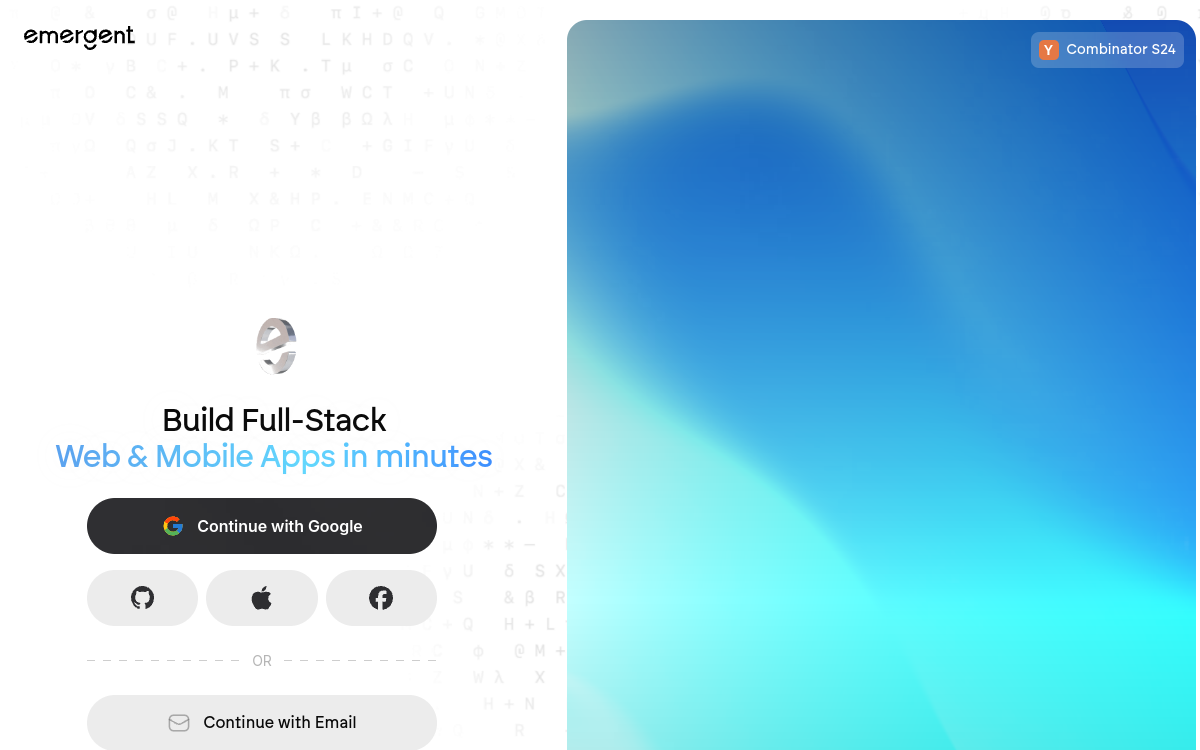
Emergent AI is a vibe coding platform that transforms simple instructions into ready-to-use full-stack applications. You describe your product in natural language, and AI agents plan the architecture, generate code, configure the database, manage integrations, and handle deployment. Designed for advanced no-code as well as developers, Emergent accelerates the creation of prototypes, internal tools, SaaS, or MVPs, while maintaining code access and infrastructure control.
What is Emergent AI?
The essentials
Emergent AI is an AI-assisted application development platform focused on creating full-stack applications from prompts. Concretely, you describe your project, its main features, and desired interface type, then the platform orchestrates a series of specialized AI agents. Some handle database modeling, others handle backend generation, others handle the interface or integrations with third-party services. The result is a structured application with usable code that can be synced with GitHub. Emergent doesn’t just produce static mockups: the tool aims for complete development of web or mobile applications, with business logic, APIs, and operational deployment, while allowing developers to take control at any time.
Key features
Among Emergent AI’s standout features is the vibe coding engine. The interface offers a natural language brief space where you describe the context, personas, use cases, and expected screens. Based on this information, the platform develops an application plan and generates the appropriate technical architecture. AI agents then produce code for the backend, frontend, and data layer. Generated code can be viewed, versioned, and connected to a GitHub repository, facilitating collaboration with developers. Emergent also handles deployment to managed cloud infrastructure, automating environment, database, and integration configuration. The platform additionally offers fine-grained iteration management: you can request changes, add features, or fix behaviors directly through new prompts without rebuilding everything. Finally, the credit-based model allows you to control AI usage based on project complexity and desired generations.
Use cases
Emergent AI targets several typical use cases. The first concerns MVP and product prototype creation, to quickly test an idea with users or investors. Non-technical founders can thus realize a vision without immediately hiring a complete development team. The platform is also well-suited for building internal tools: dashboards, HR portals, lightweight CRMs, or business applications that would be too costly to develop manually. Product teams and PMs can use it to quickly explore functional variants before finalizing requirements. Digital agencies and studios find an accelerator to deliver proof of concepts faster to their clients. Finally, for developers, Emergent can serve as an initial generation base, before being taken over and refined as a standard project in a typical development environment.
Advantages
Emergent AI’s benefits sit at the intersection of productivity and accessibility. On one hand, the platform greatly reduces the time needed to go from idea to working application, thanks to scaffolding automation, configuration, and much of the code generation. On the other hand, it opens full-stack development to less technical profiles, who can drive product construction through prompts rather than code. The ability to keep and export generated code reassures technical teams, who aren’t trapped in purely no-code logic. Integration with GitHub and deployment management also simplifies production launch and continuous application evolution, avoiding multiple tools and environments to maintain.
Pricing
On pricing, Emergent AI uses a freemium model based on generation credits. A free tier allows you to test the platform, create initial prototypes, and familiarize yourself with vibe coding principles. To go further, monthly paid plans add more credits, unlock advanced features, and offer better comfort for serious projects. Real cost depends on generation volume, application complexity, and number of iterations needed. For product teams or founders optimizing their time, the value delivered versus cost can remain very favorable, as long as you manage credit usage well and calibrate project scope entrusted to the platform.
Conclusion
Emergent AI is for teams that want to adopt an AI-first approach to application development without sacrificing the quality of a full-code stack. By combining vibe coding, coordinated AI agents, and code export, the platform positions itself as a powerful accelerator for MVPs, internal tools, and products in exploration phase. It does require some maturity in how you formulate prompts and manage credit-related costs. Used with good product methodology and minimum technical oversight, Emergent AI can become a strategic lever for reducing time-to-market, multiplying experiments, and faster industrializing ideas that find their audience.