



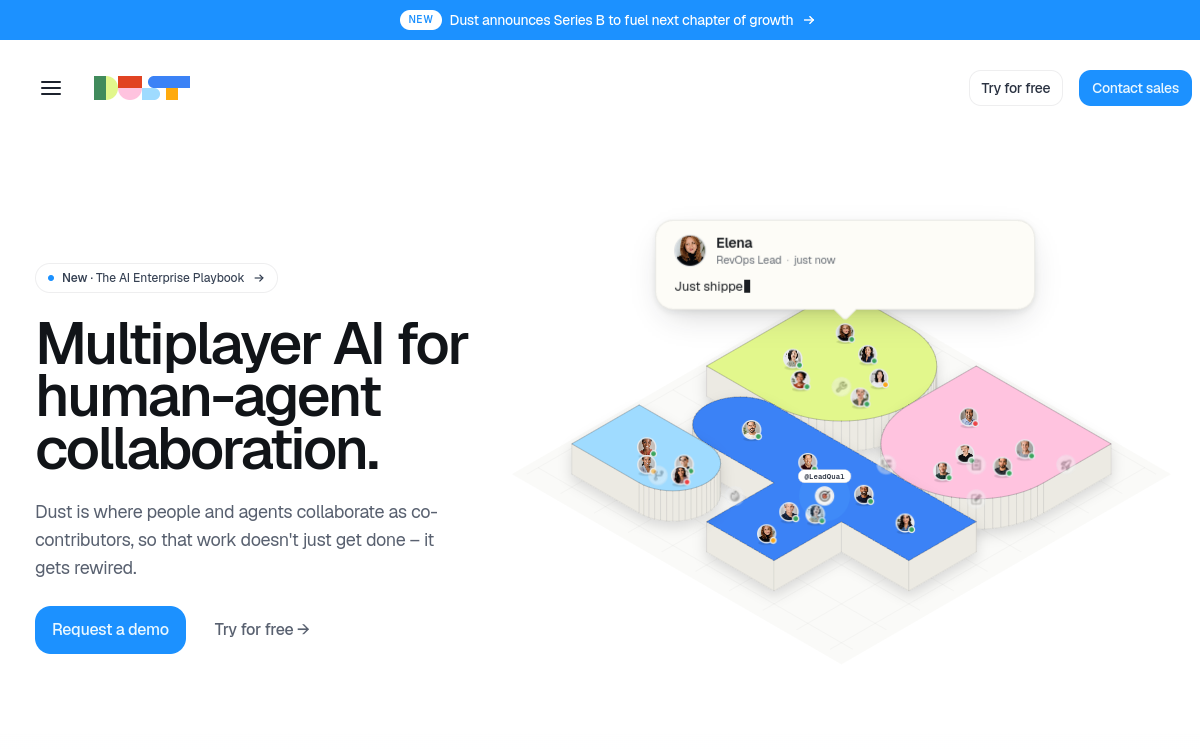
Dust is a collaborative AI workspace designed for professional teams. The platform enables creation of customized AI agents capable of interfacing with your business tools (Slack, Notion, Google Drive, Salesforce…) and understanding your organization’s unique context. Through a system of persistent memory, agent chaining, and automatic triggers, Dust transforms complex repetitive tasks into fully automated workflows. Compatible with the best models on the market (GPT, Claude, Gemini), the solution suits both small teams and large enterprises demanding security and compliance.
What is Dust?
The essentials
Dust is a collaborative workspace for AI agents. The platform enables teams to create customized agents that access company internal knowledge — documents, databases, business tools — and execute tasks autonomously. Each agent can be configured with a specific AI model, dedicated data sources, and precise permissions. Dust does not impose a single model: the platform is compatible with OpenAI GPT, Anthropic Claude, Google Gemini, Mistral, and others. Designed for support, HR, sales, or technical teams, Dust transforms knowledge dispersed throughout an organization into an asset actionable by intelligent agents.
Key features
Dust centers around several functional pillars. Agent creation is done via an intuitive interface with 50+ ready-made templates. Each agent can be published to the entire team or remain private. Data source connection is a strong point: Slack, Notion, Google Drive, Confluence, GitHub, Salesforce, HubSpot, Jira, Zendesk, SharePoint, OneDrive, and Microsoft Teams are natively supported. The MCP protocol extends possibilities further to third-party tools like Asana, Miro, or Fathom. Agents can chain together: a research agent collects information that a writer agent transforms into a report, with both operating in parallel. The persistent memory system allows each agent to remember preferences and context specific to each user. Automatic triggers allow scheduling executions in natural language or via webhooks. Observability tools complete the picture: success rates, token usage, and performance metrics per agent.
Use cases
Dust finds its place in many professional contexts. Support teams use it to create agents that automatically answer tickets by relying on internal documentation. Sales teams deploy agents connected to Salesforce to qualify leads or prepare client meetings. HR builds onboarding assistants that answer new employee questions by drawing from internal policies. Technical teams automate report generation, code review, or runbook synthesis. Content leaders use research agents to compile industry monitoring. In all cases, Dust’s value lies in its ability to connect agents to the organization’s true data sources.
Advantages
Dust’s main advantage is making AI truly operational in a real enterprise context. Rather than adapting workflows to a generic tool, Dust adapts to existing tools and processes. Neutrality toward AI models protects enterprises against technology lock-in: if a new model emerges, simply reconfigure agents. Security is integrated from design with SOC 2 Type II certification, GDPR and HIPAA compliance, and a clear principle: your data is never used to train external models. Centralized access management via Okta or Entra ID significantly simplifies administration in large organizations.
Pricing
Dust offers two plans. The Pro plan is billed at €29 per user per month with access to all core features: agent creation, integrations, persistent memory, and triggers. A 15-day free trial without credit card is available. The Enterprise plan is custom priced for organizations with 100+ members; it adds multi-workspace management, SSO/SCIM, dedicated support, and service level guarantees. Separate API pricing is available for programmatic uses.
Conclusion
Dust represents a coherent and ambitious vision of what AI can bring to professional teams. By combining flexible architecture, deep native integrations, and enterprise-grade security, the platform establishes itself as a serious alternative for organizations wanting to industrialize AI without compromise. The 15-day free trial allows getting a concrete idea before committing.