


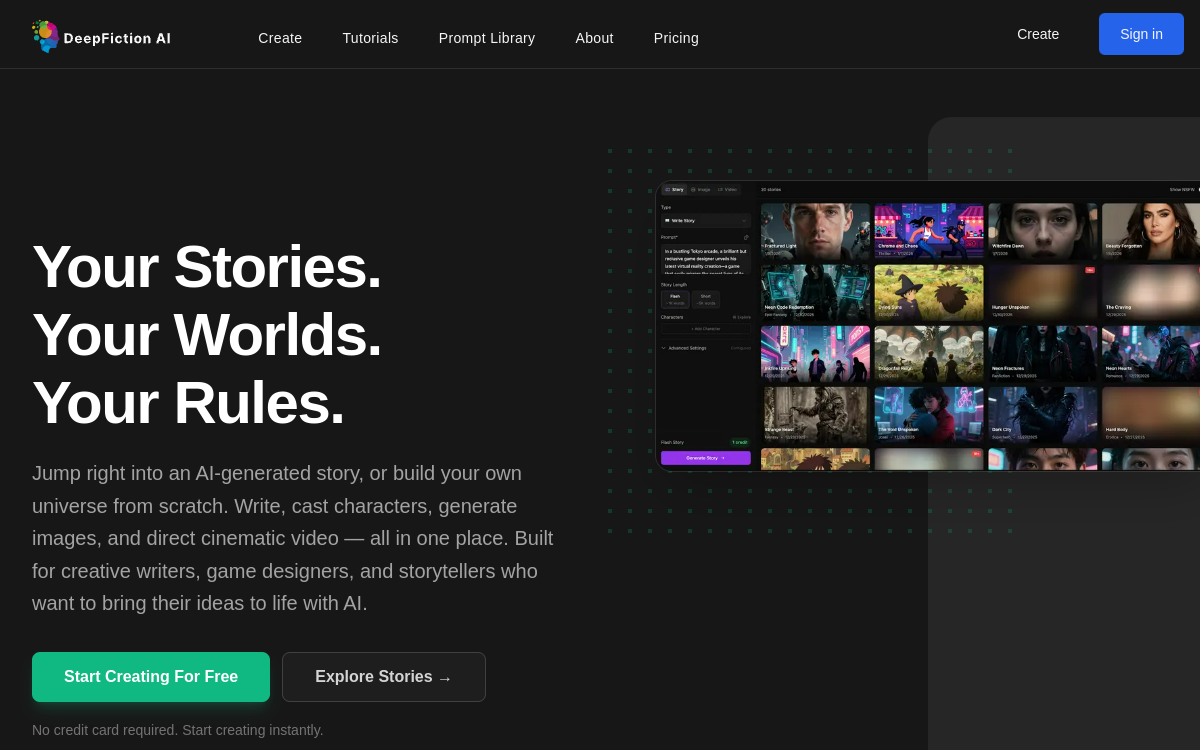
Bringing a story to life is no longer limited to words. Between drafting the narrative, illustrating scenes, and animating characters, creators often juggle multiple software tools that don’t communicate with each other. DeepFiction offers a different approach: bringing together writing, image generation, and cinematic video production in a single workspace. The stated promise is clear: write, populate characters, generate images, and direct video, all in one place. Designed for writers, game designers, and storytellers, the tool addresses both casual creators and established novelists or indie game developers. In this overview, we detail what DeepFiction actually does, its named features, concrete use cases, advantages, pricing, and key points to know before diving in. The goal is to give you a factual view of the platform so you can judge whether it fits your way of creating fictional universes.
What is DeepFiction?
The essentials
DeepFiction is an AI-powered creative platform dedicated to fiction and visual storytelling. It builds on three complementary pillars: story generation, image creation, and video production. On the writing side, the tool offers over 45 genres and 60 narrative challenges to guide creation. On the image side, it generates photorealistic visuals with precise text rendering in English and Chinese. On the video side, it produces cinematic clips up to 20 seconds long, accompanied by native audio including dialogue, ambient sounds, and music. A character system lets you create reusable figures across stories, ensuring continuity in a given narrative universe. The platform explicitly targets creative writers, game designers, and storytellers.
Key features
The heart of DeepFiction rests on four well-defined functional pillars. The first is story generation, with a large catalog of over 45 genres and 60 narrative challenges serving as starting points. The second is image creation, capable of producing photorealistic visuals with a notable feature: precise text rendering in English and Chinese, useful for book covers or typographic elements. The third pillar is video production: cinematic clips up to 20 seconds integrating native audio—that is, dialogue, ambient sounds, and music all generated with the video. The fourth is the character system, which allows reusing the same characters across multiple stories. Added to this are so-called professional controls: 17 narrative perspectives, shot sizes ranging from very wide angle to close-up, varied camera angles (high angle, dutch angle, over-the-shoulder), and camera movements like pan, tilt, tracking, crane, and follow shots. This range brings the tool close to true directorial control.
Use cases
DeepFiction’s uses revolve around narrative creation and bringing it to visual life. A novelist can write their story then illustrate key scenes and generate a book cover consistent with their universe. An indie game designer can quickly prototype a game’s atmosphere, characters, and intro sequences without mobilizing a full art team. An author in the promotion phase can produce short video clips to create a book trailer and feed their social media. Roleplaying and interactive fiction enthusiasts find in the reusable character system a way to extend a universe across multiple stories. More broadly, any creator wanting to quickly go from a written idea to a visual and video render will find in the platform an integrated workshop that avoids back-and-forth between multiple applications.
Advantages
DeepFiction’s main benefit is integration: writing, image, and video coexist in the same workflow, reducing friction and time spent exporting and re-importing files between different software. The reusable character system brings valuable visual and narrative consistency for anyone developing a universe over time. Camera and shot controls offer a level of artistic direction rarely available on mainstream tools, giving creators a true sense of control. Native audio integrated into videos avoids a separate sound post-production step. Finally, the free offer with daily credits lets you test all features before any commitment, lowering the barrier to entry for casual creators and curious professionals alike.
Pricing
DeepFiction offers a free account with daily credits to explore all features. Three monthly subscriptions structure the paid offering. The Starter tier, at $5 per month, targets exploration and occasional creation, with enough to produce dozens of stories and images. The Pro Creator tier, at $20 per month and positioned as the most popular, is aimed at serious projects like novels and ongoing work, with hundreds of creations. The Studio tier, at $75 per month, targets high-volume creation with thousands of creations, top performance, and priority access. One-off packs let you get additional capacity without a subscription, and a 20% discount applies in the first month.
Conclusion
DeepFiction holds a unique place in the AI creative tools landscape: rather than specializing in a single medium, it brings together writing, image, and video in service of fiction. This integration, combined with the reusable character system and camera controls, makes it a coherent workshop for writers, game designers, and storytellers who want to visually materialize their narratives. Short videos and credit quotas are the main limitations to keep in mind. With a free offer and tiers starting at $5 per month, the platform remains accessible for testing its potential before committing to a larger project.