


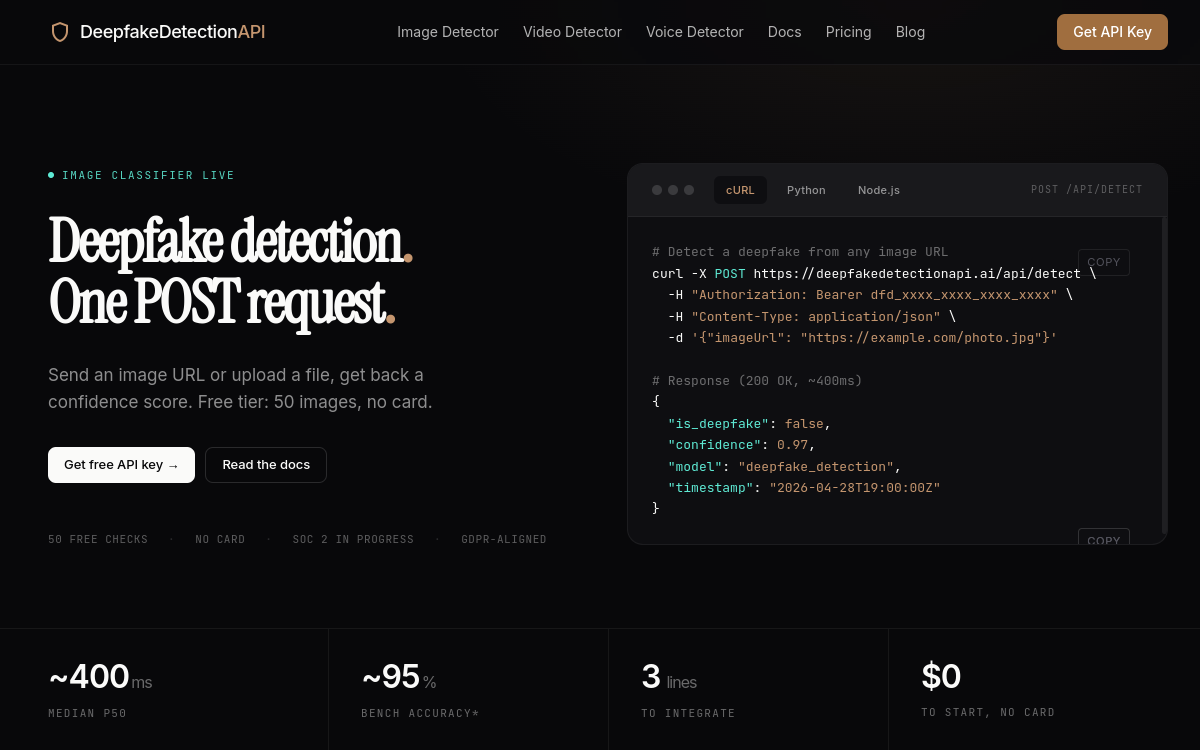
The proliferation of AI-generated content poses a concrete challenge for enterprises: how to distinguish an authentic media from a deepfake? Face swaps, cloned voices, and entirely synthetic videos now circulate at scale, with real consequences for fraud, identity theft, and misinformation. For platforms managing user-generated content or verification processes, detecting these manipulations manually is impossible at scale. Deepfake Detection API offers a technical answer to this problem. Rather than a consumer application, it is a programmable service: a REST API that developers integrate into their own systems to analyze images, videos, and voice on demand. The tool returns a structured verdict—authentic or synthetic media—accompanied by a confidence score. In this article, we examine what Deepfake Detection API actually does, its features, use cases, pricing, and limitations, to help technical and security teams judge whether it meets their needs for detecting manipulated media.
What is Deepfake Detection API?
The essentials
Deepfake Detection API is an online service dedicated to automated detection of synthetic media. It is intended for developers and technical teams who want to add deepfake detection capability to their own product without training or hosting their own machine learning model. The principle is that of an API: you send a file or URL to the service, and receive an analysis in return. The product covers three families of media: images, videos, and voice. It targets specific sectors such as fraud prevention, identity verification (KYC), and content moderation. Concretely, the service relies on models trained to recognize signatures left by synthetic generation techniques, whether face swaps or entirely fabricated content.
Key features
The core of the service is the POST /api/detect endpoint. You send it an image via URL or multipart upload, along with a Bearer token for authentication. The response is structured and directly actionable: an is_deepfake boolean indicating whether the media is synthetic, a numerical confidence score, the type of generation model detected, and a timestamp. This clear output facilitates integration into business logic, for example to automatically block or flag suspect content. The service detects several types of manipulations, from face swaps to generative overlays to entirely synthetic bodies. As for formats, it supports JPEG and PNG for images, MP4 and AVI for video, as well as voice detection. To accelerate adoption, official SDKs are offered in Python, Node.js, and Ruby. The service also announces integration with AWS, GCP, and Azure cloud pipelines, an analysis dashboard with forensic capabilities, webhooks, audit logs, and infrastructure designed to absorb traffic spikes. The advertised latency drops below 500 ms on the Pro plan, an important argument for real-time use cases such as signup verification.
Use cases
The first use case is fraud prevention and identity verification. During a KYC process, a financial platform or online service can verify that a submitted photo or video is not a deepfake intended to usurp an identity. Content moderation is a second area: social networks, marketplaces, and community platforms can automatically analyze uploaded media to detect manipulations before publication. Enterprise security teams use it to protect sensitive processes, for example detecting a cloned voice during a phone request. Finally, developers integrate the API into automated workflows: a webhook triggers analysis, and depending on the confidence score returned, the system allows, flags, or queues content for human review. This programmable logic makes the tool adaptable to various contexts without an imposed interface.
Advantages
The main advantage is transforming a complex problem—detecting synthetic media—into a simple API call. Teams don’t need to build datasets, train, or maintain models: they consume a ready-to-use service. Coverage of images, videos, and voice in a single product avoids juggling multiple vendors. The structured output, with its confidence score, allows fine-tuning decision thresholds based on acceptable risk levels. For organizations subject to regulatory requirements, displayed compliance with SOC 2 Type II and GDPR, accompanied by audit logs, facilitates integration into a governance framework. Finally, the advertised low latency makes real-time verification possible without degrading user experience during signup or file submission.
Pricing
Deepfake Detection API offers a free entry-level plan limited to 100 calls per month, restricted to image detection, with standard latency and community support, no credit card required. The Professional plan, presented as the most popular, costs $99 per month and includes 10,000 calls, image and video detection, low latency under 500 ms, a 99.9% uptime commitment, and priority email support. The Enterprise plan is for large volumes: custom pricing, unlimited calls, dedicated infrastructure, advanced forensics, on-premise deployment, and dedicated 24/7 account manager. All plans include encryption, real-time dashboard, SDKs, audit logs, and webhooks. The free tier remains the best starting point to assess the service’s relevance.
Conclusion
Deepfake Detection API occupies a well-defined niche: providing developers with a reliable, easy-to-integrate building block for synthetic media detection. Its strengths lie in its API simplicity, multi-language SDKs, and coverage of images, videos, and voice. Its limitations—modest free offering, video restricted to paid plans, approximately 95% accuracy requiring a margin of error—warrant rigorous evaluation before any critical deployment. For an anti-fraud, KYC, or moderation team seeking to strengthen defenses against manipulated content, the free tier offers a risk-free way to test detection quality before committing.