



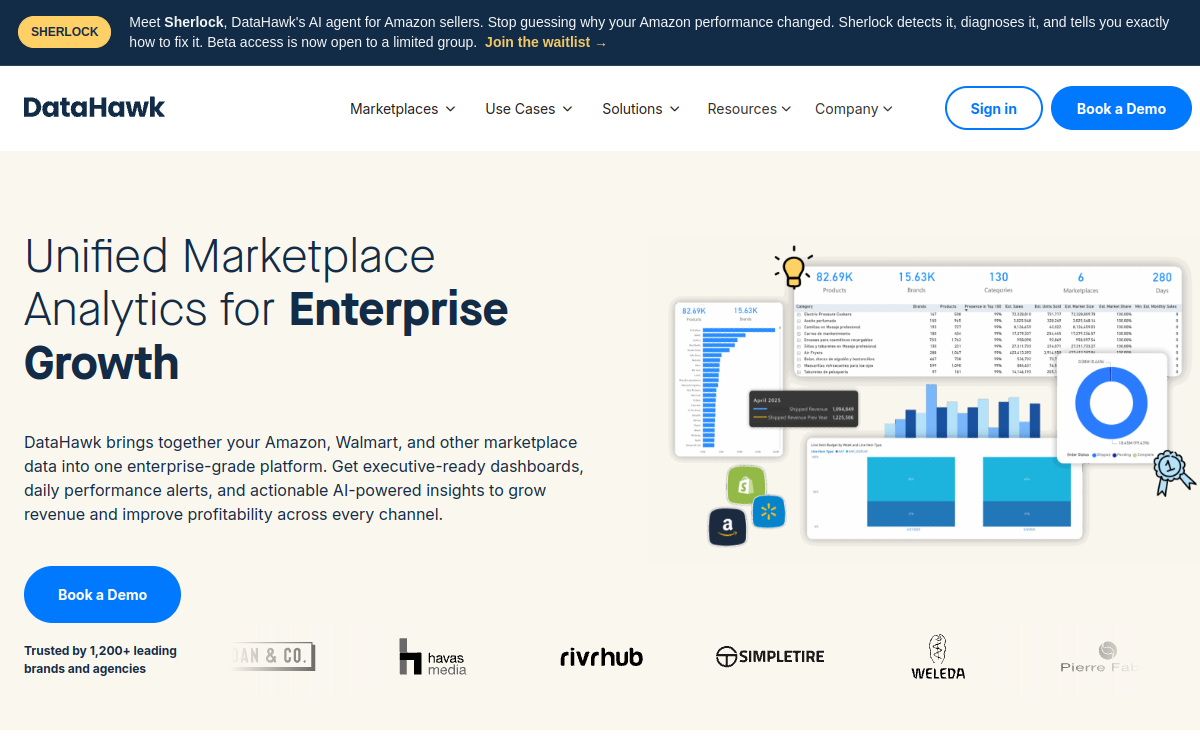
DataHawk is an e-commerce analytics solution that centralizes data from Amazon and Walmart to provide a complete view of sales, SEO, advertising, and inventory. Through its dashboards, alerts, and automated insights, the platform helps brands and agencies optimize performance, visibility, profitability, and data management across multiple marketplaces.
What is DataHawk?
The essentials
DataHawk is an e-commerce analytics platform specialized in tracking and optimizing performance on Amazon, Walmart, and other marketplaces. It automatically collects a large volume of data: sales, SEO positions, prices, inventory, Buy Box, reviews, advertising campaigns, and product trends. This information is then consolidated in structured dashboards to provide a simplified view of activity. The tool is particularly useful for brands and agencies that must manage a large portfolio of references and ensure constant monitoring of their KPIs. Through its anomaly detection modules and recommendations based on advanced models, DataHawk helps identify opportunities, risks, and areas for improvement, while eliminating tedious tasks related to manual reporting.
Key features
DataHawk stands out through a set of features designed to cover the entire marketplace management cycle. The Product Analytics module continuously tracks product indicators: Best Seller Rank changes, SEO visibility, price, reviews, Buy Box, and performance variations. The Market Intelligence module helps understand competitive dynamics through keyword analysis, market trends, niche opportunities, and estimated sales. The platform also offers a tracking tool for SEO and advertising that consolidates organic and paid data to measure campaign impact and adjust strategy. Configurable alerts notify users immediately of critical events, such as Buy Box loss, SEO drop, or price variation. Finally, BI integrations and APIs allow exporting and automating data flows to create custom dashboards or feed internal tools.
Use cases
DataHawk is used in a wide range of scenarios. Brands present on Amazon/Walmart use it to track and continuously optimize their results, while agencies managing multiple accounts benefit from centralization and automated reporting. Multi-marketplace retailers can compare their performance across channels and identify the best-performing products. Marketing and advertising teams leverage SEO and PPC analysis to improve visibility and ROAS. Data teams, meanwhile, use exports and APIs to enrich their internal models or produce advanced analysis. The tool also suits market research, allowing spotting emerging trends, monitoring best-sellers, and evaluating competition before a product launch.
Advantages
One of DataHawk’s main strengths is the time savings generated by data centralization and reporting automation. Dashboards facilitate performance reading and help prioritize high-value actions. Alerts provide increased reactivity and allow quickly correcting critical situations. Access to complete history and comparative data strengthens strategic analysis capability, while BI integrations improve collaboration between teams. For companies managing a large catalog, the platform is an effective way to structure their data approach and support sustainable growth.
Pricing
DataHawk adopts a custom pricing model that varies based on the volume of products tracked, the number of keywords, the level of support desired, and necessary modules. This approach allows precisely adapting the tool to each company’s needs, from large brands to specialized agencies. However, the absence of a public pricing grid can make initial budget estimation difficult, particularly for small structures. A demonstration is generally required to obtain a personalized quote and define the most relevant options based on your objectives.
Conclusion
DataHawk appears as a particularly solid solution for companies seeking to professionalize their marketplace tracking and consolidate their e-commerce data. Rich functionality, centralization, and advanced analysis capabilities make it a tool suited to teams wanting to industrialize their reporting and optimize performance. While it may seem less accessible to small sellers, it becomes a true growth catalyst for organizations managing a substantial catalog or multiple client accounts.